


Driving Productivity, Precision and
Manufacturing Excellence Through Automation
The automotive industry is undergoing a significant transformation, driven by the growing demand for higher production volumes, superior product quality, shorter manufacturing cycles and greater operational efficiency. As vehicle manufacturers and component suppliers strive to remain competitive in an increasingly demanding marketplace, automation has become an indispensable element of modern manufacturing. Among the various automation applications gaining prominence, machine tending has emerged as a critical enabler of productivity, consistency and manufacturing flexibility.
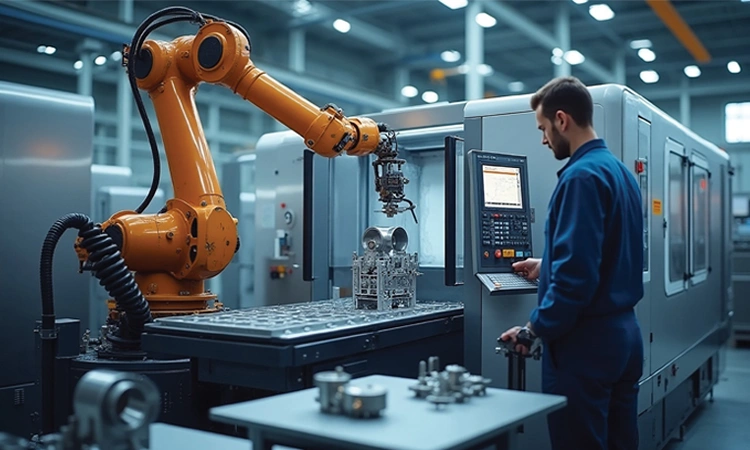
Machine tending refers to the automated loading and unloading of components into and out of machines such as CNC machining centres, turning centres, milling machines, grinding machines, presses and other production equipment. Traditionally performed manually by operators, these repetitive operations are increasingly being handled by industrial robots, collaborative robots (cobots) and automated material-handling systems. By automating the interface between machines and operators, manufacturers can achieve higher machine utilisation, reduce manual intervention and establish more efficient production workflows.
The Growing Importance of Machine Tending
Automotive manufacturing involves numerous machining and processing operations that demand precision, repeatability and consistency. Engine blocks, cylinder heads, crankshafts, camshafts, transmission components, brake discs, hubs, suspension parts and steering components all undergo multiple machining processes before reaching their final specifications.
In conventional manufacturing environments, operators are required to load raw components, position them accurately, secure them in fixtures, initiate machining cycles and subsequently unload finished components. These activities, although essential, consume valuable operator time and can restrict the productivity of expensive machine tools.
Machine tending automation addresses this challenge by enabling robots to perform repetitive loading and unloading operations with speed and precision. Once programmed, robotic systems can consistently handle components, maintain positioning accuracy and synchronise their movements with machine cycles. This allows machine operators to concentrate on more productive activities such as quality inspection, process monitoring, tool management and production planning.
For automotive manufacturers operating multiple shifts, machine tending offers an opportunity to extend production hours, reduce dependence on manual handling and improve overall equipment effectiveness (OEE).
Robotics at the Heart of Machine Tending
Industrial robots are increasingly being deployed for machine tending applications across automotive manufacturing facilities. Depending on the component size, payload requirement, machine configuration and production volume, manufacturers can choose from articulated robots, gantry robots, Cartesian systems and collaborative robots.
Articulated robots are particularly suitable for applications requiring flexibility and access to machines from different directions. Their multi-axis movement enables them to pick components from conveyors, trays or dedicated storage systems, position them inside machine fixtures and retrieve finished parts after machining.
Gantry and Cartesian robots, on the other hand, are useful in applications involving large components, repetitive movements and well-defined production layouts. They can also be integrated into multi-machine tending systems where a single automated arrangement serves several machines.
Collaborative robots are gaining attention, particularly among small and medium-sized automotive component manufacturers. Their relatively compact footprint, ease of programming and ability to work in suitably designed collaborative environments make them attractive for operations where conventional industrial robots may be economically or spatially challenging.
The choice of automation technology depends on several factors, including cycle time, component weight, machining complexity, production mix, required flexibility and available floor space.
Improving Productivity and Machine Utilisation
One of the most compelling advantages of machine tending is its ability to improve machine utilisation. In conventional setups, CNC machines may remain idle while operators attend to other activities, manually load components or perform inspection and material movement tasks.
Automated tending reduces these non-machining intervals. Robots can unload completed components and load fresh workpieces while following precisely programmed sequences. With appropriate machine and robot synchronisation, the time between successive machining cycles can be substantially reduced.
More advanced systems can also enable a single robot to tend multiple machines. For example, a robotic cell may serve two or more CNC turning or machining centres, depending on their cycle times and spatial arrangement. This approach improves the utilisation of both the machines and the robotic system while reducing the need for dedicated operators at every machine.
For automotive component manufacturers working with high production volumes, even small reductions in cycle time can translate into substantial productivity gains over an entire production year.
Precision, Quality and Process Consistency
Quality is a defining requirement in automotive manufacturing. Components must conform to stringent dimensional tolerances, surface-finish specifications and functional requirements. Variations arising from inconsistent handling, incorrect positioning or improper clamping can compromise machining accuracy and result in rejection or rework.
Robotic machine tending helps minimise such inconsistencies through repeatable component handling and accurate positioning. Robots can be programmed to follow identical movement paths and loading sequences, ensuring that workpieces are consistently presented to the machine.
Integration with vision systems, sensors and intelligent gripping devices further enhances operational reliability. Vision-guided robots can identify component orientation, locate parts and adjust their movements accordingly. Force and proximity sensors can help detect improper seating, misplaced components or potential obstructions before the machining cycle begins.
Automated inspection systems can also be incorporated into the production cell. Components may be checked for critical dimensions, presence of features or surface defects before being transferred to subsequent operations. This facilitates early identification of quality issues and supports a more effective quality-control regime.
Flexible Manufacturing and Product Diversity
The automotive industry is witnessing increasing product diversification. The transition towards electric mobility, lightweight vehicle architectures and advanced powertrain technologies is changing the nature of components and their manufacturing requirements.
Manufacturers are consequently required to accommodate multiple component variants, shorter production runs and frequent changes in product specifications. Conventional dedicated automation systems may struggle to respond economically to these requirements.
Modern robotic machine-tending solutions offer greater flexibility through programmable movement sequences, interchangeable grippers and adaptable fixtures. Recipe-based programming allows manufacturers to switch between different component types with relatively little downtime, subject to the machine and cell configuration.
Quick-change tooling and automatic gripper-changing systems further enhance this flexibility. A robot can be equipped with different gripping arrangements to handle components of varying dimensions, shapes and weights.
Such capabilities are particularly valuable for automotive suppliers catering to multiple vehicle manufacturers and producing a wide range of precision-engineered components.
Integration with Smart Manufacturing
Machine tending is evolving beyond standalone robotic loading and unloading. It is increasingly becoming an integral part of connected manufacturing ecosystems.
Through integration with CNC controls, programmable logic controllers (PLCs), manufacturing execution systems (MES) and enterprise resource planning (ERP) platforms, robotic tending cells can exchange real-time production information. This enables coordinated machine operation, production scheduling, material tracking and performance monitoring.
Industrial Internet of Things (IIoT) technologies allow manufacturers to monitor robot movements, machine status, cycle times, downtime and production output. Such information can be analysed to identify bottlenecks, improve scheduling and optimise resource utilisation.
Artificial intelligence (AI) and machine vision are adding further intelligence to these systems. AI-enabled applications can support component identification, orientation correction, adaptive handling and predictive maintenance. By analysing operational data, manufacturers can identify abnormal conditions and schedule maintenance before unexpected failures disrupt production.
Digital twins and simulation tools also enable engineers to design, validate and optimise robotic cells virtually before implementing them on the shop floor. This helps reduce commissioning time, minimise layout-related errors and improve overall system performance.
Safety, Ergonomics and Workforce Development
Machine tending automation also contributes significantly to workplace safety and ergonomics. Manual loading and unloading often involve repetitive movements, lifting heavy components and working in close proximity to moving machine elements. Over extended periods, these activities can lead to fatigue, musculoskeletal injuries and workplace accidents.
Robotic systems take over such repetitive and physically demanding tasks, reducing operator exposure to potential hazards. Safety fencing, interlocked access doors, light curtains, safety scanners and emergency-stop arrangements provide additional protection in conventional robotic cells.
Collaborative applications require appropriate risk assessments and safety measures based on the specific robot, tooling, workpiece and operating environment.
Automation, however, does not eliminate the need for skilled personnel. Instead, it changes the nature of manufacturing jobs. Operators and technicians increasingly require competencies in robot programming, CNC operation, sensor technology, troubleshooting and preventive maintenance. Continuous training and upskilling will therefore be essential to maximise the benefits of machine tending.
Overcoming Implementation Challenges
Despite its advantages, machine tending automation requires careful planning. Initial investment, integration complexity, space constraints and the need for skilled personnel can present challenges, particularly for smaller manufacturers.
A successful implementation begins with a detailed assessment of production requirements, including machine cycle times, component characteristics, loading arrangements, production volumes and expected return on investment.
Manufacturers must also consider the compatibility of robots with existing CNC machines, the availability of suitable gripping solutions and the ease of future reconfiguration. Modular robotic cells and scalable automation platforms can help reduce implementation risks and allow gradual expansion.
Equally important is the selection of a reliable automation partner capable of providing system design, integration, programming, commissioning and after-sales support.
The Road Ahead
As the automotive industry embraces Industry 4.0 and progresses towards increasingly autonomous production environments, machine tending will play an even greater role in manufacturing competitiveness. The convergence of robotics, AI, machine vision, connected machines and intelligent material handling is creating opportunities for highly integrated production cells capable of operating with minimal manual intervention.
The growth of electric vehicles will further expand the scope of machine tending across battery components, electric motors, transmission systems, lightweight structural parts and precision-machined assemblies. Automotive suppliers will need flexible automation solutions that can accommodate evolving technologies while maintaining stringent quality and cost requirements.
Ultimately, machine tending is no longer merely a means of automating repetitive loading and unloading operations. It is becoming a strategic manufacturing investment that enhances productivity, improves quality, optimises machine utilisation and supports safer working environments.
For automotive manufacturers aspiring to build agile, efficient and future-ready factories, intelligent machine tending represents an important step towards achieving manufacturing excellence.