

Towards Intelligent, Autonomous and Connected Manufacturing
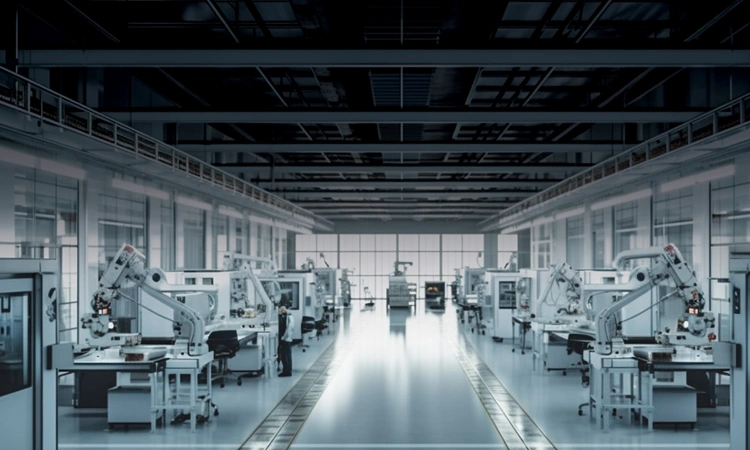
Manufacturing is entering a new era in which competitiveness will be determined not merely by production capacity or the degree of automation, but by the ability to create intelligent, connected, adaptive and highly responsive factories. While industrial robotics has played a transformative role in improving productivity, precision and operational efficiency, the next phase of industrial evolution goes considerably further. It encompasses artificial intelligence (AI), Industrial Internet of Things (IIoT), digital twins, autonomous material handling, advanced analytics, intelligent machine connectivity and integrated manufacturing ecosystems.
This emerging factory paradigm represents a shift from conventional automated production towards intelligent manufacturing environments in which machines, systems, processes and people work in coordination. The objective is to develop factories that can monitor their own performance, anticipate operational challenges, optimise resources and respond dynamically to changing production requirements.
From Automation to Intelligent Manufacturing
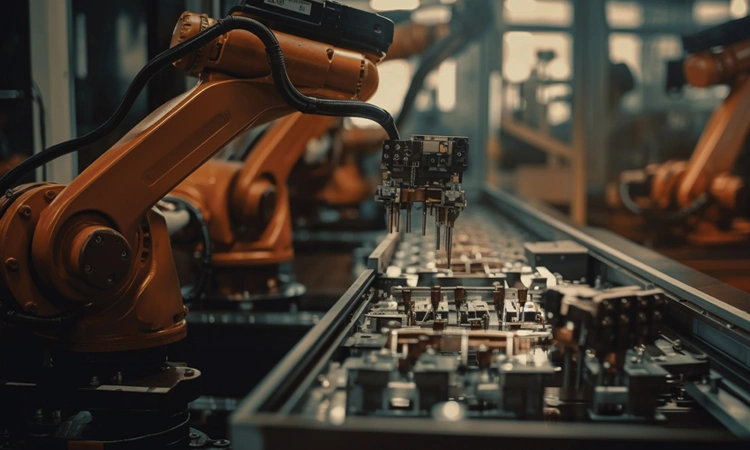
Traditional automation focused primarily on mechanising repetitive operations and improving production consistency. Industrial robotics subsequently expanded these capabilities through automated welding, painting, assembly, material handling and precision machining.
Today, manufacturers are moving towards a more comprehensive approach. IIoT-enabled equipment collects real-time data relating to machine performance, temperature, vibration, energy consumption, production output and quality parameters. This provides manufacturers with greater visibility into shop-floor operations, enabling faster decision-making and improved process control.
The integration of Manufacturing Execution Systems (MES), Enterprise Resource Planning (ERP) platforms and production equipment facilitates seamless coordination between production planning, inventory management, procurement and dispatch. The result is a connected manufacturing environment in which information flows across the entire production ecosystem.
Artificial Intelligence: The Intelligence Behind Smart Factories
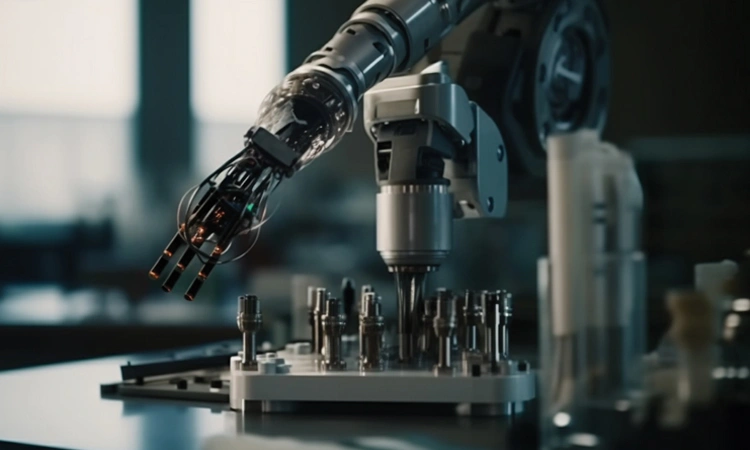
Artificial intelligence is emerging as a key enabler of the new factory paradigm. By analysing large volumes of operational data, AI-powered systems can identify patterns, predict equipment failures, optimise production schedules and improve quality management.
Predictive maintenance is among the most promising applications. By continuously monitoring machine conditions, AI algorithms can identify early warning signs of equipment deterioration and recommend maintenance interventions before breakdowns occur. This reduces unplanned downtime, improves equipment availability and extends machine life.
AI-powered quality inspection systems using machine vision can detect surface defects, dimensional variations and assembly errors with remarkable consistency. In addition, intelligent production planning tools can optimise machine utilisation, workforce allocation and material requirements, helping manufacturers respond more effectively to fluctuating demand.
Generative AI is also beginning to influence engineering design, production documentation, troubleshooting and technical support. Its integration with industrial data platforms could further accelerate decision-making and operational efficiency.
Digital Twins: Bridging the Physical and Virtual Worlds
Digital twin technology is transforming the way manufacturing systems are designed, monitored and optimised. A digital twin is a virtual representation of a physical machine, production line or entire manufacturing facility, continuously updated using operational data.
Manufacturers can use digital twins to simulate production processes, test alternative configurations, identify bottlenecks and evaluate equipment performance without interrupting actual operations.
In machine-tool manufacturing, for instance, digital twins can help assess machining parameters, optimise tool paths and predict machine behaviour. In automotive production, they can simulate assembly-line operations and improve plant layouts before physical implementation.
By reducing trial-and-error, improving planning accuracy and enabling informed decision-making, digital twins are becoming valuable tools for both greenfield projects and existing manufacturing facilities.
Beyond Industrial Robots: The Rise of Autonomous Systems
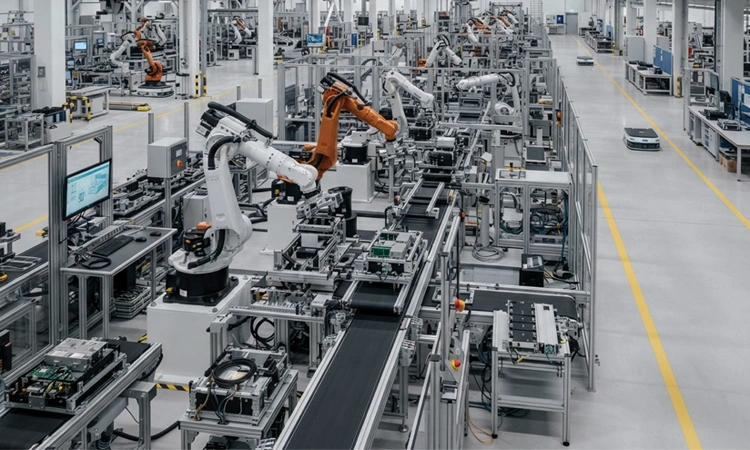
The next factory generation will extend automation beyond fixed industrial robots. Autonomous Mobile Robots (AMRs), Automated Guided Vehicles (AGVs), collaborative robots (cobots) and intelligent material-handling systems are increasingly transforming internal logistics and production workflows.
Unlike conventional fixed automation, AMRs can navigate dynamic factory environments, identify obstacles and adjust their routes in real time. They can transport raw materials, work-in-progress components and finished products between production stations, warehouses and dispatch areas.
Cobots, meanwhile, are designed to work alongside human operators, assisting with repetitive, physically demanding or precision-sensitive tasks. Their flexibility makes them particularly relevant for small and medium-sized enterprises (SMEs) that require adaptable automation without necessarily investing in extensive production-line modifications.
The integration of autonomous systems with warehouse management and production scheduling software can further improve material flow, reduce handling time and minimise operational bottlenecks.
Human-Machine Collaboration: The Changing Role of the Workforce
The new factory paradigm does not imply the elimination of human involvement. Rather, it redefines the relationship between people and machines. As repetitive tasks become increasingly automated, employees can focus on supervision, programming, process optimisation, troubleshooting and higher-value technical activities.
Augmented Reality (AR) and Virtual Reality (VR) technologies are opening new possibilities in operator training, equipment maintenance and remote technical assistance. Workers can access digital instructions, visual guidance and equipment information while performing complex tasks.
However, this transformation demands a workforce equipped with new competencies in robotics, data analytics, industrial software, cybersecurity and digital manufacturing. Continuous training and reskilling will therefore be essential to ensure that technological investments translate into tangible business benefits.
Cybersecurity and Interoperability: Critical Enablers
As factories become increasingly connected, cybersecurity assumes greater importance. Industrial networks, connected equipment and digital platforms can become vulnerable to cyberattacks, unauthorised access and operational disruptions.
Manufacturers must therefore adopt robust cybersecurity frameworks, network segmentation, access controls, secure data management and continuous monitoring. Equally important is interoperability between machines and software platforms from different manufacturers.
Open communication standards, industrial connectivity protocols and integrated data architectures are essential to ensuring that equipment, production systems and enterprise applications can exchange information reliably.
Sustainable Manufacturing: Efficiency Beyond Productivity
The intelligent factory is also expected to be a more sustainable factory. Real-time monitoring of energy, water and material consumption enables manufacturers to identify inefficiencies and reduce resource wastage.
AI-driven energy management, smart power distribution, efficient compressed-air systems, waste recovery and optimised production scheduling can contribute significantly to reducing the environmental footprint of manufacturing operations.
Digital monitoring also supports better traceability, resource planning and compliance with environmental standards. Thus, productivity improvement and sustainability are increasingly becoming complementary objectives.
The Road Ahead: Building Factories of the Future
The transition towards intelligent manufacturing presents enormous opportunities, but it also involves challenges. High initial investments, legacy equipment integration, data quality, cybersecurity risks and shortages of digitally skilled manpower can affect adoption, particularly among SMEs.
A phased approach, beginning with machine connectivity, data acquisition and targeted automation, can help manufacturers build capabilities progressively while demonstrating measurable returns on investment.
Ultimately, the factory of the future will not be defined by the number of robots installed, but by how intelligently its entire manufacturing ecosystem operates. The convergence of AI, IIoT, digital twins, autonomous systems and human-machine collaboration will create production environments that are more flexible, resilient, efficient and sustainable.
Beyond robotics lies a new industrial paradigm – one in which intelligence, connectivity and adaptability become the true drivers of manufacturing excellence. For India, embracing this transformation will be crucial to strengthening manufacturing competitiveness, enhancing productivity and establishing a stronger position in global value chains.