

From precision machining to advanced cooling, Pratap Tex-Chem Pvt. Ltd. is helping EV and automotive manufacturers build for a more demanding future.
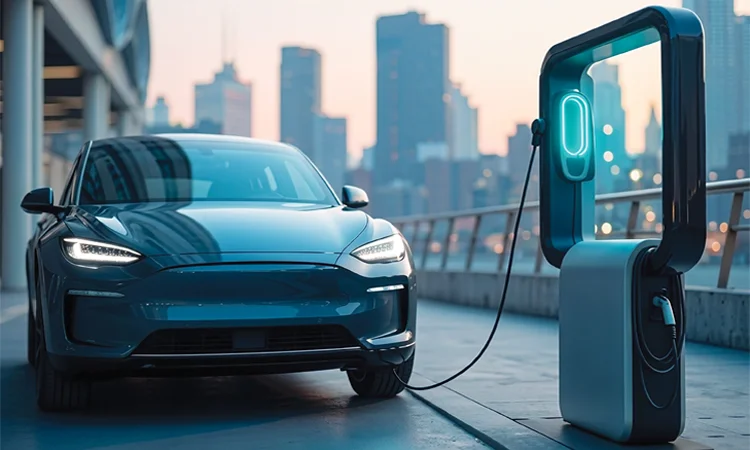
The electric vehicle is no longer simply an alternative to the internal-combustion engine. It represents a fundamental shift in how vehicles are designed, engineered and manufactured.
Globally, electric-car sales exceeded 20 million units in 2025, meaning that around one in every four new cars sold was electric. India’s electric-car market also gained momentum, with sales rising 75% year-on-year to approximately 165,000 units.
For OEMs and component manufacturers, this growth raises an equally important question:
How can the next generation of mobility products be manufactured with greater precision, productivity, reliability, and thermal efficiency—at scale?
This is where the right technology partners can make a meaningful difference.
For more than 27 years, Pratap Tex-Chem Pvt. Ltd. (PTCPL) has developed and delivered speciality chemical and lubrication solutions for demanding industrial applications. The company’s journey began in 1979, and it was incorporated as a private limited company in 1999 before expanding its industrial-lubrication and metalworking-fluid capabilities.
Today, through brands such as Lubeco Green Fluids, Lubeco Futuristic Greases, Supergen, Krushagra, and Fluidmate, PTCPL brings together expertise across metalworking, lubrication, fluid management, and emerging thermal-management applications.
As mobility becomes electric, this expertise is finding new relevance.
EV MANUFACTURING IS CHANGING. SO ARE THE CHALLENGES.
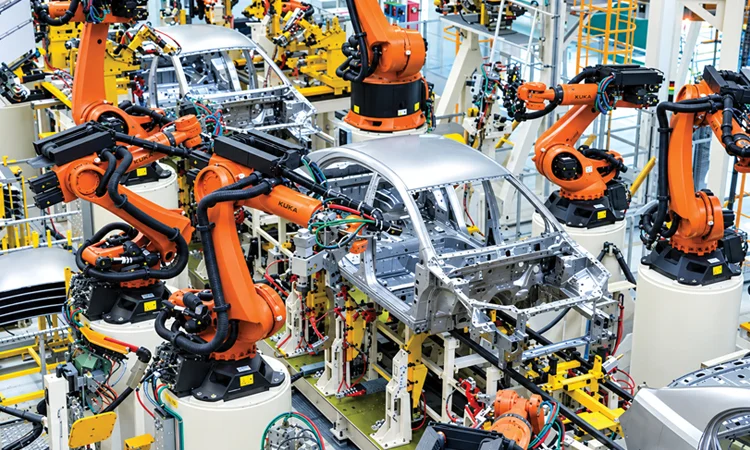
EV manufacturing brings together some of the most demanding processes in modern engineering. Battery components, motor housings, transmission and e-axle parts, aluminium structures, electrical connectors, precision-machined parts, power electronics, and charging systems all require increasingly controlled manufacturing environments.
For component manufacturers, the challenge extends beyond machining accuracy. It includes:
- Achieving higher productivity without compromising surface finish
- Extending tool life and maintaining process stability
- Managing heat during high-speed machining
- Machining aluminium and other lightweight alloys effectively
- Minimising smoke, foam, corrosion and residue
- Maintaining cleanliness for critical components
- Protecting components between manufacturing and final assembly
- Reducing fluid-related downtime and maintenance
- Improving resource efficiency and lowering operating waste
The pressure is coming from both directions: components are becoming more sophisticated, while production expectations continue to rise. As EV platforms become more electronics-intensive, thermal management is emerging as another critical engineering consideration.
THE FLUID CAN BE PART OF THE SOLUTION
Manufacturing fluids are often treated simply as consumables. At PTCPL, the approach is different.
The right fluid can influence tool life, surface quality, machine cleanliness, corrosion protection, process stability, maintenance requirements, and overall manufacturing productivity. This philosophy is at the heart of Lubeco green fluids, PTCPL’s portfolio of high-performance metalworking fluids and industrial-lubrication solutions.
The portfolio addresses a broad range of manufacturing needs:
- Cutting and metalworking fluids- Support machining operations where cooling, lubricity, surface finish, chip evacuation and tool performance are critical
- Industrial lubricants- Hydraulic, gear, spindle, and other speciality lubrication solutions for industrial equipment and machinery
- EDM and wire-EDM fluids- Support precision electrical-discharge machining applications
- Punching, stamping, and drawing fluids- Help maintain process consistency in demanding metal-forming applications
- Aqueous and solvent cleaners- Support component cleanliness and reliable downstream processing
- Rust preventives and VCI solutions- Protect components against corrosion during manufacturing, storage, and transport
For EV and automotive component manufacturers, this shifts the conversation beyond, “Which lubricant should we use?” to a more valuable question:
How can we optimise the complete fluid-dependent process?
FROM MACHINING TO IMMERSION: PREPARING FOR THE NEXT THERMAL CHALLENGE
As EV systems become more compact and powerful, thermal management is becoming increasingly important. Batteries, inverters, power electronics, charging systems, and other heat-generating electronic assemblies must operate within controlled temperature limits to support safety, performance, and long-term reliability.
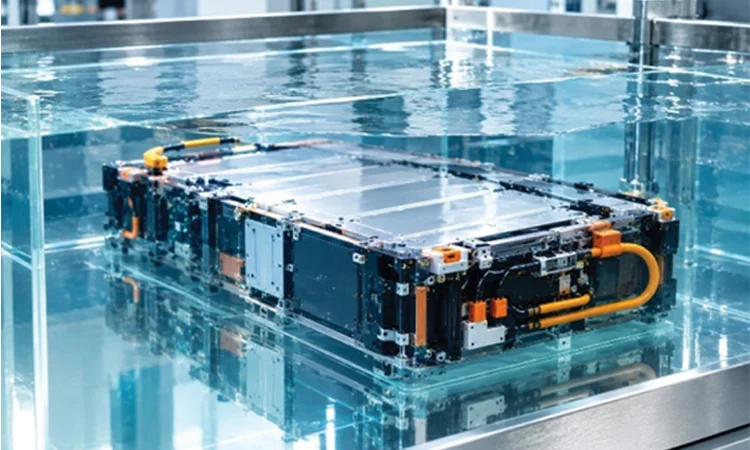
Conventional cooling approaches can require fans, heat sinks, cooling plates, and significant supporting infrastructure. This has created growing interest in dielectric immersion cooling, in which electronic components are directly immersed in a specially designed, electrically insulating fluid.
The principle is remarkably simple: place the heat-generating component in direct contact with the cooling medium—without creating an electrical short circuit.
That is the thinking behind Lubeco SUPERCOOL 15000 DC, a single-phase dielectric immersion-cooling fluid developed for high-heat electronic and EV-related systems.
Unlike water-based cooling media, a suitable dielectric fluid can provide electrical insulation while transferring heat away from immersed components.SUPERCOOL 15000 DC is formulated as a synthetic, non-polar hydrocarbon-based immersion-cooling fluid with low viscosity and heat-transfer capability. The supplied product data indicates a viscosity of approximately 9.5–10.5 cst at 40°C, a flash point above 200°C and a pour point of approximately −39°C—properties intended to support demanding thermal-management environments.
Its value proposition is clear:
Electrical insulation + direct heat transfer.
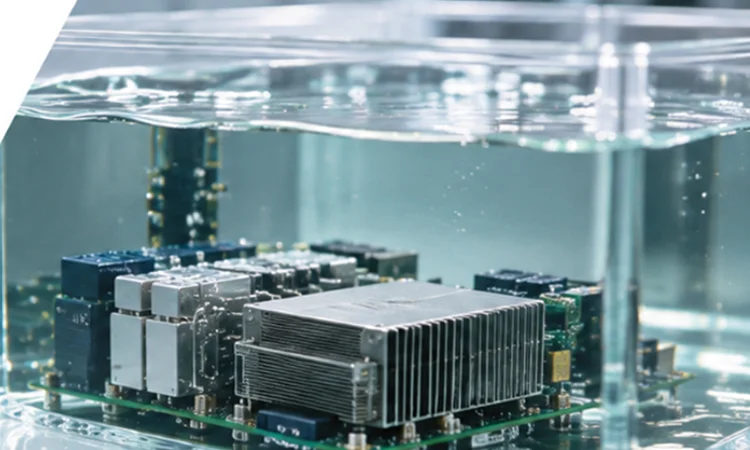
This creates potential opportunities across EV and automotive electronics, battery thermal-management systems, power electronics, inverters, motor electronics and charging systems, as well as industrial electronics, power systems, energy-storage equipment, and data centres.
The opportunity is not necessarily about replacing every conventional cooling system overnight. It is about giving engineers another technology pathway as power density, operating temperatures, and thermal-management demands continue to evolve.
WHY EV COMPONENT MANUFACTURERS NEED A SOLUTION PARTNER
The future of automotive manufacturing will not be built around one product. It will be built around connected systems.
A machining fluid affects machining performance. Machining performance affects productivity. Productivity affects cost. Component cleanliness affects downstream assembly. Corrosion protection affects quality during storage and transportation. Thermal management affects the performance and reliability of increasingly powerful electronic systems. This is where PTCPL’s broader portfolio becomes relevant.
Lubeco Green Fluids addresses metalworking and industrial-fluid requirements; Lubeco Futuristic Greases focuses on high-performance lubrication; Fluidmate brings fluid-management technologies to the shop floor; and SUPERCOOL 15000 DC extends the portfolio towards dielectric immersion cooling. Together, these capabilities reflect PTCPL’s focus on the wider fluid-management ecosystem.
The objective is not simply to supply a product. It is to understand the process behind that product.
This approach is particularly relevant to EV and automotive OEMs, Tier 1 suppliers and component manufacturers, where even a modest improvement in tool life, downtime, fluid consumption, component protection or thermal efficiency can create a significant impact at production scale.
27+ YEARS OF ENGINEERING EXPERIENCE. BUILT FOR WHAT COMES NEXT.
PTCPL’s journey began in 1979 with textile manufacturing in Mumbai. In 1999, the company entered industrial lubricants and metalworking fluids as a private limited company in Pune. Over the past 27+ years, it has steadily expanded its expertise across metalworking fluids, industrial lubricants, speciality greases, automotive lubricants, speciality chemicals and fluid-management technologies.
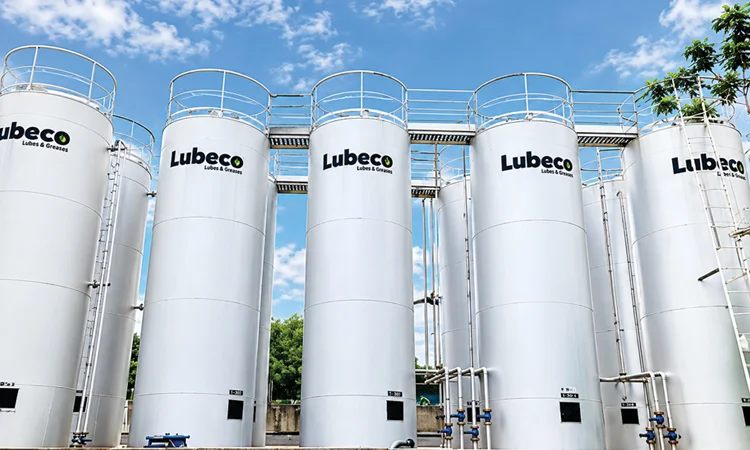
Today, PTCPL operates from Pune with a modern manufacturing facility with an installed capacity of 6,000 KL, supported by in-house R&D, tribology, and application-focused laboratory capabilities, along with a team of 100+ professionals across technical, manufacturing, sales and operations.
For the evolving EV and automotive ecosystem, this combination of manufacturing capability, technical expertise and application understanding is increasingly valuable. Modern EV components require solutions matched to specific materials, machining processes, thermal conditions, cleanliness requirements and production challenges.
THE NEXT EV ADVANTAGE MAY COME FROM PLACES YOU DON’T EXPECT
EV innovation is often associated with batteries, motors, software, and vehicle architecture. Yet competitive advantage is also created much earlier—inside the manufacturing plant.
It can come from:
- A longer-lasting cutting tool
- A cleaner machine
- A more stable machining process
- Better corrosion protection
- Reduced fluid-related downtime
- Smarter fluid management
- A new approach to cooling high-heat electronic systems
As India’s EV ecosystem expands, these seemingly small factors can become meaningful contributors to quality, productivity, reliability and cost efficiency.
The transition to electric mobility is not simply a transition from fuel to electricity. It is a move towards higher precision, higher power density, smarter manufacturing and more advanced engineering. And the fluids supporting that transition have an important role to play.
From machining the component to managing the heat, PTCPL is building solutions for the complete journey.
Pratap Tex-Chem Pvt. Ltd.
Since 1999 | 27+ Years of Industrial Expertise
Brands: Lubeco Green Fluids | Lubeco Futuristic Greases | Supergen | Fluidmate | Krushagra
Serving: EV and Automotive | Engineering and Precision Manufacturing | Industrial Electronics | Energy and Power
Explore: www.lubecogreenfluids.com
Enquiries: info@lubecogreenfluids.com