


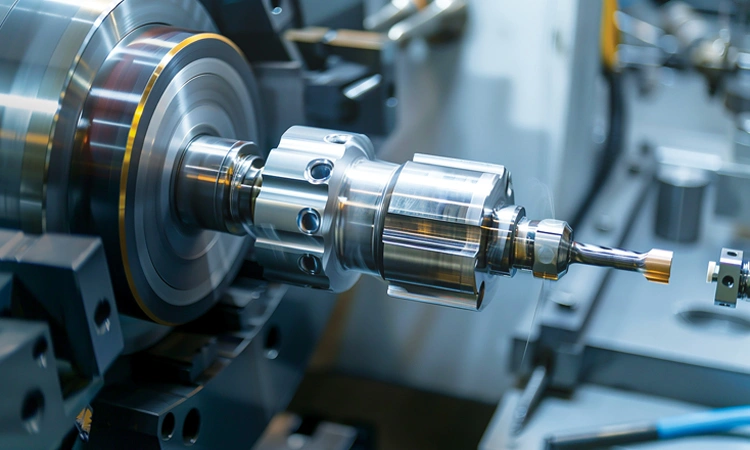
In modern manufacturing, the machine tool spindle is far more than a rotating shaft that drives a cutting tool. It is the heart of the machining system, directly influencing cutting speed, material removal rate, surface finish, dimensional accuracy, tool life and overall productivity. As manufacturers increasingly process difficult-to-machine materials, complex geometries and miniature features, the demand for spindles capable of delivering higher speeds, greater rigidity, superior thermal stability and exceptional accuracy continues to grow.
The evolution of spindle technology is therefore closely linked to the evolution of machine tools themselves. From conventional belt-driven systems to sophisticated motorised spindles with intelligent monitoring, spindle development is increasingly focused on achieving the delicate balance between speed, power, stiffness, precision and reliability.
Speed Meets Productivity
Higher spindle speeds have become an important enabler of productivity, particularly in high-speed milling, die and mould machining, aerospace component manufacturing, electronics and medical-device production. Increasing spindle speed allows smaller-diameter tools to operate at appropriate cutting speeds while enabling efficient machining of intricate features.
However, simply increasing revolutions per minute (rpm) is not enough. At high speeds, even a minor imbalance in the rotating assembly can generate significant centrifugal forces. These forces can cause vibration, adversely affect surface finish, accelerate bearing wear and reduce tool life.
Consequently, today’s high-speed spindles are engineered as highly integrated systems. Rotor balance, bearing selection, shaft geometry, toolholding, lubrication and cooling must all work together to ensure stable operation.
Modern machining centres may employ spindles ranging from conventional speeds of several thousand rpm to high-speed configurations exceeding 20,000 or 30,000 rpm, while specialised applications can demand considerably higher speeds. The appropriate speed, however, depends on the machining application rather than on the maximum rpm specified in a catalogue.
The Challenge of Accuracy
Speed without accuracy has little value in precision manufacturing. As tolerances become tighter, spindle runout and thermal growth become critical considerations.
Even microscopic radial or axial errors at the spindle can translate into measurable dimensional deviations on the workpiece. Runout can also cause uneven tool loading, leading to premature tool wear and poor surface quality.
Precision spindle manufacturers therefore pay close attention to shaft geometry, bearing preload, manufacturing tolerances and assembly quality. High-precision bearings—particularly angular-contact ceramic or hybrid bearings—are increasingly employed in demanding applications because of their ability to operate at high speeds while maintaining stiffness and low friction.
Toolholding technology is equally important. High-precision interfaces such as HSK and other modern coupling systems help minimise tool deflection and improve repeatability, especially at elevated spindle speeds.
Bearings: The Foundation of Spindle Performance
The spindle bearing system is one of its most critical elements. Bearings must simultaneously withstand radial and axial cutting forces, maintain rigidity and operate reliably at high rotational speeds.
Conventional steel bearings continue to be widely used, but hybrid ceramic bearings have gained prominence in high-speed applications. Ceramic rolling elements are lighter than steel, reducing centrifugal forces and enabling higher rotational speeds. They also offer favourable wear and thermal characteristics.
Bearing preload must be carefully controlled. Excessive preload increases friction and heat generation, while insufficient preload can compromise rigidity and accuracy. The optimum solution therefore depends on the spindle’s intended speed range, cutting loads and operating environment.
Thermal Stability: The Hidden Battle
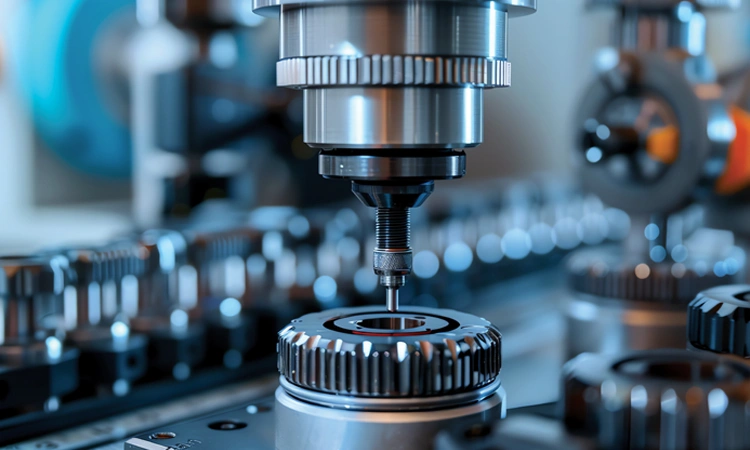
Heat is one of the greatest enemies of spindle accuracy. Bearings, motor windings and friction within the spindle generate heat during operation. Cutting processes can also transfer heat into the spindle through the tool and workpiece.
Thermal expansion changes spindle geometry and can shift the position of the cutting tool relative to the workpiece. Even a small amount of thermal growth can become significant in precision machining.
This has led to major advances in spindle cooling. Liquid-cooled motor housings, bearing cooling circuits and temperature-controlled lubrication systems are increasingly used to manage heat. Some high-performance spindles incorporate sophisticated thermal compensation within the machine control, allowing the CNC to compensate for predictable changes in spindle geometry.
The objective is not simply to remove heat, but to control the thermal behaviour of the spindle so that it remains predictable throughout the machining cycle.
Motorised Spindles Transform the Architecture
The introduction of the integrated motor spindle has eliminated several mechanical transmission elements traditionally associated with belt- or gear-driven spindles. In a motorised spindle, the motor rotor is incorporated directly into the spindle assembly.
This architecture reduces mechanical transmission losses and allows higher speeds with fewer moving components. It also provides rapid acceleration and deceleration, which is valuable for machining operations involving frequent changes in cutting conditions.
Nevertheless, integrated motors introduce their own thermal challenges. Heat generated within the motor must be efficiently dissipated without adversely affecting bearing performance or spindle accuracy. Consequently, motor design and cooling technology have become inseparable from spindle engineering.
Rigidity Vs Speed
One of the fundamental engineering challenges is balancing high speed with sufficient stiffness. A spindle designed primarily for high-speed finishing may favour low rotating mass and high rpm, whereas heavy-duty roughing requires considerable torque and rigidity.
This has encouraged the development of application-specific spindle designs. High-speed spindles for aluminium and die/mould applications may prioritise rpm, acceleration and dynamic response. Heavy-duty machining of steels and hard materials may instead require high torque, robust bearings and greater structural stiffness.
Variable-speed and two-range spindle systems also help machines address different machining requirements without compromising versatility.
Vibration Control and Dynamic Balancing
At high rotational speeds, spindle dynamics become increasingly important. Unbalance, bearing characteristics, toolholder geometry and tool overhang can interact to create vibration or chatter.
Precision dynamic balancing of the spindle rotor is therefore essential. Advanced spindle systems may also incorporate vibration monitoring and balancing technologies to identify abnormal operating conditions.
The trend is moving towards condition-aware spindles capable of detecting changes in vibration, bearing temperature, power consumption and other operating parameters. Such information can support predictive maintenance and prevent catastrophic spindle failures.
Smart Spindles and Industry 4.0
The spindle is increasingly becoming a source of manufacturing intelligence. Sensors embedded in or around the spindle can monitor temperature, vibration, speed, load and bearing condition.
This information can be integrated into the machine’s CNC or factory monitoring system. Abnormal trends can provide early warning of bearing degradation, lubrication problems, tool imbalance or other conditions.
Such capabilities support predictive maintenance, helping manufacturers move from scheduled replacement to condition-based intervention. Considering that spindle failure can result in significant machine downtime, this transition can have a substantial economic impact.
Beyond Speed: The New Performance Equation
The future of spindle technology will not be defined by rpm alone. Manufacturers increasingly require a combination of speed, torque, stiffness, precision, thermal stability, energy efficiency and intelligence.
Advanced materials, improved bearing technologies, better motor designs, sophisticated cooling systems and digital monitoring are collectively pushing spindle performance to new levels. At the same time, spindle manufacturers are focusing on energy consumption, serviceability and lifecycle costs.
For end users, the most appropriate spindle is therefore not necessarily the one with the highest maximum speed. It is the spindle that delivers the right combination of performance characteristics for the intended machining application.
Conclusion
Machine tool spindles sit at the intersection of productivity and precision. The industry’s quest for higher speeds is being matched by an equally important pursuit of accuracy, rigidity and thermal stability. As machining processes become faster, tighter and more automated, spindle technology will remain a decisive factor in determining machine tool capability.
The next generation of spindles is likely to be faster, smarter, more thermally stable and increasingly application-specific. With intelligent sensing and predictive maintenance becoming integral to modern machine tools, the spindle is evolving from a mechanical power-transmission component into a sophisticated, digitally connected precision system—one that will play a central role in the continuing transformation of high-performance manufacturing.