

Building the foundation for energy-efficient, resource-conscious and future-ready production
The machine tool is often described as the “mother machine” of manufacturing because it produces the components that go into almost every industrial product. As manufacturing moves towards greater sustainability, the machine tool itself is undergoing a fundamental transformation. Green machine tools are emerging not merely as energy-efficient machines, but as the building blocks of environmentally responsible manufacturing systems.
The transition is being driven by rising energy costs, tightening environmental regulations, customer expectations and the growing importance of ESG performance. At the same time, manufacturers are discovering that sustainability and productivity need not be conflicting objectives. Reduced energy consumption, longer tool life, lower coolant usage, minimal waste and predictive maintenance can simultaneously improve environmental performance and operating economics.
Beyond Energy Efficiency
The first generation of “green” machine tools primarily focused on reducing electricity consumption. Modern sustainable machines take a much broader view.
Energy-efficient spindle motors, servo drives, pumps, fans and hydraulic systems can reduce power consumption during machining. Automatic standby modes can switch off auxiliary equipment when the machine is idle, while intelligent controls can optimise the energy used during acceleration, cutting and non-productive movements.
However, a genuinely green machine must consider its entire life cycle—from design and manufacture to installation, operation, maintenance and eventual recycling.
Machine builders are therefore increasingly examining material selection, component durability, modular construction, ease of maintenance and recyclability. The objective is to minimise the environmental footprint throughout the machine’s working life rather than simply reducing electricity consumption during cutting.
Intelligent Energy Management
A significant opportunity lies in understanding where and when a machine consumes energy.
A CNC machine does not use the same amount of power continuously. The spindle, axes, coolant pumps, chip conveyors, lubrication systems, lighting and other auxiliaries have different consumption profiles.
Modern machines can incorporate energy monitoring at machine and component level. This makes it possible to identify energy-intensive operations and optimise them.
For example, a high-efficiency spindle can reduce consumption during machining, while variable-speed pumps can adjust coolant flow according to actual process requirements rather than running continuously at full capacity.
Intelligent energy management can also provide operators with information on energy consumption per component or per machining cycle. This transforms sustainability from an abstract corporate objective into a measurable manufacturing parameter.
The Role of CNC and Automation
Advanced CNC systems are increasingly becoming central to green manufacturing.
Optimised toolpaths can reduce unnecessary axis movements, machining time and acceleration/deceleration losses. High-speed machining strategies can reduce cycle times, while process simulation can identify inefficient operations before production begins.
Automation contributes in another way. Robots and automated handling systems can reduce waiting time between operations and improve machine utilisation. When integrated effectively, a manufacturing cell can produce more components with the same installed equipment and energy infrastructure.
This leads to an important principle:
The greenest component is often the one produced with the least material, energy, time and rework.
Consequently, productivity itself becomes an important sustainability metric.
Cutting Fluids: Less Is More
Metalworking fluids represent another major area of innovation.
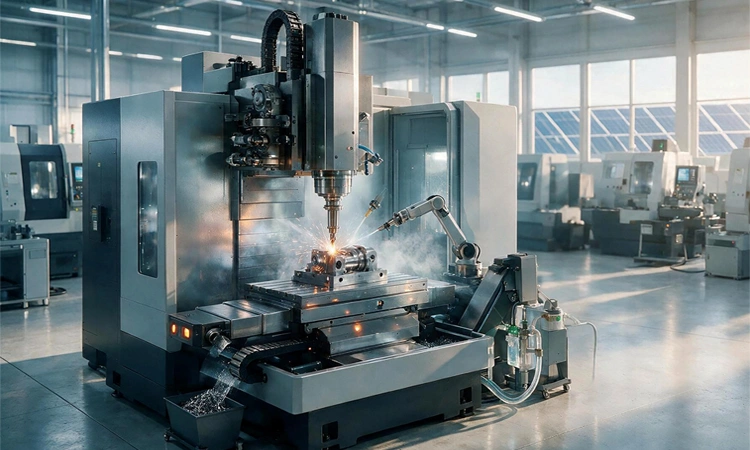
Conventional flood cooling can consume substantial quantities of coolant, requiring storage, filtration, maintenance and eventual disposal. Modern machining increasingly employs minimum quantity lubrication (MQL), high-pressure cooling, dry machining and targeted coolant delivery, wherever the application permits.
MQL supplies a very small quantity of lubricant directly to the cutting zone, reducing fluid consumption while providing adequate lubrication for suitable machining operations.
High-pressure coolant systems can improve chip evacuation and tool life, potentially enabling higher cutting parameters. Intelligent coolant systems can adjust delivery according to machining conditions instead of continuously supplying maximum flow.
Better filtration and recycling systems also extend coolant life, reduce waste and lower operating costs.
Tool Life and Resource Efficiency
Sustainability does not stop at the machine.
Cutting tools are resource-intensive products, and premature tool replacement creates additional material and manufacturing burdens. Tool monitoring systems can detect wear and enable tools to be replaced at the optimum point.
Predictive tool-life management can therefore reduce unnecessary tool consumption while avoiding catastrophic tool failure and scrap.
Similarly, process monitoring can detect chatter, vibration, excessive cutting forces or abnormal spindle behaviour. Correcting these conditions early improves surface quality, protects the machine and reduces rejected components.
Every avoided defective component represents savings in raw material, energy, tooling, labour and machine time.
Thermal Management and Waste Heat
Machine tools generate heat through motors, bearings, hydraulic systems, electrical equipment and cutting processes. Thermal stability is particularly important in precision machining because temperature changes can affect dimensional accuracy.
Modern machine designs incorporate improved thermal management, including optimised cooling circuits, temperature monitoring and compensation algorithms.
Instead of simply removing heat, future manufacturing systems could increasingly recover and reuse waste heat. Heat generated by machine cooling systems or compressors can potentially be used for factory heating, hot water or other processes.
Such integration moves sustainability from an individual machine level to the factory level.
Digitalisation Enables Sustainability
Industry 4.0 technologies are giving manufacturers unprecedented visibility into resource consumption.
Connected machine tools can transmit information on energy, spindle load, cycle time, coolant consumption, tool condition and machine utilisation to manufacturing software platforms.
This data can be analysed to determine the carbon and resource footprint of individual products and processes.
Digital twins can further help manufacturers simulate production scenarios and compare energy and resource requirements before physically changing the process.
Artificial intelligence can take this a step further by identifying patterns and recommending process parameters that balance productivity, quality and energy consumption.
Thus, digitalisation is becoming an important enabler of sustainability rather than simply a productivity technology.
Remanufacturing and Longer Machine Life
One of the most effective sustainability strategies is to extend the useful life of existing equipment.
Machine tool builders and service providers are increasingly focusing on retrofit, rebuilding and remanufacturing. CNC upgrades, efficient drives, new control systems, spindle refurbishment, automation retrofits and energy-efficient auxiliaries can significantly extend machine life.
This approach can reduce the environmental impact associated with manufacturing and transporting a completely new machine.
Modular machine architecture also makes it easier to replace or upgrade individual subsystems rather than discarding the complete machine.
Towards Circular Manufacturing
The concept of the circular economy is gaining importance in machine tool manufacturing.
Instead of following a linear model—extract, manufacture, use and discard—circular manufacturing seeks to retain materials and products in productive use for as long as possible.
For machine tools, this could involve designing equipment for disassembly, recovering valuable materials, refurbishing components and reusing functional assemblies.
Manufacturers can also minimise packaging, use recyclable materials and optimise logistics.
At the production level, chip recycling becomes particularly significant. Metal chips generated during machining can be collected, segregated and recycled, while effective chip management improves housekeeping and reduces material loss.
Green Machine Tools and the Smart Factory
The real potential of green machine tools emerges when several machines are connected as a sustainable manufacturing system.
A smart factory can monitor energy consumption across machines, compressors, HVAC systems, coolant systems and material-handling equipment. Production schedules can then be optimised to avoid unnecessary peaks in energy demand.
Machines can automatically enter energy-saving modes when production is interrupted. Maintenance systems can predict component failures before they lead to downtime or energy-intensive breakdown conditions.
Integration with renewable energy sources can further improve sustainability. Machine utilisation can potentially be aligned with periods of greater availability of solar or other renewable power.
Measuring What Matters
For green manufacturing to become meaningful, manufacturers must move beyond broad claims of “energy efficiency” and establish measurable indicators.
These could include:
- Energy consumed per component
- Material utilisation rate
- Coolant consumption per production hour
- Tool consumption per component
- Machine utilisation
- Scrap and rework rates
- Carbon emissions per manufactured part
- Machine life-cycle footprint
Such metrics enable manufacturers to identify improvements and compare alternative processes objectively.
The Road Ahead
The green machine tool of the future will not be defined by a single energy-saving feature. It will be an intelligent, connected and resource-efficient manufacturing platform designed to maximise output while minimising environmental impact.
Energy-efficient drives, regenerative systems, intelligent cooling, advanced lubrication, automation, predictive maintenance, digital twins and AI-based optimisation will increasingly work together.
Most importantly, sustainability will become embedded in machine-tool design rather than treated as an add-on.
The manufacturing industry is entering an era in which productivity, precision and sustainability must advance together. Green machine tools will be central to this transformation—defining not only how components are machined, but how future manufacturing systems consume energy, use resources, manage waste and create value.