

The aerospace industry represents one of the most demanding sectors for precision manufacturing. Every component-from turbine blades and engine casings to landing gear, structural airframe parts, and satellite assemblies-must meet exceptionally stringent standards for dimensional accuracy, material integrity, and reliability. Even the slightest deviation can compromise performance, fuel efficiency, or, more importantly, safety. As aircraft manufacturers strive to build lighter, stronger, and more fuel-efficient platforms, precision machining has become a cornerstone of aerospace production.
The increasing use of advanced materials, complex geometries, and tight production schedules has transformed aerospace machining into a sophisticated blend of engineering expertise, cutting-edge machine tools, intelligent software, and advanced cutting technologies. Today’s precision machining solutions are not only improving productivity but also enabling the next generation of commercial aircraft, military systems, spacecraft, and unmanned aerial vehicles (UAVs).
The Demand for Extreme Precision
Unlike conventional industrial components, aerospace parts often require dimensional tolerances measured in microns, superior surface finishes, and complete traceability throughout the manufacturing process. Components are subjected to extreme operating conditions, including high temperatures, pressure fluctuations, vibration, and corrosive environments. Consequently, every machined part must consistently meet rigorous international quality standards.
Manufacturers are expected to produce complex components with minimal variation while ensuring repeatability across large production volumes. This has led to widespread adoption of advanced CNC machining centres equipped with sophisticated control systems capable of maintaining exceptional accuracy over extended production cycles.
Machining Advanced Aerospace Materials
One of the biggest challenges in aerospace manufacturing is the extensive use of difficult-to-machine materials. Titanium alloys, nickel-based superalloys, Inconel, Hastelloy, stainless steels, and high-strength aluminium alloys have become indispensable because of their excellent strength-to-weight ratio, corrosion resistance, and high-temperature performance.
However, these materials present significant machining challenges. Titanium, for instance, generates high cutting temperatures while exhibiting poor thermal conductivity, causing heat to concentrate at the cutting edge. Nickel-based superalloys are extremely tough and rapidly wear cutting tools.
To overcome these challenges, manufacturers employ advanced carbide, ceramic, cubic boron nitride (CBN), and polycrystalline diamond (PCD) cutting tools, combined with optimized cutting parameters and high-performance cooling techniques.
Multi-Axis Machining for Complex Components
Modern aerospace components feature intricate geometries that cannot be produced efficiently using conventional three-axis machining.
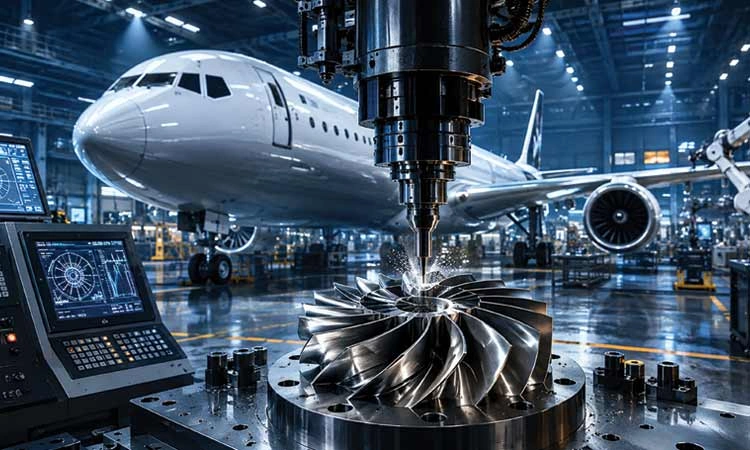
Five-axis and even seven-axis CNC machining centres enable manufacturers to machine complex free-form surfaces, impellers, turbine blades, blisks (blade integrated disks), structural brackets, and aerospace housings in a single setup.
Multi-axis machining offers several advantages:
- Reduced setup time
- Improved dimensional accuracy
- Superior surface finish
- Shorter production cycles
- Better tool accessibility
- Lower risk of positioning errors
Single-setup machining also minimizes cumulative tolerance variations while improving component consistency.
High-Speed Machining Improves Productivity
High-speed machining (HSM) has become an essential technology in aerospace manufacturing. Modern machining centres operate at extremely high spindle speeds with optimized feed rates, allowing faster metal removal while maintaining exceptional precision.
When machining aluminium aerospace structures, HSM significantly reduces production time while producing excellent surface finishes. Advanced CAM software generates optimized tool paths that reduce sudden direction changes, minimize vibration, and extend tool life.
Adaptive machining strategies further improve cutting efficiency by maintaining constant cutter engagement throughout the machining process.
Tooling Innovations
The evolution of cutting tool technology has played a crucial role in aerospace precision machining.
Today’s cutting tools feature:
- Nano-layer PVD and CVD coatings
- Variable helix geometries
- Advanced chip breakers
- Optimized edge preparation
- High-performance carbide substrates
These innovations reduce cutting forces, improve heat dissipation, extend tool life, and enable higher machining speeds.
Digital tool management systems further enhance productivity by tracking tool wear, predicting replacement schedules, and minimizing unexpected failures during production.
Smart Machining and Artificial Intelligence
Industry 4.0 technologies are redefining aerospace machining through intelligent automation and data-driven manufacturing.
Modern CNC machines incorporate numerous sensors that monitor spindle loads, vibration, temperature, tool wear, and machine health in real time.
Artificial Intelligence (AI) analyses this data to optimize cutting parameters, predict tool failures, and recommend corrective actions before machining quality is affected.
Machine learning algorithms continuously improve machining strategies by learning from previous production runs, resulting in higher efficiency and lower scrap rates.
Precision Measurement and In-Process Inspection
Maintaining micron-level tolerances requires equally advanced metrology solutions.
Coordinate Measuring Machines (CMMs), laser scanners, touch probes, optical measurement systems, and in-machine inspection technologies verify dimensional accuracy throughout the machining process.
In-process probing automatically measures critical dimensions during machining and compensates for tool wear or thermal variations without removing the workpiece from the machine.
This closed-loop manufacturing approach reduces inspection time while ensuring consistent quality.
Automation Enhances Aerospace Manufacturing
Automation has become indispensable in aerospace machining, particularly for high-volume production.
Robotic loading and unloading systems, pallet changers, automated tool changers, and flexible manufacturing systems (FMS) allow machining centres to operate continuously with minimal operator intervention.
Automated production cells improve machine utilization, reduce labour costs, minimize handling damage, and increase overall productivity.
Autonomous Material Handling Systems and Manufacturing Execution Systems (MES) further streamline production scheduling and workflow management.
Digital Twins and Virtual Machining
Digital twin technology is rapidly gaining prominence in aerospace manufacturing.
Virtual replicas of machining centres simulate cutting operations before actual production begins, allowing engineers to detect collisions, optimize tool paths, estimate machining time, and validate process parameters.
Simulation significantly reduces programming errors, shortens machine setup times, and minimizes costly production interruptions.
Digital twins also support predictive maintenance by continuously monitoring machine performance and forecasting maintenance requirements.
The Road Ahead
The future of aerospace precision machining will be shaped by increasing automation, Artificial Intelligence, additive-subtractive hybrid manufacturing, digital twins, cloud-based manufacturing platforms, and real-time process optimization.
Advanced materials, including ceramic matrix composites and next-generation lightweight alloys, will demand further innovations in cutting tools, machine design, and machining strategies.As commercial aviation, defence production, space exploration, and urban air mobility continue to expand, manufacturers will require even greater precision, productivity, and flexibility.
Conclusion
Precision machining is the backbone of modern aerospace manufacturing, enabling the production of highly complex, safety-critical components with exceptional accuracy and reliability. Despite the challenges posed by advanced materials, intricate geometries, and stringent quality standards, continuous innovations in machine tools, cutting technologies, automation, AI, digital twins, and metrology are transforming aerospace production.As the aerospace sector enters a new era of innovation, precision machining will remain a key enabler of safer aircraft, more efficient engines, advanced defence systems, and the exploration of new frontiers
in space.