

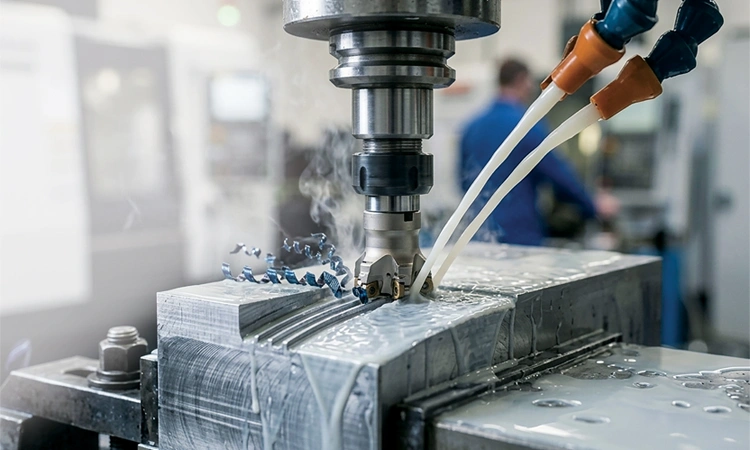
Metal cutting fluids have been an integral part of machining for more than a century. Their fundamental purpose has remained familiar—to reduce friction and heat, improve tool life, facilitate chip evacuation and enhance surface finish. Yet the technology behind these fluids has changed dramatically.
What began largely with mineral-oil-based formulations has evolved into a sophisticated field encompassing synthetic and semi-synthetic fluids, high-performance additives, bio-based lubricants, minimum quantity lubrication, dry machining and digitally monitored fluid-management systems.
Today, cutting fluid is no longer regarded simply as a consumable. It is increasingly viewed as an important component of the overall machining process, influencing productivity, tool life, quality, operator safety, machine cleanliness and environmental performance.
From Oils to Engineered Fluids
Early machining operations relied extensively on straight mineral oils. These provided good lubrication and were particularly useful in applications involving low cutting speeds and significant friction.
As cutting speeds increased and machines became more productive, heat generation became a greater concern. Water-based fluids emerged as an effective means of dissipating heat, leading to the development of soluble oils, semi-synthetic fluids and fully synthetic coolants.
Each technology brought a different balance between lubricity, cooling, corrosion protection, biological stability and cost.
Soluble oils offered a useful combination of cooling and lubrication. Semi-synthetic fluids reduced the amount of mineral oil while providing improved cooling and cleanliness. Synthetic fluids eliminated mineral oil altogether and were formulated using water-soluble chemical components.
This evolution mirrored the transformation of machine tools themselves—from relatively slow mechanical equipment to high-speed CNC and automated machining systems.
Additives Transform Performance
The modern metalworking fluid is a carefully engineered chemical formulation rather than simply oil mixed with water.
Additives play a critical role in determining performance. Extreme-pressure and anti-wear additives can improve lubrication under severe cutting conditions. Corrosion inhibitors protect both the workpiece and machine. Surfactants help maintain stable emulsions, while defoamers control foam formation.
Biocides and fungicides have traditionally been used to control microbial growth in water-based fluids, although regulatory and environmental considerations are encouraging the industry to develop safer alternatives and better fluid-management practices.
The challenge today is to achieve high machining performance while reducing hazardous substances, extending fluid life and improving worker and environmental safety.
The High-Speed Machining Challenge
Modern cutting tools and machines permit significantly higher cutting speeds and feeds than earlier generations. Materials such as hardened steels, titanium alloys, nickel-based superalloys and advanced composites can also generate considerable heat and impose high mechanical loads.
This has increased the demands placed on cutting fluids.
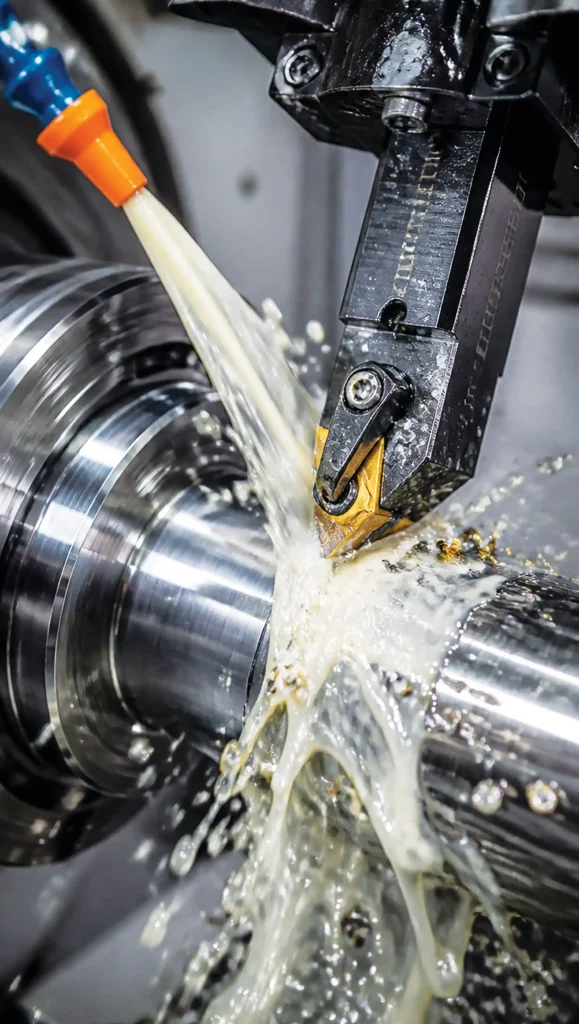
The fluid must reach the cutting zone effectively, remove heat rapidly, lubricate the tool-workpiece interface and carry chips away without creating excessive mist or foam.
High-pressure coolant systems have therefore become increasingly important, particularly in difficult machining operations. Directed jets can penetrate deep cavities, improve chip evacuation and reduce the risk of chips re-cutting.
In applications involving difficult-to-machine materials, specialised formulations are engineered to withstand extreme temperature and pressure conditions while maintaining lubrication.
Minimum Quantity Lubrication
One of the most important developments in recent decades has been Minimum Quantity Lubrication (MQL).
Instead of flooding the machining area with large quantities of coolant, MQL supplies a precisely controlled, very small quantity of lubricant, generally carried to the cutting zone in an air stream.
The approach can dramatically reduce fluid consumption and associated disposal requirements.
MQL is particularly attractive for applications where lubrication is more important than intensive cooling. It can also reduce the amount of wet waste and improve machine cleanliness.
However, MQL is not universally applicable. High-heat-generating operations and certain difficult-to-machine materials may still require conventional flood or high-pressure cooling. The future therefore lies not in replacing one technology with another, but in selecting the right fluid-delivery strategy for each process.
Dry Machining Finds Its Place
The ultimate reduction in cutting-fluid consumption is dry machining.
Advances in cutting-tool materials, coatings and geometries have made dry or near-dry machining possible in selected applications. Carbide, ceramic, CBN and diamond tools can withstand increasingly demanding cutting environments.
Dry machining eliminates coolant purchase, filtration, pumping and disposal costs. It also reduces the environmental burden associated with fluid management.
Nevertheless, heat-sensitive workpieces, difficult materials and certain precision operations continue to require cooling and lubrication. Consequently, dry machining should be viewed as one element within a broader spectrum of fluid-minimisation strategies.
Bio-Based and Renewable Lubricants
Environmental concerns have stimulated interest in vegetable-oil-based and other renewable lubricants.
Vegetable oils naturally possess good lubricity and high viscosity indices, making them attractive for certain metalworking applications. They can also offer favourable biodegradability compared with some conventional petroleum-based products.
However, bio-based formulations must overcome challenges such as oxidation stability, thermal resistance and storage life.
Research and formulation advances are addressing these limitations, and hybrid formulations are increasingly being developed to combine renewable raw materials with performance-enhancing additives.
The objective is not simply to replace petroleum with a renewable ingredient, but to deliver a fluid that performs reliably over the complete machining cycle.
Nanofluids and Advanced Lubrication
Another area attracting attention is the use of nanoparticles in cutting fluids.
The addition of carefully selected nanoparticles can potentially improve thermal conductivity and lubricating behaviour. Materials such as graphene, carbon-based particles and certain ceramic nanoparticles have been investigated for enhancing heat transfer and reducing friction.
While promising, nanofluids also raise questions about stability, cost, health, filtration and end-of-life disposal. Their wider industrial adoption will therefore depend on demonstrating consistent performance and safe handling.
Smarter Fluid Management
The evolution of cutting fluids is increasingly linked to digitalisation.
A cutting fluid deteriorates over time. Concentration, pH, contamination, temperature, conductivity and microbial activity can change during production.
Traditionally, these parameters were checked manually at periodic intervals. Today, sensors and connected monitoring systems can enable continuous or more frequent fluid-condition monitoring.
This supports predictive fluid management. Instead of replacing a coolant at a fixed interval, manufacturers can determine when intervention is actually required.
Such systems can reduce unnecessary fluid consumption, maintain consistent machining performance and prevent unexpected process deterioration.
Filtration and Recycling
Fluid management extends beyond the formulation itself.
Advanced filtration systems can remove chips, fines, tramp oil and other contaminants, thereby extending coolant life. Centrifugal separators, magnetic filtration, coalescers and membrane technologies can be selected according to the application.
Recycling and reclamation can significantly reduce the volume of fluid requiring disposal.
For large machining facilities, centralised coolant-management systems can serve multiple machines while maintaining controlled fluid quality.
The result is a shift from a “use and dispose” model towards a “monitor, maintain, recover and reuse” approach.
The Human and Environmental Dimension
Modern fluid technology is also being shaped by occupational health requirements.
Fluid manufacturers are increasingly focused on reducing unpleasant odours, skin irritation, mist formation and exposure to potentially hazardous substances. Better formulation chemistry, improved housekeeping, enclosure design, mist extraction and fluid monitoring all contribute to a safer workplace.
This is especially important because cutting-fluid performance cannot be separated from the environment in which it is used.
A technically excellent formulation can perform poorly if concentration is incorrect, contamination is uncontrolled or the fluid is not properly maintained.
The Future: Application-Specific Fluids
The next phase of development is likely to focus on application-specific and digitally managed cutting fluids.
Rather than relying on a universal coolant, manufacturers can select formulations based on workpiece material, cutting tool, machine architecture, cutting parameters and environmental requirements.
AI and process analytics could eventually correlate fluid condition with tool wear, surface quality, energy consumption and machining performance, enabling the fluid-management system to recommend corrective action automatically.
Conclusion
The evolution of metal cutting fluids reflects the evolution of manufacturing itself. From simple mineral oils, the industry has progressed towards sophisticated formulations and delivery technologies designed to meet the demands of high-speed, high-precision and sustainable machining.
The future will be defined by less fluid, longer fluid life, better lubrication, smarter monitoring and greater resource efficiency.
Cutting fluids will increasingly become an integral part of the digital manufacturing ecosystem—working alongside machine tools, cutting tools, sensors and automation to deliver higher productivity with lower environmental impact.
In tomorrow’s factory, the question will no longer be simply “Which coolant should we use?” but rather “How intelligently can we manage lubrication, cooling and resources across the entire machining process?”