

The Unsung Enablers of Precision Manufacturing
In modern manufacturing, attention is often focused on machine tools, cutting tools, automation systems, and software technologies. Yet, one critical element that directly influences machining accuracy, cycle times, productivity, and product quality often receives less recognition than it deserves—the workholding device. Whether machining a simple shaft, a complex aerospace component, a medical implant, or an automotive transmission housing, the success of the operation depends significantly on how securely and accurately the workpiece is held. Workholding devices form the vital link between the machine tool and the component being manufactured, ensuring stability throughout the machining process.
As manufacturers strive for higher productivity, tighter tolerances, and greater operational efficiency, advanced workholding solutions are becoming increasingly important. Today, workholding is no longer merely about clamping a component; it is about optimizing the entire manufacturing process.
Why Workholding Matters
A machine tool can only perform as accurately as the setup permits. Even the most sophisticated CNC machining center equipped with advanced cutting tools cannot deliver optimum results if the workpiece is inadequately secured.
Proper workholding minimizes vibration, reduces chatter, improves dimensional accuracy, and enhances surface finish. It enables higher cutting parameters, shorter cycle times, and longer tool life. Most importantly, it ensures process consistency, which is critical in high-volume production environments.
Poor workholding, on the other hand, can lead to component rejection, excessive tool wear, machine downtime, and compromised productivity. In many machining operations, productivity improvements can be achieved more effectively through enhanced workholding solutions than by investing in additional machine capacity.
Evolution of Workholding Technology
Traditional workholding devices such as vises, chucks, collets, and fixtures continue to serve many manufacturing applications. However, modern manufacturing requirements have driven significant advancements in workholding technology.
Today’s workholding systems are designed to support high-speed machining, multi-axis operations, unmanned production, and flexible manufacturing environments. They provide greater precision, faster setup times, and improved accessibility to workpiece surfaces. Manufacturers increasingly demand modular, adaptable, and automated workholding solutions capable of accommodating a wide variety of component geometries and production volumes.
The result has been the development of highly sophisticated workholding technologies that contribute directly to enhanced productivity. Proper workholding minimizes vibration, reduces chatter, improves dimensional accuracy, and enhances surface finish. It enables higher cutting parameters, shorter cycle times, and longer tool life. Most importantly, it ensures process consistency, which is critical in high-volume production environments.
Precision Clamping Improves Machining Performance
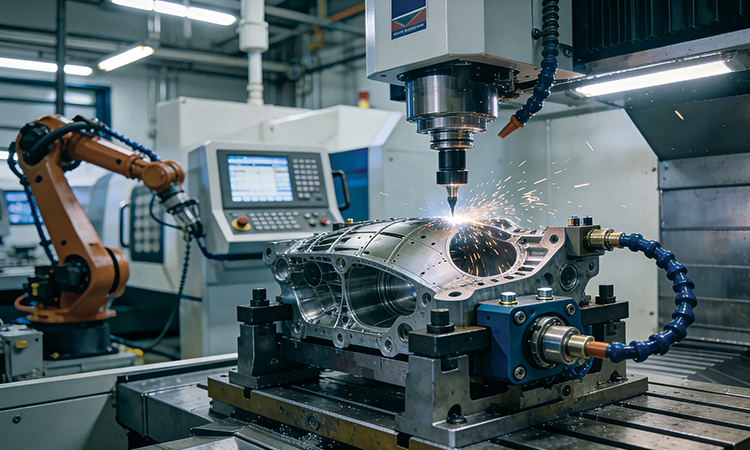
One of the primary objectives of any workholding device is to provide secure and repeatable clamping. Advanced clamping systems ensure consistent positioning and minimize deformation of the workpiece during machining. Precision hydraulic and mechanical clamping solutions offer uniform force distribution, reducing the risk of distortion while maintaining rigidity.
Stable clamping enables machinists to increase cutting speeds and feeds without compromising component quality. Reduced vibration also contributes to improved tool life and superior surface finishes. In industries such as aerospace, medical device manufacturing, and precision engineering, where tolerances are measured in microns, precision workholding has become indispensable.
Hydraulic and Pneumatic Systems Gain Popularity
Hydraulic and pneumatic workholding systems have become increasingly popular due to their ability to improve productivity and repeatability.
Hydraulic fixtures provide high clamping forces with excellent consistency, making them ideal for mass production applications. They reduce operator effort and ensure uniform clamping across multiple components. Pneumatic systems offer rapid actuation and are particularly suitable for automated production lines where speed and efficiency are paramount. Both technologies help reduce setup times and enhance process reliability, allowing manufacturers to achieve higher throughput without sacrificing quality.
Modular Fixtures Support Flexible Manufacturing
The manufacturing landscape is evolving toward greater product variety and shorter production runs. This trend has increased demand for flexible workholding solutions.
Modular fixture systems have emerged as an effective answer to these challenges. These systems utilize standardized components that can be assembled and reconfigured quickly to accommodate different workpieces. The flexibility offered by modular fixtures reduces design and manufacturing costs while shortening setup times. Manufacturers can respond more rapidly to changing production requirements without investing in dedicated fixtures for every component. For job shops and low-volume, high-mix production environments, modular workholding systems provide significant operational advantages.
Workholding for Multi-Axis Machining
The widespread adoption of 5-axis machining centers has transformed manufacturing capabilities. However, these machines require equally advanced workholding solutions.
Traditional fixtures often restrict access to critical machining surfaces, necessitating multiple setups. Modern 5-axis workholding systems are specifically designed to maximize accessibility while maintaining rigidity. Low-profile vises, self-centering fixtures, tombstone systems, and specialized clamping devices enable complete machining in a single setup. This reduces handling, improves accuracy, and significantly shortens production cycles. Single-setup machining has become a major productivity driver, particularly in aerospace, medical, and mold-making applications.
Automation Demands Smarter Workholding
The growing adoption of automation is reshaping workholding requirements. Robotic loading systems, pallet changers, and flexible manufacturing cells require workholding devices that can support unattended operation while maintaining consistent performance. Quick-change fixture systems have gained widespread acceptance in automated environments. These systems allow rapid fixture replacement and minimize machine downtime during changeovers.
Many advanced workholding solutions now incorporate sensors that verify proper component positioning and clamping force before machining begins. Such capabilities enhance process reliability and reduce the risk of costly errors during unattended production. As smart factories continue to evolve, intelligent workholding systems will become increasingly important.
Vacuum and Magnetic Workholding Expands Possibilities
Certain applications require innovative approaches beyond conventional clamping methods. Vacuum workholding systems are widely used for thin-walled components, composite materials, and non-ferrous parts where traditional clamping may cause deformation.
Magnetic workholding offers significant advantages in grinding, milling, and machining ferrous materials. It provides unrestricted access to workpiece surfaces while ensuring secure retention. These specialized technologies enable manufacturers to machine complex components more efficiently while maintaining high levels of precision and productivity.
The Economics of Better Workholding
Many manufacturers view workholding devices as secondary investments compared to machine tools or cutting tools. However, this perspective often overlooks the substantial productivity gains that advanced workholding can deliver.
Improved workholding reduces setup times, increases machine utilization, enhances process stability, and minimizes component rejection. It also enables higher cutting parameters and reduces tool consumption. The cumulative impact of these benefits often results in a rapid return on investment. In competitive manufacturing environments where margins are increasingly under pressure, optimized workholding can provide a significant competitive advantage.
Emerging Trends in Workholding Technology
Several trends are shaping the future of workholding. Digitalization is enabling smarter fixtures capable of monitoring clamping forces and communicating with machine control systems. Additive manufacturing is being used to create lightweight, customized fixtures with complex geometries that would be difficult to produce using conventional methods.
Zero-point clamping systems are gaining popularity for their ability to dramatically reduce setup times. Meanwhile, the growing use of composite and lightweight materials is driving demand for innovative fixturing solutions that prevent distortion while maintaining secure clamping. These developments are helping manufacturers achieve new levels of productivity and process efficiency.
Conclusion
Workholding devices may not always command the spotlight, but their contribution to manufacturing productivity is undeniable. They directly influence machining accuracy, cycle times, tool life, setup efficiency, and overall operational performance.
As manufacturing technologies continue to advance, workholding solutions are evolving in parallel. Precision clamping, modular fixtures, hydraulic systems, automation-ready designs, and intelligent monitoring technologies are transforming workholding from a simple support function into a strategic productivity enabler.
For manufacturers seeking to maximize machine utilization, improve quality, and enhance competitiveness, investing in advanced workholding technology is no longer optional—it is essential. In the quest for manufacturing excellence, effective workholding remains one of the most powerful tools for unlocking productivity and achieving sustainable success.