

Heat has always been a fundamental element in manufacturing and industrial processing. From forging and hardening to brazing and melting, controlled heat treatment is essential for transforming raw materials into high-performance components. Today, as industries seek greater efficiency, precision, sustainability, and automation, induction heating and thermal engineering have emerged as indispensable technologies driving modern manufacturing.
Induction heating is a non-contact process that uses electromagnetic fields to generate heat directly within electrically conductive materials. Coupled with advances in thermal engineering—the science of heat transfer, temperature control, and energy management—it enables manufacturers to achieve superior process consistency, reduced energy consumption, and enhanced product quality.
As industries such as automotive, aerospace, railways, machine tools, energy, and heavy engineering continue to evolve, induction heating and thermal engineering are playing an increasingly important role in enabling smarter, cleaner, and more productive manufacturing operations.
Understanding Induction Heating
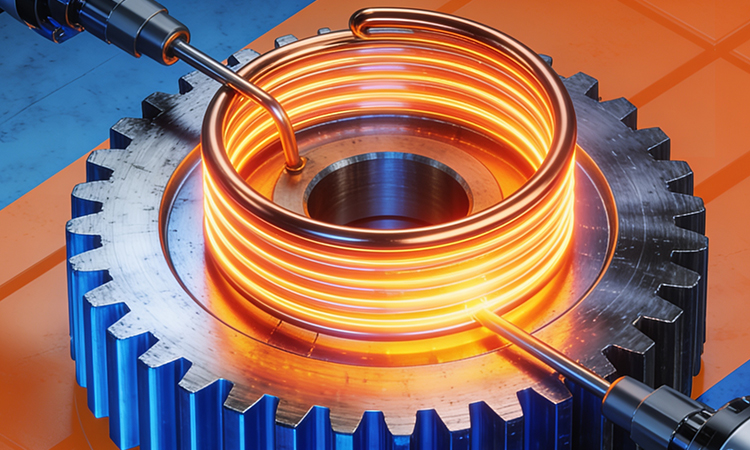
Induction heating operates on the principle of electromagnetic induction. When alternating current passes through an induction coil, it creates a rapidly changing magnetic field. When a conductive workpiece is placed within this field, eddy currents are generated inside the material. These currents encounter resistance and produce heat directly within the component.
Unlike conventional heating methods that transfer heat from an external source, induction heating generates heat internally. This results in faster heating rates, improved efficiency, and precise temperature control.
The process is widely used for:
• Hardening
• Annealing
• Tempering
• Brazing
• Soldering
• Forging
• Shrink fitting
• Melting
• Preheating before welding
Its ability to deliver localized heating without physical contact makes it particularly suitable for precision manufacturing applications.
Advantages of Induction Heating
Superior Energy Efficiency
One of the greatest advantages of induction heating is its high energy efficiency. Since heat is generated directly within the workpiece, energy losses associated with furnaces and open-flame systems are significantly reduced Modern induction systems can achieve efficiencies exceeding 80–90 percent, making them an attractive solution for industries focused on reducing energy costs and carbon emissions.
Precision Temperature Control
Manufacturing processes often require exact temperature profiles to achieve desired metallurgical properties.
Induction heating systems offer:
• Rapid response times
• Accurate temperature control
• Uniform heating
• Repeatable process performance
This level of control helps improve product quality while reducing scrap and rework.
Faster Processing Cycles
Heating rates in induction systems are considerably higher than conventional methods. Components can often reach target temperatures within seconds rather than minutes.
Shorter cycle times contribute to:
• Higher productivity
• Increased throughput
• Reduced work-in-progress inventory
Improved manufacturing efficiency
Enhanced Workplace Safety
Because induction heating eliminates open flames and combustible fuels, workplace safety is significantly improved.
Benefits include:
• Reduced fire hazards
• Lower emissions
• Cleaner work environments
• Improved operator safety
These advantages make induction heating particularly attractive in modern manufacturing facilities where safety and environmental compliance are critical priorities.
The Role of Thermal Engineering
While induction heating provides the heat source, thermal engineering ensures that heat is generated, transferred, distributed, and controlled effectively throughout the manufacturing process.
Thermal engineering encompasses the study and application of:
• Heat transfer
• Thermodynamics
• Fluid mechanics
• Energy systems
• Process optimization
Its objective is to maximize energy utilization while ensuring consistent process outcomes. In industrial environments, thermal engineers focus on designing systems that maintain optimal temperature conditions, improve energy efficiency, and minimize thermal losses.
Applications in Metal Processing
Heat Treatment
Heat treatment remains one of the largest applications of induction technology.
Processes such as hardening, tempering, annealing, and stress relieving require precise temperature control to achieve specific material properties.
Induction hardening is widely used for:
• Gears
• Shafts
• Bearings
• Axles
• Machine tool components
The process selectively hardens critical surfaces while maintaining core toughness, resulting in superior wear resistance and fatigue strength.
Forging Operations
Induction heating has revolutionized forging operations by providing rapid and uniform billet heating.
Compared to traditional furnace heating, induction systems offer:
• Faster heating cycles
• Reduced scale formation
• Better temperature consistency
• Lower energy consumption
This results in improved forging quality and reduced material wastage.
Brazing and Joining
Induction heating is increasingly employed for brazing and joining applications in industries such as automotive, HVAC, aerospace, and electrical equipment manufacturing. The process enables localized heating of joint areas without affecting surrounding components, resulting in strong, reliable joints and improved production efficiency.
Thermal Engineering in Industrial Systems
Furnace Design and Optimization
Industrial furnaces remain essential for numerous manufacturing processes. Thermal engineering principles help optimize furnace performance through improved insulation, airflow management, combustion efficiency, and heat recovery systems.
• Modern furnace designs focus on:
• Reduced fuel consumption
• Uniform temperature distribution
• Lower emissions Enhanced productivity
Energy Recovery Systems
A significant amount of energy in industrial operations is lost as waste heat.
Thermal engineers develop heat recovery systems that capture and reuse this energy through technologies such as:
• Recuperators
• Regenerators
• Heat exchangers
• Waste heat recovery boilers
These systems improve overall plant efficiency while reducing operating costs and environmental impact.
Cooling Technologies
Thermal engineering extends beyond heating processes. Effective cooling is equally important for maintaining equipment performance and product quality.
• Applications include:
• Machine tool cooling
• Electronic equipment cooling
• Mold temperature control
• Power generation systems
Advanced cooling solutions help maintain process stability and prolong equipment life
Induction Heating and Industry 4.0
The rise of Industry 4.0 is transforming thermal processes through digitalization and automation. Modern induction systems now incorporate:
• Real-time monitoring
• Closed-loop temperature control
• Data analytics
• Remote diagnostics
• Predictive maintenance
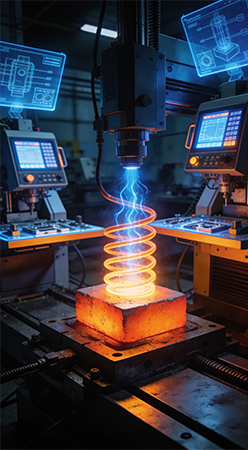
Sensors continuously monitor process parameters and provide feedback to intelligent control systems, ensuring optimal heating performance. This integration enhances process consistency, reduces downtime, and improves overall operational efficiency.
Sustainability and Green Manufacturing
Sustainability has become a key driver for technological adoption across industries. Induction heating aligns strongly with sustainability objectives due to:
• Reduced energy consumption
• Lower greenhouse gas emissions
• Minimal waste generation
• Improved process efficiency
As industries transition toward renewable energy sources, electrically powered induction systems offer a cleaner alternative to fossil-fuel-based heating technologies. Thermal engineering also contributes to sustainability by optimizing energy utilization and reducing heat losses throughout industrial operations.
Emerging Trends in Induction Heating
High-Frequency Technologies
Advances in power electronics are enabling the development of high-frequency induction systems capable of delivering extremely precise heating for specialized applications. These technologies are particularly valuable in:
• Medical device manufacturing
• Electronics production
• Aerospace components
• Precision engineering
Advanced Simulation Tools
Modern thermal engineering increasingly relies on simulation software to model heat transfer behavior and optimize process parameters before physical implementation. Digital twins and computational modeling allow engineers to:
• Predict thermal performance
• Reduce development time
• Improve process reliability Lower operating costs
Smart Thermal Management
Artificial intelligence and machine learning are beginning to play an important role in thermal process optimization. AI-driven systems can analyze operational data, predict thermal behavior, and automatically adjust process parameters to maximize efficiency and quality. This represents a significant step toward fully autonomous thermal management systems.
Challenges and Future Opportunities
Despite their numerous advantages, induction heating and thermal engineering continue to face challenges.
Manufacturers increasingly demand:
• Greater energy efficiency
• Higher process accuracy
• Faster production rates
• Lower environmental impact
Meeting these expectations requires continuous innovation in:
• Power electronics
• Material science
• Process control
• Thermal modeling
• Automation technologies
Emerging sectors such as electric vehicles, renewable energy, advanced aerospace systems, and semiconductor manufacturing are creating new opportunities for thermal engineering solutions. As these industries grow, demand for sophisticated heating and temperature control technologies is expected to rise significantly.
Conclusion
Induction heating and thermal engineering represent a powerful combination that is reshaping modern manufacturing. By enabling precise temperature control, rapid processing, improved energy efficiency, and enhanced sustainability, these technologies are helping industries meet the demands of an increasingly competitive and environmentally conscious world.
From heat treatment and forging to energy recovery and smart manufacturing, their applications continue to expand across virtually every industrial sector. Advances in automation, digitalization, and artificial intelligence are further enhancing their capabilities, paving the way for more intelligent and efficient thermal processes.
As manufacturers strive for higher productivity, superior quality, and sustainable growth, induction heating and thermal engineering will remain at the forefront of industrial innovation—transforming heat from a simple utility into a strategic driver of performance and competitiveness.