


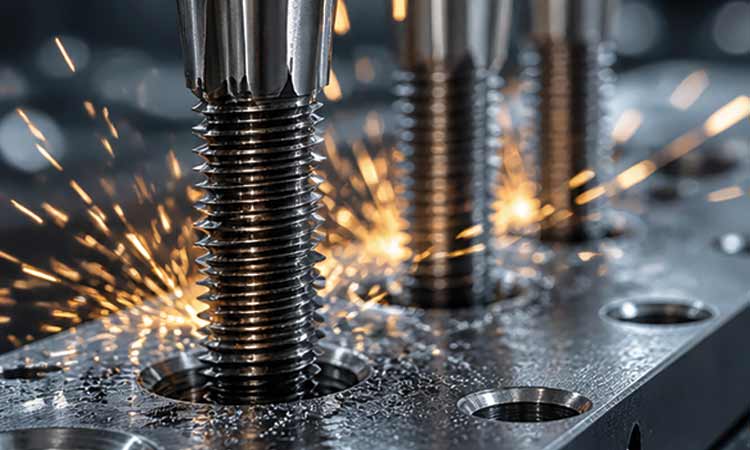
Threading is one of the most fundamental yet critical machining operations in manufacturing. Whether it is an automotive engine block, an aerospace component, a hydraulic manifold, a medical implant, or a consumer electronic device, threaded holes are indispensable for reliable assembly and fastening. The quality of the thread directly influences the strength, functionality, and longevity of the final product. As industries demand tighter tolerances, higher productivity, and machining of increasingly challenging materials, machine taps and advanced threading solutions have evolved significantly to meet these expectations. Today’s threading technologies combine high-performance tool materials, advanced coatings, optimized geometries, CNC machining, intelligent process monitoring, and precision toolholding to produce consistent, high-quality threads with minimal downtime. Modern machine taps are no longer simple cutting tools-they are engineered solutions designed for speed, precision, and long service life.
The Importance of Precision Threading
Internal threads play a crucial role in mechanical assemblies. Poorly formed threads can result in loose joints, assembly failures, leakage, reduced fatigue strength, and costly rework. In industries such as aerospace, medical devices, defence, and automotive, thread quality is directly linked to product safety and reliability.
Machine tapping enables manufacturers to produce highly accurate internal threads with excellent repeatability. The process is widely employed on CNC machining centres, turning centres, transfer lines, and flexible manufacturing systems, allowing high-volume production while maintaining stringent quality standards.
Understanding Machine Taps
A machine tap is a precision cutting tool used to produce internal threads in drilled holes. It cuts matching threads that accommodate screws, bolts, studs, and threaded inserts.
Machine taps are available in several configurations depending on the application:
- Straight flute taps are suitable for general-purpose threading, particularly in through and blind holes where chip evacuation is manageable.
- Spiral point taps, often called gun taps, push chips forward, making them ideal for through-hole applications and high-speed production.
- Spiral flute taps pull chips upward and out of the hole, making them highly effective for blind-hole threading.
- Forming (roll) taps create threads by plastically deforming the material instead of cutting it. They generate stronger threads, eliminate chips, and are especially suitable for ductile materials such as aluminium, copper alloys, and low-carbon steels.
Selecting the correct tap type is essential for maximizing productivity and ensuring consistent thread quality.
Challenges in Modern Threading
Threading may appear straightforward, but it presents several machining challenges.
Different workpiece materials exhibit varying machinability. Stainless steels, titanium alloys, Inconel, hardened steels, and other high-strength materials generate high cutting forces and elevated temperatures, accelerating tool wear.
Blind-hole threading requires efficient chip evacuation to prevent chip packing, tap breakage, and poor thread quality. Small-diameter taps are particularly susceptible to breakage due to their limited torsional strength.
Additionally, maintaining thread accuracy at high production speeds demands excellent machine rigidity, precise spindle synchronization, and optimized cutting conditions.
Tool Material Innovations
Advances in tool materials have greatly improved machine tap performance.
High-Speed Steel (HSS) remains widely used due to its toughness and versatility. Powder Metallurgy HSS offers finer grain structures, delivering greater wear resistance and longer tool life.
Solid carbide taps provide exceptional rigidity and wear resistance, making them ideal for high-volume production, especially when machining cast iron and abrasive materials.
To further enhance performance, manufacturers apply advanced Physical Vapour Deposition (PVD) coatings such as TiN, TiCN, TiAlN, AlCrN, and multi-layer nano coatings. These coatings reduce friction, improve heat resistance, minimize built-up edge formation, and significantly extend tool life.
Optimized Tap Geometry
Modern machine taps are carefully engineered to achieve maximum cutting efficiency.
Variable flute designs reduce vibration and cutting forces while improving chip flow. Optimized rake angles enhance cutting action in difficult materials, whereas specially designed relief angles reduce friction between the tool and the workpiece.
Advanced chamfer designs distribute cutting loads evenly across multiple teeth, lowering torque requirements and reducing the likelihood of tap breakage.
Such refinements enable manufacturers to achieve higher speeds without compromising thread quality.
Thread Milling: A Flexible Alternative
Thread milling has gained widespread acceptance as an alternative to conventional tapping, particularly for large-diameter threads and difficult materials.
Unlike taps, thread mills generate threads through circular interpolation using CNC machining centres. A single thread mill can produce different thread sizes of the same pitch simply by modifying the CNC program.
Thread milling offers several advantages:
- Reduced risk of tool breakage
- Excellent chip control
- Superior thread accuracy
- Capability to machine interrupted threads
- Easy machining of large diameters
Simplified recovery if tool failure occurs
It is especially valuable in aerospace, mould and die, and high-value component manufacturing.
Smart Threading in the Industry 4.0 Era
Digital manufacturing has transformed threading operations.
Modern CNC machines are equipped with sensors that monitor spindle load, torque, vibration, temperature, and cutting forces during tapping. These data are analysed in real time to detect abnormal conditions such as excessive torque, tool wear, or impending breakage.
Artificial Intelligence (AI) and machine learning algorithms optimize cutting parameters based on historical machining data, helping manufacturers improve productivity while reducing scrap and tool consumption.
Integrated tool management systems also track tool usage, schedule replacements, and maintain complete traceability for quality assurance.
Effective lubrication is essential for successful threading.
Quality Assurance and Inspection
Thread quality is verified using GO/NO-GO gauges, optical measurement systems, coordinate measuring machines (CMMs), and advanced vision inspection technologies.
Manufacturers inspect thread pitch, profile, major and minor diameters, surface finish, and dimensional accuracy to ensure compliance with international standards such as ISO, DIN, ANSI, and ASME.
In-process inspection using spindle probes enables automatic verification of hole dimensions before tapping, reducing the risk of defective threads.
Applications Across Industries
Machine taps and advanced threading solutions are indispensable in numerous industries:
Automotive: Engine blocks, transmission housings, brake systems, chassis components, and electric vehicle assemblies.
Aerospace: Aircraft structures, turbine engines, landing gear, hydraulic systems, and precision fasteners.
Medical: Surgical instruments, orthopaedic implants, dental components, and medical equipment.
Oil & Gas: Valves, pumps, drilling equipment, and pressure-control systems.
General Engineering: Machine tools, industrial equipment, fluid power systems, and automation components.
Each application demands threading solutions tailored to specific materials, tolerances, and production volumes.
Conclusion
Although threading is one of the oldest machining processes, it remains a vital operation in modern manufacturing. Advances in machine tap design, cutting materials, coatings, thread milling, precision toolholding, digital monitoring, and intelligent machining have transformed threading into a highly efficient and reliable process.In the evolving landscape of precision engineering, machine taps and innovative threading solutions will continue to play a crucial role in building the products and infrastructure that power the modern world.