

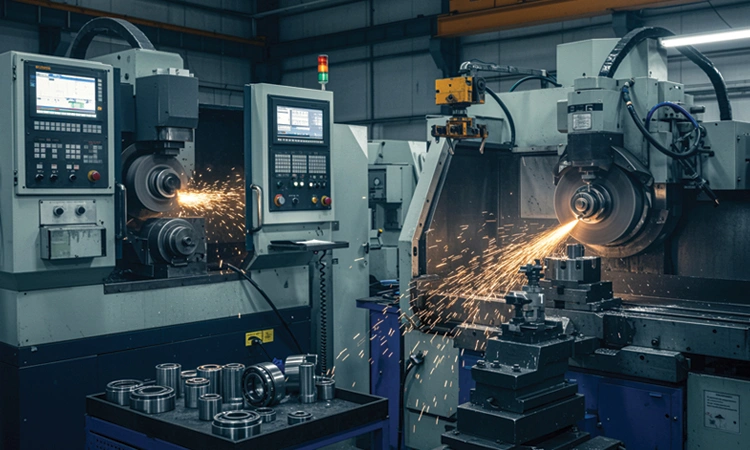
Grinding is often described as the final and most critical stage of metal cutting. While turning, milling and drilling shape the component, grinding perfects it. In industries such as automotive, aerospace, bearings, machine tools, toolmaking and die & mould manufacturing, grinding is the process that delivers the ultimate dimensional accuracy, surface finish and functional integrity. From rough stock removal to mirror-finish precision grinding, today’s grinding machines and processes are highly evolved, capable of handling a vast spectrum of materials and geometries. The modern grinding shop is no longer a dusty, slow and manual environment; it is a high-technology domain combining CNC, automation, in-process gauging and intelligent wheel technology.
Why Grinding Remains Indispensable
Despite rapid advances in machining centres and high-precision turning, grinding remains unmatched when it comes to:
- Achieving tight tolerances in microns
- Producing superior surface finish
- Grinding hardened materials
- Maintaining roundness, flatness and concentricity
- Finishing complex profiles and tools
Components such as bearing races, shafts, gears, fuel injection parts, hydraulic components, cutting tools and mould inserts simply cannot meet functional requirements without precision grinding.
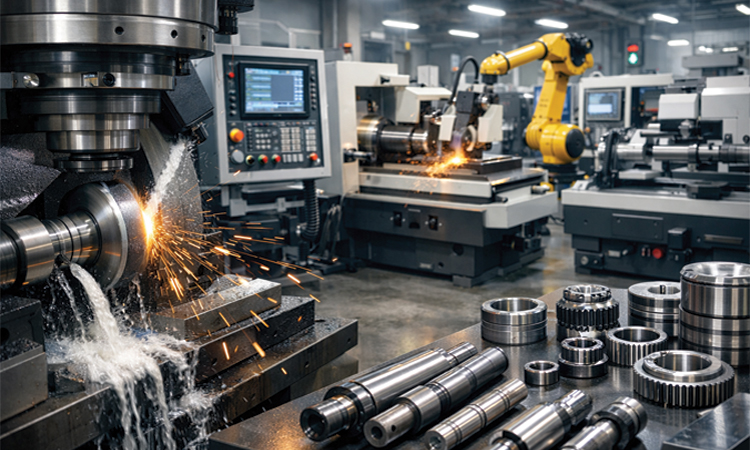
The Evolution of Grinding Technology
Traditional grinding relied heavily on operator skill, manual adjustments and frequent wheel dressing. Today, grinding has become a highly automated and digitally controlled process.
Modern grinding machines feature:
- CNC and servo-driven axes
- High-speed spindles
- Automatic wheel dressing and balancing
- In-process gauging and feedback
- Adaptive control based on cutting load
- Automation with robots and gantry loaders
These advances have transformed grinding from a “finishing operation” into a high-productivity, value-adding manufacturing process.
Surface Grinding – Creating Flat Perfection
Surface grinding is used to produce flat, smooth and accurate surfaces. It is widely employed in tool rooms, die and mould shops, automotive plants and general engineering.
Surface grinders are available in:
- Horizontal spindle machines
- Vertical spindle machines
- Reciprocating table designs
- Rotary table designs
They are used for grinding plates, blocks, fixtures, machine components and mould bases. Rotary surface grinders, in particular, offer high productivity for large flat components such as clutch plates, pump housings and bearing covers.
Cylindrical Grinding – Precision in Rotation
Cylindrical grinding is one of the most widely used grinding processes, especially for round and shaft-type components.
It is used for:
- Shafts
- Spindles
- Gear blanks
- Bearing journals
- Automotive transmission parts
Cylindrical grinders may be external, internal or universal, and modern CNC cylindrical grinders can perform multiple operations in a single setup. High-speed wheel technology, linear motors and automatic gauging have made cylindrical grinding extremely accurate and repeatable.
Centreless Grinding – Productivity at Scale
Centreless grinding is a unique process where the workpiece is supported between a grinding wheel and a regulating wheel, without the need for centres or chucks. This allows extremely fast and continuous grinding.
Centreless grinders are extensively used in:
- Automotive component production
- Bearing manufacturing
- Fastener and pin production
- Hydraulic and pneumatic parts
The process is ideal for high-volume production of cylindrical components with consistent diameter, roundness and surface finish.
Internal Grinding – Precision from the Inside
Internal grinding is used to grind internal diameters and bores. These include bearing races, bushings, sleeves, hydraulic cylinders and gearbox components.
Modern CNC internal grinders feature:
- High-speed internal spindles
- Automatic gauging
- Temperature control
- Multiple grinding wheels
They are essential wherever internal geometry directly affects the performance, noise and life of a component.
Tool & Cutter Grinding – The Foundation of Machining
Every cutting tool used in machining must itself be precisely ground. Tool and cutter grinders are used to manufacture and re-sharpen:
- End mills
- Drills
- Reamers
- Form tools
- Hobs and gear cutters
Modern CNC tool grinders can produce complex geometries with extreme accuracy. With multi-axis control, they can grind flutes, relief angles and cutting edges in one setup. As tooling costs rise and performance expectations increase, tool grinding has become a strategic function for manufacturing competitiveness.
Rotary and Specialised Grinding
Rotary grinders use a rotating table and are ideal for grinding circular components such as brake discs, valve plates and bearing components. They offer high stock removal and consistent flatness.
Other specialised grinding machines include:
- Gear grinding machines
- Camshaft and crankshaft grinders
- Profile grinders
- Thread grinders
These machines are designed for specific geometries and are critical in industries such as automotive, aerospace and power transmission.
Grinding Wheels – The Cutting Tools of Grinding
Grinding wheels are as important as the machines themselves. They are made from abrasive grains bonded together and act as thousands of microscopic cutting edges.
Common abrasive materials include:
- Aluminium oxide
- Silicon carbide
- Cubic boron nitride (CBN)
- Diamond
Superabrasive wheels such as CBN and diamond are widely used for grinding hardened steels, carbides and advanced materials. Modern wheels are engineered for better cutting action, lower heat generation and longer life.
The Role of Coolants and Filtration
Grinding generates intense heat and fine particles. High-performance coolants and filtration systems are essential to:
- Maintain surface integrity
- Prevent thermal damage
- Extend wheel life
- Ensure operator safety
Centralised coolant systems with fine filtration are now standard in high-end grinding shops.
Grinding in the Age of Electric Vehicles
Electric vehicles are creating new grinding demands. Components such as motor shafts, rotor assemblies, bearing seats and transmission parts require extremely fine finishes and tight tolerances to reduce noise, vibration and losses.
Grinding remains the preferred process for achieving the precision and surface integrity required in EV drivetrains and battery-related components.
Conclusion
Grinding is no longer merely the final step in manufacturing—it is a critical enabler of performance, quality and reliability. With its wide variety of machines, processes and technologies, grinding addresses everything from toolmaking to mass production. As materials become harder, designs more complex and tolerances tighter, grinding technology will continue to evolve, ensuring that modern engineering meets the ever-growing demands of precision and productivity.