

One of the greatest threats to the long life of a linear motion system usually occurs on its very first stroke.
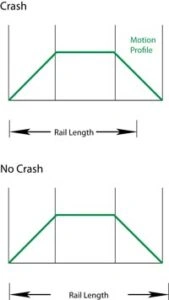
How do you know when a linear bearing has reached its end of travel? When the carriage hits the wall. At least, that is how the old engineering joke goes. But in reality, crashes are no laughing matter. Also known euphemistically as “hard stops,” crashes occur when an out-of-control pillow block slams into the bearing’s end stop or some other intermediate target. They most often occur when a linear axis is started up for the first time. Even a single crash on that very first stroke can ruin a bearing, triggering expensive repair or replacement costs. The reason why bearings crash on start up mostly comes down to human factors. A control engineer can do a great job calculating the perfect motion profile for a given application, only to overlook some installation details during start up. Small errors like entering an incorrect motion parameter or failing to connect a limit switch are common and can be catastrophic for the linear bearing. Fortunately, it is not that difficult to minimize crashes and give your bearings a longer lease on life without spending a lot of money.
Here’s how:
GET ON THE SAME PAGE
All too often there is little communication between the engineer who designs a mechanical system and the engineer who ultimately runs it. This lack of communication can make crashes more likely because it increases the likelihood that the linear axis may be run with motion profile it was not designed to handle. For example, a linear axis may have adequate space for over-travel based on the design inputs—loads, speeds, accelerations and inertia mismatch. Yet if it runs under different conditions, that over-travel space can shrink or disappear. To avoid this kind of problem, it is important for both design and control engineers to have a sense of whether the design values leave enough flexibility to accommodate changes in real-world operating parameters. If not, a less aggressive motion profile may be the only way to avoid crashes.
AVOID OVER-ENGINEERING
Other than busted bearings, one of the negative consequences of crashes is over-engineering. Instead of trying to avoid crashes, the engineer will accept them as inevitable and try to design systems that will survive them. To do so, engineers may end up specifying bumpers or gas shocks. As popular as they are, bumpers and other shock absorbers are a bit like training wheels on a bike. Once someone knows how to ride, off they go. Likewise, linear motion systems that are properly designed and controlled can run safely without the expense of additional protection. Another crash protection strategy involves beefing up linear motion components. Engineers will sometimes size the bearings to survive crashes rather than to meet the application’s load, speed and acceleration requirements. This strategy may not add much cost on a single axis, but upsizing the linear motion components on an entire machine can get expensive. All the more so if all those upsized bearings trigger a shift to larger motors, gearboxes and framing elements. When upsized bearings lead to this kind of pervasive over-engineering, it would not be unusual to see 30 percent increase in total machine cost.
FAVOR CRASH-WORTHY BEARING DESIGNS
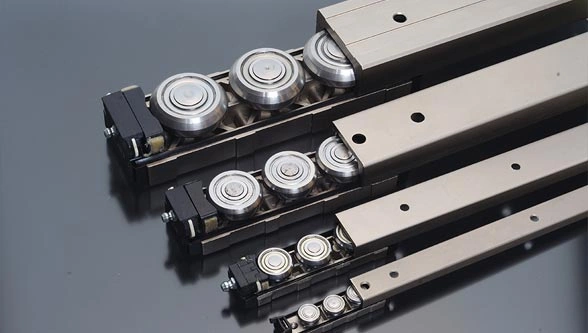
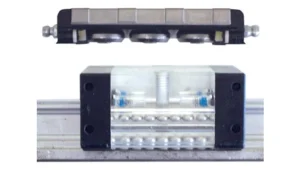
While most crashes do occur on start up, it is true that they occasionally occur well after a machine has been commissioned. Sometimes a loss of power can trigger a crash, or someone might inadvertently change a control parameter. And truth be told, some machines are not run all that carefully. For these reasons, it can make sense for engineers to design with some crash-worthiness in mind. But what is the best way to do that? Engineers can choose to go with shock absorbers and over-engineered components, accepting those costs as the price of crash protection. Or they can favor linear bearings that inherently have crash-worthy construction. Not all bearings are created equal when it comes to surviving a crash. Recirculating ball systems whose pillow blocks have plastic end caps are notoriously susceptible to crash damage—because the plastic tends to shatter. Even a single crash with this type of pillow block, and you may find its ball bearings all over the floor. Bearings based on larger roller elements lack this particular Achilles heel. Their ball bearings and their raceway are contained within the roller element, not within a plastic cap. Rollon’s Compact Rail is a prime example of this type of bearing, and it will run just fine with a shattered end cap. And if it ever does experience any crash damage, its interchangeable rollers and pillow blocks allow it to be easily repaired without changing the rails. Given the choice between crash avoidance and crash protection, engineers can save the most money by avoiding crashes in the first place. And it is true that carefully designed motion systems with room for unexpected overtravel are unlikely to crash. Yet in the real world, it pays to be prepared for the occasional hard stop. With the availability of crash resistant roller bearings, crash protection does not necessarily require the expense of adding shock absorbers and over-sized components.
For more information,
Rollon India Pvt. Ltd.
Web: www.rollonindia.in