

In the early industrial days of cutting tool development, metalworking was very limited. It was a slow task until the nineteenth century when the industrial age brought the availability of machine power from the steam engine and, later, electricity.
Machine tools developed considerably in response and with the introduction of High Speed Steel (HSS) in the twentieth century, the modern metal cutting era began.
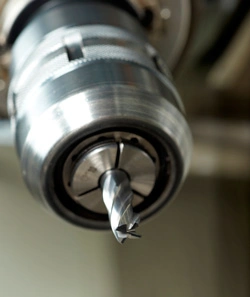
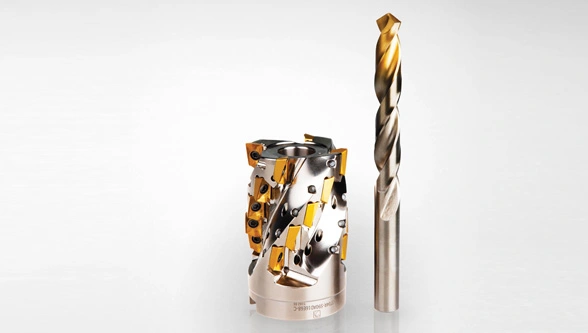
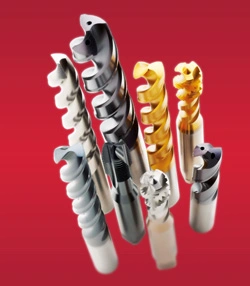
Today, there are two types of cutting tools, rotary and indexable. Rotary, also known as solid round tools, forms one entire piece made up of the cutting edge and shank. It is typically associated with drilling, threading and milling applications.
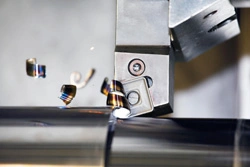
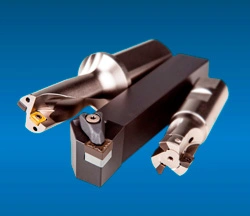
Indexable tools are predominantly made of inserts or tips, where the cutting edge is a replaceable shaped piece which is welded or clamped on to a tool body. These are generally used for turning, milling and hole-making operations.
Fabio Sala is product manager for round tools and Lukas Pavlis, product manager for indexables, at global manufacturer Dormer Pramet. Both discuss the key elements which make up the differences between the two types of cutting tools, including the material, performance and versatility.
Material – indexable
At the beginning of the twentieth century, cutting tool material was sometimes only slightly harder than the material being cut. Therefore tool-life was poor and cutting speeds had to be kept very low.
As cutting tool materials developed, they allowed for increased machining parameters and the ability to withstand higher temperatures while maintaining hardness.
The harder the tool substrate the more wear resistant the cutting tool, resulting in longer tool life. The compromise here is that harder tool substrates are more brittle and more likely to fracture or break under adverse operating conditions.
Softer tool substrates mean the tool will be tougher, allowing successful machining even under adverse conditions. Although, tougher substrates are less likely to fracture or break, they operate at lower performance parameters and so tool life is not as long.
An ideal cutting tool material should resist flank and point wear, as well as deformation, be tough to resist breakage, does not chemically interact with the work piece material, resist oxidation and diffusion and have good resistance to sudden thermal changes.
Inserts are made from tungsten carbide, which is the most commonly used material for indexables. Other available material used for inserts includes cermet (CT), ceramics (CC), cubic boron nitride (CBN) or polycrystalline diamond (PCD). CT has good flank and crater wear resistance and is not prone to built-up-edge. Because of this, the cutting edge maintains its sharpness over a longer time.
CC has a wide application area in cutting hard materials (45-55 HRc) and has high resistance to abrasive and thermal conditions. CBN is an excellent cutting tool material and offers extremely hard high thermal resistance. CBN is utilized in materials such as hardened steels and cast iron.
PCD exists in two types (natural diamond or industrial diamond) and is utilized for non-ferrous materials, such as high silicon aluminum due to its high resistance to wear. As PCD is extremely hard and brittle, it is not a good choice for high hardness or impact applications.
Material – rotary
Round tools are traditionally made from High Speed Steel (HSS), High Speed Cobalt (HSCo or HSS-E) or Solid Carbide.
Carbon, Chromium, Tungsten, Molybdenum, Vanadium and Cobalt all make up the main alloy elements used within high speed steel cutting tools.
HSS is a medium alloy that has good machinability and performance. It offers toughness and is a cost-effective option for a wide variety of large scale drilling and threading applications in multiple materials.
However, it is not very wear resistant and so not suited to demanding, difficult conditions.
Cobalt high speed steel offers a good combination of toughness and hardness, providing good machinability and wear resistance. This makes the material suitable for drills, taps, milling cutters and reamers.
Solid Carbide is the most widely used and wear resistant cutting tool material today and is suitable for both round tool and indexable applications.
Performance & versatility – indexable
From a cost perspective, indexable inserts and tool holders represent a significant investment, however, they have the potential to last for longer periods of time. Also, when a replacement is needed, this is more time and cost efficient because of the need to only rotate or change the insert.
To support the long-term investment of indexable inserts, they are also interchangeable and versatile. Machinists have the ability to keep the cutter (or tool holder) in place while easily switching the inserts with varying alternative grades more suited to machining different work-piece materials.
Indexable cutting tools offer greater versatility in terms of performance than rotary tools, providing stable results even in adverse conditions and are able to perform multiple operations.
For example, the operational versatility for milling inserts includes plunging, helical interpolation, profiling and enlarging a hole. Indexable cutting tools can also offer much larger diameter capability than round tools.
Performance & versatility – rotary
Although round tools generally involve a large initial investment compared to inserts, this investment can be spread over the long-term with the added possibility of regrinding. This is not an option with inserts.
The geometry, substrate and coating of a round tool determine performance. Application specific tools have the potential to produce greater accuracy than general purpose tools. Also, the overall design allows the machine operator to achieve much smaller diameters.
The four-facet Split Point geometry, for example, used on rotary drills, was originally developed for deep oil holes in automotive crankshafts. Today, it is used on many drill designs for a wide variety of hard and soft materials. It can be applied to a variety of drill point angles, the most common being 135°.
This highlights the evolution of round tools where key features, developed for specialist and unique applications have, in time, expanded for use in a wide number of applications and materials.
A key benefit of the split point is easier and more precise self-centering and to prevent the tool from “walking” before penetrating the work-piece. The web thinning or split point greatly reduces thrust and adds a positive rake cutting edge that extends to the center of the drill.
In many materials the point will also act as a chip breaker to produce small chips which can be ejected more efficiently through the flutes. This is a distinct advantage in most applications, but especially when portable drilling or in a drill press where bushings cannot be used.
Summary
Both round tools and indexable tools have their own distinct advantages based on material, operation and user requirements. Each one continues to see on-going developments and improvements, including new geometries, coatings, substrates and manufacturing processes, such as edge preparations, surface finishing and other treatments.
As cutting tools, they present a collective offer to end-users by providing an overlap in diameters and applications, so that tooling engineers can assess and advise where and when it is appropriate to apply each.
Dormer Pramet has a range of support services, including printed publications, an E-shop and product selector tool, as well as face-to-face advice, to help make choosing the right cutting tool simple.
For more information about the comprehensive program of round tools and indexable available from Dormer Pramet,
visit www.dormerpramet.com.