

From precision finishing to intelligent, high-productivity manufacturing
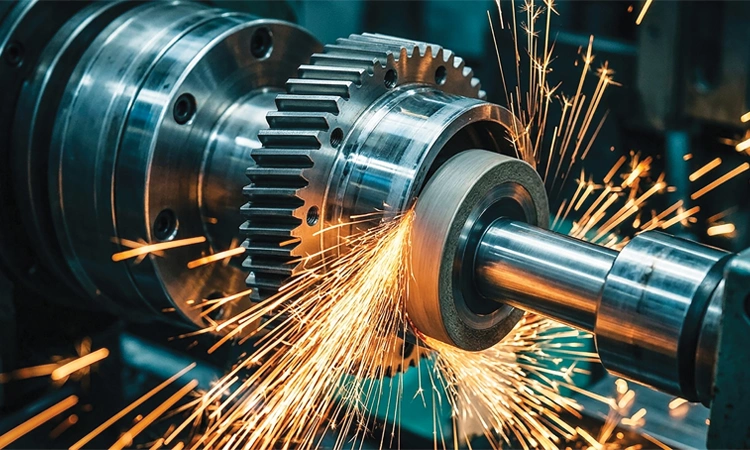
Grinding has traditionally been regarded as a finishing process—one that follows machining to achieve the required dimensional accuracy and surface quality. Today, however, surface and centreless grinding have evolved into highly engineered, digitally controlled manufacturing processes capable of delivering micron-level accuracy, superior surface integrity and high-volume productivity.
The transformation is being driven by advances in CNC technology, superabrasive wheels, automated dressing, in-process gauging, sensors, adaptive controls, coolant management and Industry 4.0 connectivity. Recent developments presented across the grinding industry increasingly focus on higher material-removal rates, improved bonding systems, longer wheel life and resource-efficient grinding.
Surface Grinding Gets Smarter
Surface grinding remains indispensable for producing flat, parallel and highly accurate surfaces on components ranging from dies and moulds to precision machine parts, automotive components and aerospace hardware. Modern CNC surface grinders are moving well beyond conventional reciprocating-table machines.
Multi-axis CNC control enables complex grinding strategies, while high-rigidity machine structures, precision guideways, high-speed spindles and advanced servo systems improve repeatability. Closed-loop position feedback and sophisticated CNC controls can provide extremely fine control over wheel infeed and compensate for process variations.
One important development is the integration of automatic measurement and compensation. Instead of removing the workpiece for inspection after grinding, in-process or post-process gauging can provide dimensional information directly to the machine control. The system can then automatically compensate for wheel wear, thermal effects or other deviations.
This is particularly valuable in high-volume production, where maintaining consistency over hundreds or thousands of components is more important than achieving accuracy on a single component.
The Superabrasive Revolution
Perhaps the most significant innovation in grinding has been the increasing adoption of CBN and diamond superabrasives.
Cubic boron nitride (CBN) is particularly effective for hardened steels and difficult-to-machine ferrous materials. Vitrified CBN wheels combine high abrasive hardness with strong bonding characteristics and are used for precision surface and cylindrical grinding applications.
The latest generation of grinding wheels is increasingly engineered rather than simply manufactured. Grain size, grain distribution, bond characteristics, porosity and wheel structure can be optimised for a specific application.
Highly porous wheels, for example, provide greater chip clearance and improve coolant access to the grinding zone. This can help control grinding temperature and reduce the risk of thermal damage.
Another interesting development is structured grinding wheels. Additive manufacturing is being used to create precisely engineered wheel structures, including customised slots, channels and cooling passages. Such concepts demonstrate how grinding wheels themselves are becoming sophisticated engineered tools rather than consumables.
Dressing Becomes a Precision Process
The performance of any grinding wheel ultimately depends on maintaining its cutting characteristics. Dressing is therefore no longer viewed merely as a periodic maintenance operation.
Modern CNC grinding machines increasingly incorporate automatic, programmable dressing systems. Dressing parameters can be controlled according to component geometry, wheel wear and production requirements.
Dress-on-demand technology can reduce unnecessary dressing while ensuring that the wheel remains in optimum condition. Automatic balancing and acoustic-emission monitoring can further detect abnormal wheel behaviour and assist in maintaining process stability.
Advanced research is also exploring laser-assisted truing and dressing of superabrasive wheels. Laser energy can locally modify the bond material, potentially improving the efficiency and precision of wheel preparation.
Centreless Grinding: Precision at Production Speed
Centreless grinding occupies a special position in mass production because components are supported without centres or chucking. This makes the process particularly suitable for shafts, pins, bearing components, rollers, bushes and other cylindrical parts.
The technology has historically been associated with high-volume automotive and bearing production. Today, however, advanced centreless grinders combine CNC control, automatic dressing, sophisticated gauging and high-speed automation to deliver both flexibility and precision.
The evolution of centreless grinding has been driven by improvements in machine structure, spindles, guideways, work-rest systems, wheel technology and process monitoring. Research has demonstrated the potential of advanced centreless grinding to achieve extremely high throughput alongside sub-micron levels of roundness and dimensional control.
Modern CNC centreless grinders can incorporate independently controlled slides, precision feedback systems, automatic wheel balancing, automatic dressing and gauging feedback. Some machines also use variable-frequency drives to optimise wheel speeds when employing superabrasive wheels such as vitrified CBN.
In-Process Gauging and Closed-Loop Grinding
One of the biggest changes in grinding is the movement from inspection after production to measurement during production.
Laser gauges, optical sensors, air gauges and contact measurement systems can monitor component dimensions while the grinding process is taking place. The information can be fed directly to the CNC control, enabling automatic size compensation.
For centreless grinding, this capability is especially valuable because wheel wear and thermal changes can gradually influence component diameter and roundness. A closed-loop system can recognise the deviation and adjust the process before components move outside specification.
The result is reduced rejection, less operator intervention and greater consistency.
Sensors and Intelligent Process Monitoring
Grinding is a complex process involving vibration, force, temperature, acoustic emissions, wheel condition and coolant behaviour. Modern machines are increasingly equipped with sensors that allow these variables to be monitored.
Acoustic-emission monitoring, for example, can provide information about wheel-workpiece interaction, dressing events and abnormal conditions. Vibration monitoring can help identify imbalance, bearing problems or unstable grinding conditions.
The next step is the application of analytics and artificial intelligence. Instead of merely displaying sensor data, intelligent systems can identify patterns and predict potential problems. Adaptive grinding systems can modify feed rates or process parameters in response to changing grinding conditions.
This represents a fundamental shift—from manually controlled grinding towards self-monitoring and adaptive grinding.
Automation and Lights-Out Production
Labour availability and the need for consistent production are accelerating automation. Modern grinding cells can integrate robotic loading and unloading, part orientation, washing, gauging, marking and material handling.
For centreless grinding, automated throughfeed systems can support continuous production with minimal operator intervention. Automated wheel dressing and gauging further reduce the need for manual adjustment.
The objective is not simply to eliminate labour. Rather, automation enables skilled personnel to concentrate on process engineering, quality improvement and machine optimisation while repetitive handling and inspection tasks are automated.
Quick-change tooling and simplified CNC setup are also becoming important as manufacturers move from long production runs towards smaller batches and greater product variety.
Thermal Management and Coolant Technology
Grinding generates considerable heat, and controlling this heat is critical to surface integrity. Excessive grinding temperatures can cause burns, residual stresses, dimensional distortion and metallurgical damage.
Consequently, modern grinding systems are paying greater attention to coolant delivery, filtration and thermal stability. High-pressure and accurately directed coolant systems improve heat removal and chip evacuation.
Advanced wheel structures can also facilitate coolant penetration into the grinding zone. At the same time, manufacturers are looking at minimum-quantity lubrication, improved filtration, coolant recycling and energy-efficient pumping to reduce environmental impact.
Sustainability Enters the Grinding Cell
Sustainability is becoming another important innovation driver. Grinding wheels with longer life, improved dressing intervals and higher material-removal rates can reduce consumable consumption and machine downtime.
New bonding technologies are being developed to combine higher removal rates with fine surface finishes, while improved grain retention can extend wheel life and productivity.
Energy-efficient spindle drives, intelligent coolant systems and automatic standby modes can further reduce the energy footprint of grinding operations.
The Road Ahead
The future of surface and centreless grinding lies in integration. Machine accuracy alone is no longer sufficient. The grinding machine, wheel, dressing system, measurement technology, coolant system, automation and software must work together as a single manufacturing ecosystem.
The emergence of digital twins, predictive maintenance, AI-assisted process optimisation and connected machines will take this integration further. Grinding cells will increasingly collect and analyse production data, learn from process behaviour and automatically optimise themselves.
For manufacturers, the message is clear: grinding is no longer simply the final step in machining. It is becoming a high-value, data-driven precision manufacturing technology.
As automotive, aerospace, medical, energy, electronics and precision engineering industries demand tighter tolerances, superior surface integrity and greater productivity, innovations in surface and centreless grinding will play a decisive role in determining the next generation of manufacturing performance.