


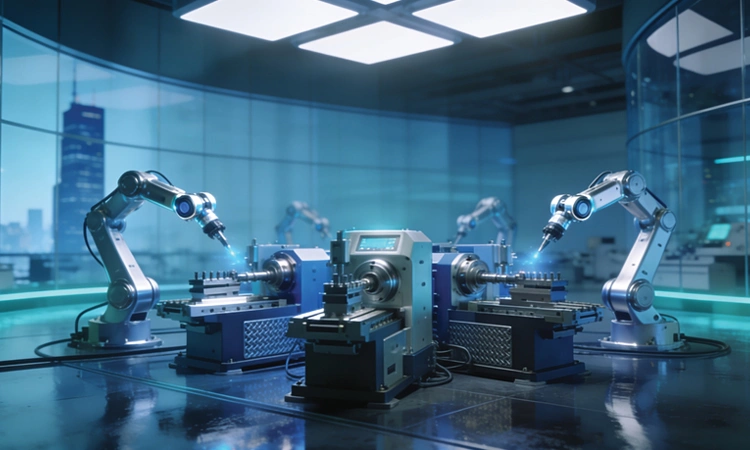
The machine tool industry is often referred to as the “mother industry” because it forms the foundation upon which every manufacturing sector is built. From automotive and aerospace to defence, electronics, medical devices, railways and renewable energy, the quality and productivity of manufacturing are directly linked to the capabilities of machine tools. As India aspires to become a global manufacturing hub under initiatives such as Make in India, Atmanirbhar Bharat, and the National Manufacturing Mission, the machine tool industry finds itself at a defining moment.
Over the last decade, Indian machine tool manufacturers have made remarkable progress in developing technologically advanced CNC machines, multi-axis machining centres, grinding machines, turning centres, automation solutions, and flexible manufacturing systems. Several companies have successfully reduced dependence on imported technologies while catering to demanding domestic and export markets.
However, despite these achievements, the industry continues to face significant challenges ranging from technological dependence and import competition to skill shortages and supply chain constraints. The coming years will determine whether India can transform from a major consumer of machine tools into a globally competitive manufacturing powerhouse.
A Growing Market with Immense Potential
India today ranks among the world’s fastest-growing manufacturing economies. Government emphasis on infrastructure development, defence indigenisation, semiconductor manufacturing, electric vehicles, renewable energy, railway modernisation, and aerospace has substantially increased demand for precision manufacturing equipment.
The emergence of new-age industries has also changed the expectations from machine tools. Manufacturers today seek:
- Higher productivity
- Multi-tasking capabilities
- Automation readiness
- Digital connectivity
- Energy efficiency
- Superior precision
- Predictive maintenance
Consequently, Indian machine tool builders have significantly upgraded their product offerings. Modern CNC machining centres now integrate robotics, automatic pallet changers, tool monitoring systems, IoT connectivity, AI-assisted diagnostics, and real-time production monitoring.
The increasing adoption of Industry 4.0 practices has further accelerated investments in intelligent manufacturing solutions.
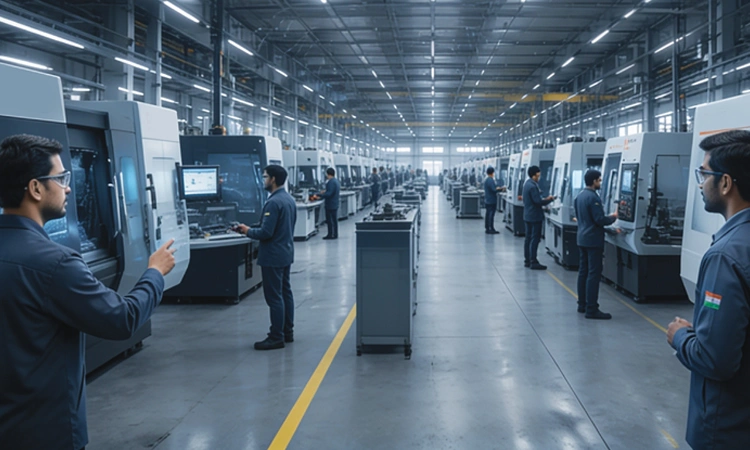
Government Policies Driving Growth
Several policy initiatives have created a favourable ecosystem for the machine tool industry.
The Production Linked Incentive (PLI) schemes have encouraged investments in sectors such as automobiles, electronics, white goods, telecom equipment, pharmaceuticals, and solar modules. All these sectors require advanced machine tools for precision manufacturing.
Similarly, defence procurement policies encouraging indigenous manufacturing have generated demand for sophisticated machining centres capable of producing complex components with micron-level accuracy.
The government’s focus on railways, metro projects, defence corridors, aerospace manufacturing, and indigenous semiconductor fabrication facilities has further widened the customer base for Indian machine tool manufacturers.
Additionally, MSME development programs, cluster-based manufacturing initiatives, and increasing public infrastructure investments continue to stimulate industrial growth.
Technology is Transforming the Industry
Today’s machine tools are no longer standalone pieces of equipment.
They have evolved into intelligent manufacturing systems capable of communicating with enterprise software, monitoring their own performance, and optimising production automatically.
Some of the major technological trends include:
- Multi-axis machining
Five-axis and even higher-axis machining centres are enabling manufacturers to produce complex parts with fewer setups, reducing production time while improving accuracy. - Automation Integration
Robots, pallet systems, automatic tool changers, and unmanned machining cells are increasingly becoming standard features, especially in high-volume production. - Digital Twins
Virtual simulation allows manufacturers to optimise machining strategies before actual production, reducing errors and improving efficiency. - Artificial Intelligence
AI-based systems help optimise cutting parameters, predict tool wear, schedule maintenance, and improve machine utilisation. - Industrial Internet of Things (IIoT)
Connected machines provide real-time production data, enabling predictive maintenance, remote diagnostics, and improved asset management.
Indian manufacturers have rapidly embraced many of these technologies, narrowing the gap with global competitors.
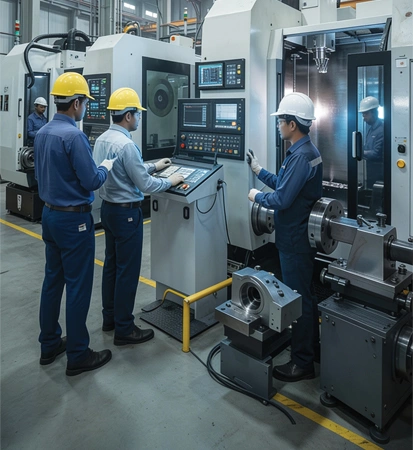
Emerging Sectors Creating New Demand
Several sunrise sectors are expected to fuel long-term growth.
- Electric Vehicles
The EV ecosystem demands precision machining of battery housings, motor components, transmission systems, and lightweight structural parts. - Aerospace
India’s growing aerospace ecosystem requires ultra-precision machining of titanium, nickel alloys, composites, and complex structural components. - Defence Manufacturing
Indigenisation of defence equipment presents enormous opportunities for advanced machining centres capable of handling difficult-to-machine materials. - Medical Devices
The growing medical device industry requires micron-level precision for implants, surgical instruments, and diagnostic equipment. - Semiconductor Manufacturing
As semiconductor fabrication gains momentum, demand will rise for ultra-high precision machining, cleanroom-compatible equipment, and specialised tooling. - Import Dependence Remains a Major Concern
Despite significant progress, India continues to import a substantial portion of its high-end machine tools.
Sophisticated five-axis machining centres, ultra-precision grinding machines, gear manufacturing systems, high-speed machining centres, and specialised aerospace machining equipment are still largely sourced from countries such as Japan, Germany, Switzerland, Italy, South Korea, and Taiwan.
This dependence increases costs while exposing Indian manufacturers to exchange rate fluctuations and geopolitical uncertainties.
Bridging this technological gap requires sustained investments in research and development, indigenous design capabilities, and advanced manufacturing technologies.
Technology Development Demands Higher Investment
Machine tool manufacturing is highly capital-intensive.
Developing next-generation CNC machines involves investments in:
- Precision engineering
- Mechatronics
- Control systems
- Software development
- Testing infrastructure
- Automation technologies
- Artificial intelligence
- Materials engineering
While larger companies continue to invest in innovation, many small and medium manufacturers struggle with limited financial resources.
Collaborative R&D involving industry, academia, research institutions, and government support can significantly accelerate indigenous technology development.
Competition from Low-Cost Imports
Indian manufacturers face intense competition from imported machine tools, particularly low-cost products entering from various Asian markets.
Although imported machines may appear economically attractive during initial purchase, long-term considerations such as service support, spare availability, machine uptime, and lifecycle costs often favour domestic manufacturers.
Indian companies have responded by improving product quality, enhancing after-sales service, and offering customised solutions tailored to customer requirements.
However, maintaining competitiveness while investing in advanced technology remains a delicate balancing act.
Skill Development: An Urgent Priority
Modern machine tools demand highly skilled manpower.
Today’s manufacturing workforce must possess expertise in:
- CNC programming
- CAD/CAM software
- Robotics
- Automation
- Servo systems
- Mechatronics
- Industrial networking
- Data analytics
Unfortunately, the availability of adequately trained personnel has not kept pace with technological advancements.
Educational institutions, technical universities, Industrial Training Institutes (ITIs), and industry associations have begun introducing specialised programs aligned with Industry 4.0 requirements. Greater collaboration between industry and academia will be crucial in bridging the skills gap and ensuring a future-ready workforce.
Export Opportunities are Expanding
Indian machine tool manufacturers have steadily increased their global presence.
Machines manufactured in India are now exported to markets across Southeast Asia, the Middle East, Africa, Europe, and North America.
India enjoys several competitive advantages:
- Competitive manufacturing costs
- Strong engineering talent
- Flexible customisation
- English-speaking technical workforce
- Growing design capabilities
- Improving quality standards
As global manufacturers seek supply chain diversification beyond traditional manufacturing hubs, Indian companies have an opportunity to emerge as reliable global suppliers.
To fully capitalise on these opportunities, Indian manufacturers must continue improving quality, precision, delivery timelines, and international certifications.
Sustainability is Becoming a Competitive Advantage
Environmental considerations are increasingly influencing purchasing decisions.
Customers now evaluate machine tools not only on productivity but also on:
- Energy consumption
- Carbon footprint
- Coolant management
- Lubrication efficiency
- Material utilisation
- Recyclability
Machine builders are responding by designing energy-efficient spindle drives, regenerative braking systems, eco-friendly coolant solutions, and intelligent power management systems.
Sustainability is no longer merely a regulatory requirement; it has become an important differentiator in global markets.
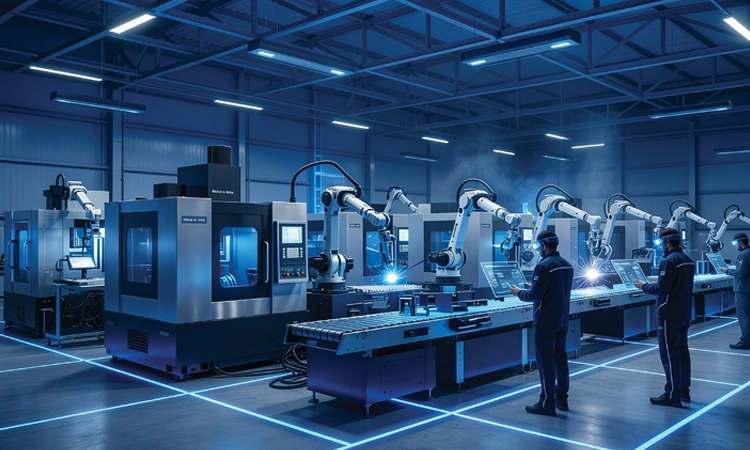
Collaboration Will Drive Future Growth
The future competitiveness of the Indian machine tool industry will depend on stronger collaboration across the manufacturing ecosystem.
Industry associations, government agencies, research laboratories, universities, software developers, automation companies, component suppliers, and end-user industries must work together to accelerate innovation.
Joint development programs, technology incubation centres, shared testing facilities, and public-private partnerships can help reduce development costs while enhancing indigenous capabilities.
Collaborative innovation will also enable smaller manufacturers to access advanced technologies that might otherwise remain beyond their reach.
As manufacturing becomes the cornerstone of India’s economic ambitions, the machine tool industry will remain its indispensable enabler-powering productivity, fostering innovation, and shaping the nation’s journey towards becoming a leading industrial economy.
The Road Ahead
The Indian machine tool industry stands at the threshold of a transformative era. The convergence of favourable government policies, rapid industrialisation, digital manufacturing, automation, and the emergence of high-value sectors presents unprecedented opportunities for growth. At the same time, challenges such as technological self-reliance, global competition, skilled manpower shortages, and sustained investment in research and innovation demand strategic attention.
Encouragingly, Indian machine tool manufacturers have already demonstrated their ability to innovate, adapt, and compete. Increasingly sophisticated CNC systems, automation-ready solutions, and smart manufacturing technologies developed within the country are testament to the industry’s growing maturity.
If supported by continuous investment in advanced technologies, robust skill development, collaborative R&D, and a conducive policy framework, the Indian machine tool industry is well positioned to move beyond import substitution and establish itself as a globally recognised supplier of high-performance manufacturing solutions.
As manufacturing becomes the cornerstone of India’s economic ambitions, the machine tool industry will remain its indispensable enabler-powering productivity, fostering innovation, and shaping the nation’s journey towards becoming a leading industrial
economy.
P.K. Balasubramanian