

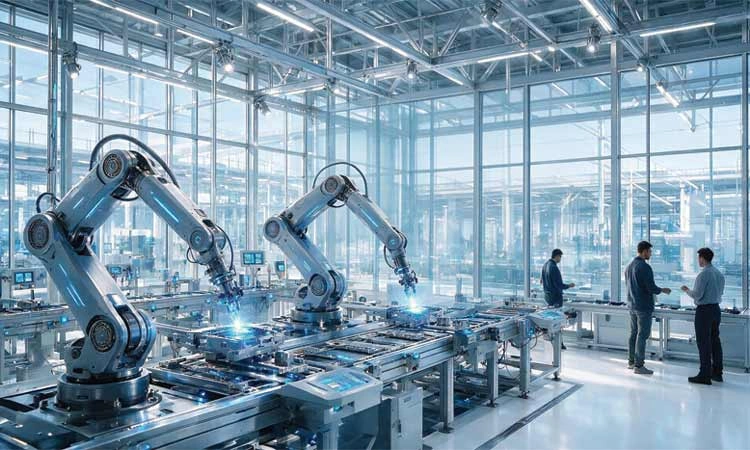
Automation has long been associated with industrial robots performing repetitive tasks such as welding, painting, assembly, and material handling. While robotics continues to play a pivotal role in manufacturing, the modern factory is evolving into a far more intelligent ecosystem. Today, automation extends well beyond robots, encompassing connected machines, intelligent software, advanced sensors, artificial intelligence (AI), autonomous decision-making, and digital twins. Collectively, these technologies are transforming factories into adaptive, data-driven production environments capable of responding to changing demands with unprecedented speed and precision. The future of manufacturing is therefore not just robotic-it is intelligent, connected, and autonomous.
Beyond Mechanical Automation
Traditional automation focused primarily on replacing manual labour with machines that executed predefined tasks. Modern automation, however, is centred on information, connectivity, and intelligence. Every machine, sensor, controller, and software platform contributes valuable data that enables manufacturers to monitor operations in real time, predict failures, optimize processes, and continuously improve productivity.
This shift marks the transition from isolated automated equipment to fully integrated manufacturing systems.
AI Drives Intelligent Decision-Making
Artificial Intelligence has become the brain of next-generation automation. AI algorithms analyse massive volumes of production data to identify trends, detect abnormalities, and recommend corrective actions before problems escalate.
Instead of merely executing commands, AI-enabled systems can adjust machining parameters, optimize production schedules, predict maintenance requirements, and improve product quality automatically. Machine learning models become increasingly accurate as they process more operational data, allowing factories to continuously enhance efficiency.
For manufacturers facing skilled labour shortages and increasing product complexity, AI provides a valuable decision-support system that complements human expertise.
Digital Twins Create Virtual Factories
One of the most significant developments beyond robotics is the adoption of digital twins. A digital twin is a virtual replica of a machine, production line, or entire factory that mirrors real-time operating conditions.
By simulating production scenarios before implementing physical changes, manufacturers can optimize workflows, identify bottlenecks, reduce commissioning time, and minimize costly errors.
Digital twins also assist predictive maintenance by simulating equipment behaviour under various operating conditions, allowing maintenance teams to intervene before breakdowns occur.
Industrial Internet of Things (IIoT)
The Industrial Internet of Things has become the backbone of intelligent automation. Thousands of connected sensors continuously monitor vibration, temperature, pressure, power consumption, tool wear, machine health, and product quality.
The collected information is transmitted through industrial networks to centralized dashboards where engineers can monitor production remotely.
Real-time visibility enables faster decision-making, improved Overall Equipment Effectiveness (OEE), reduced downtime, and better utilization of production assets.
Autonomous Material Flow
Automation today extends far beyond robotic arms. Autonomous Mobile Robots (AMRs), Automated Guided Vehicles (AGVs), smart conveyors, and intelligent warehouse systems now manage material movement across factories with minimal human intervention.
Unlike conventional AGVs that follow fixed routes, modern AMRs use sensors, cameras, LiDAR, and AI-based navigation to move safely around workers while dynamically selecting the most efficient paths.
This level of flexibility significantly improves logistics efficiency in high-mix, low-volume manufacturing environments.
Smart Vision Systems
Machine vision has evolved into an intelligent inspection technology capable of detecting microscopic defects with remarkable speed and consistency.
Powered by deep learning algorithms, modern vision systems inspect complex surfaces, verify assembly operations, identify missing components, read barcodes, and perform dimensional measurements with exceptional accuracy.
Unlike traditional rule-based inspection systems, AI-powered vision continuously learns from production data, improving inspection reliability over time.
Predictive Maintenance
Maintenance strategies have shifted from reactive repairs to predictive intelligence.
Advanced sensors continuously monitor equipment health by analysing vibration, acoustic signals, lubrication quality, spindle behaviour, motor temperatures, and electrical parameters.
AI algorithms interpret these signals to predict component failures well before production is affected.
Predictive maintenance minimizes unexpected downtime, extends equipment life, reduces spare-part inventories, and lowers maintenance costs.
Collaborative Human-Machine Operations
Automation beyond robotics emphasizes collaboration rather than replacement.
Collaborative robots (cobots), augmented reality (AR), wearable devices, and intelligent operator assistance systems support workers in performing complex manufacturing tasks safely and efficiently.
AR-based maintenance instructions, digital work instructions, and AI-powered guidance systems help reduce training time while improving process consistency.
Human expertise remains indispensable, but workers are increasingly empowered by intelligent digital tools.
Edge Computing Accelerates Automation
Modern factories generate enormous volumes of data that cannot always be transmitted to cloud servers due to latency concerns.
Edge computing addresses this challenge by processing data directly at the machine or production line.
Immediate analysis allows instant process adjustments, faster machine responses, improved cybersecurity, and reduced network congestion.
This decentralized computing approach is becoming essential for real-time industrial automation.
Cloud Manufacturing and Remote Operations
Cloud platforms enable centralized monitoring of geographically distributed manufacturing facilities.
Production managers can access machine performance, energy consumption, production schedules, quality metrics, and maintenance status from virtually anywhere.
Cloud connectivity also facilitates software updates, predictive analytics, remote diagnostics, and collaboration between suppliers, manufacturers, and customers.
Such capabilities proved especially valuable during recent global supply chain disruptions, highlighting the importance of remote manufacturing management.
Automation Enhances Sustainability
Beyond improving productivity, intelligent automation contributes significantly to environmental sustainability.
Smart energy management systems optimize electricity consumption by monitoring machine loads and automatically reducing unnecessary power usage.
AI algorithms minimize material waste through optimized cutting strategies, improved process control, and better quality management.
Digital production planning also reduces inventory, transportation requirements, and carbon emissions across manufacturing operations.
Sustainability has become an integral objective of modern automation strategies.
Conclusion
Automation is no longer defined solely by industrial robots performing repetitive tasks. It now represents an intelligent network of connected machines, AI-driven analytics, digital twins, predictive maintenance, autonomous logistics, cloud computing, and human-machine collaboration. These technologies are reshaping manufacturing into a responsive, self-optimizing ecosystem capable of delivering higher productivity, superior quality, and sustainable operations. Automation beyond robotics is no longer a vision-it is rapidly becoming the new foundation of global manufacturing excellence.