

From science fiction fantasies to everyday industrial reality, lasers have come a long way. Once considered exotic and confined to research labs, laser technology has now permeated almost every major industry, revolutionizing the way materials are processed, marked, and joined. Whether it’s the high-speed cutting of metals, precision welding in automotive manufacturing, or permanent marking of components, lasers offer unmatched accuracy, control, & versatility.
As industries push the boundaries of performance, aesthetics, traceability, and miniaturization, lasers continue to emerge as a key enabling technology. Their contactless, non-wearing nature, coupled with adaptability to automation, makes them indispensable in modern manufacturing environments.
The Science Behind Lasers
The word LASER is an acronym for Light Amplification by Stimulated Emission of Radiation. A laser emits a beam of light that is highly coherent, monochromatic, and collimated, making it fundamentally different from ordinary light sources. These properties enable the laser to concentrate energy on a very small area, producing extremely high power densities suitable for cutting, welding, and surface modifications.
Depending on the application, different types of lasers are used—CO₂ lasers, fiber lasers, diode lasers, and Nd:YAG (neodymium-doped yttrium aluminum garnet) lasers, among others. Each type varies in wavelength, efficiency, power, and material compatibility.
Laser Cutting: Precision and Speed Redefined
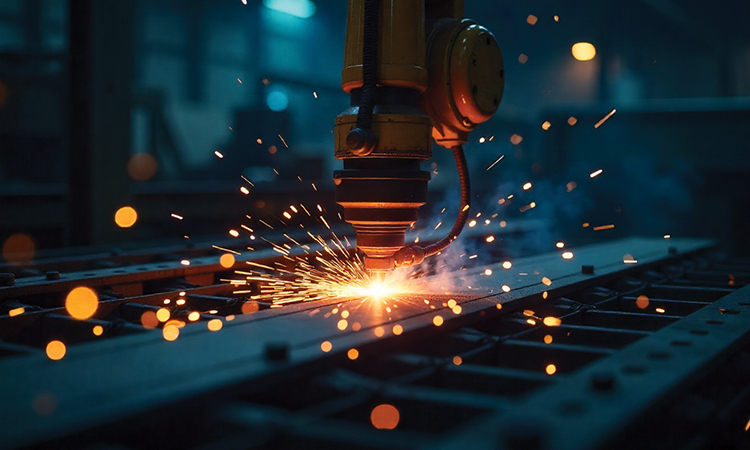
One of the most widespread industrial applications of lasers is laser cutting. It involves directing a high-powered laser beam onto a material, which heats, melts, or vaporizes it, while a jet of gas blows away the molten material, creating a clean cut.
Laser cutting offers several advantages over traditional methods such as plasma cutting, waterjet cutting, or mechanical sawing. These include:
• High precision and minimal kerf width
• Non-contact processing with minimal mechanical stress
• Capability to cut complex geometries
• Reduced need for post-processing or finishing
Minimal material waste
Fiber lasers are particularly popular for cutting metals such as steel, stainless steel, aluminum, copper, and brass. Their short wavelength allows for better absorption in metallic materials, enabling faster cutting speeds and lower operating costs. CO₂ lasers, on the other hand, are more suited for cutting non-metals like wood, plastics, fabrics, glass, and paper.
The automotive, aerospace, electronics, and construction industries rely heavily on laser cutting for manufacturing structural components, intricate assemblies, and aesthetic parts.
Laser Welding: Joining with Integrity
Laser welding is another area where lasers outperform conventional techniques. In this process, a high-intensity laser beam is focused onto a joint, melting the material at the interface and fusing it upon solidification. Depending on the material and application, laser welding can be done with or without filler material.
The key advantages of laser welding include:
• Deep penetration with narrow weld seams
• High-speed processing
• Minimal thermal distortion due to localized heating
• Capability to weld difficult-to-access areas
• Suitable for dissimilar metals and thin sheets
Fiber lasers and Nd:YAG lasers are commonly used for welding metals, including steels, aluminum alloys, titanium, and nickel-based alloys. In automotive manufacturing, laser welding is used extensively for body-in-white assemblies, gear components, and battery modules for electric vehicles. Medical device manufacturers leverage laser welding for joining small, intricate parts without affecting the surrounding material. Laser welding is also making inroads into micro-welding applications for electronics and watchmaking, where precision and aesthetics are critical.
Laser Marking and Engraving: Permanent and Precise
Laser marking involves using a focused laser beam to alter the surface of a material, resulting in a visible mark such as a logo, barcode, serial number, or design. It encompasses a range of techniques, including:
• Laser engraving: Material is vaporized to create deep marks.
• Laser etching: Surface is melted slightly to create shallow marks.
• Annealing: Heat is applied to induce a color change, often in metals.
• Foaming: Used on plastics to raise material for contrast.
Unlike inkjet printing or mechanical engraving, laser marking is permanent, tamper-proof, and eco-friendly. It requires no consumables, works on a wide variety of materials, and integrates easily with production lines.
Laser marking is widely used in:
• Electronics: For marking components with part numbers and QR codes.
• Medical devices: For traceability and regulatory compliance.
• Automotive: For marking VIN numbers and logos.
• Consumer goods: For personalization and branding.
• Packaging: For batch coding and expiry dates.
Fiber lasers dominate this space due to their high beam quality and long operational life. They are efficient for marking metals and some plastics. UV lasers are also used for delicate materials such as glass and ceramics where heat damage must be minimized.
Other Industrial Applications of Lasers
Beyond cutting, welding, and marking, lasers are used in a host of other industrial processes that benefit from their unique properties:
• Laser Cladding: A process where a laser is used to melt and deposit a layer of material on a substrate to improve wear resistance or repair damaged parts.
• Laser Cladding: A process where a laser is used to melt and deposit a layer of material on a substrate to improve wear resistance or repair damaged parts.
• Laser Drilling: Creating micro- or macro-holes with extreme precision in metals, ceramics, and polymers—vital in aerospace, turbine, and medical sectors.
• Additive Manufacturing (Laser Sintering): Lasers are a central component of 3D metal printing technologies such as Selective Laser Sintering (SLS) and Direct Metal Laser Sintering (DMLS).
• Surface Cleaning: Laser ablation is used to clean rust, paint, or contaminants from surfaces without chemicals or abrasives—ideal for restoration, heritage conservation, and maintenance.
The Road Ahead: Smart, Compact, and Sustainable
As laser technology matures, it continues to evolve in exciting directions. Compact fiber laser systems are becoming more affordable, increasing accessibility. Green lasers and ultrashort pulse lasers (femtosecond and picosecond) are enabling processing of sensitive materials with negligible heat impact. Lasers integrated with AI and machine vision are enhancing process reliability and precision. Real-time feedback systems are helping manufacturers achieve zero-defect goals in high-stakes industries like aerospace and medical devices. In the context of sustainable manufacturing, lasers contribute to cleaner, waste-free, and energy-efficient processes. Their ability to eliminate chemicals, reduce rework, and minimize raw material usage aligns well with global environmental goals.
Conclusion
The journey of lasers from laboratory curiosities to industrial powerhouses is a testament to their transformative potential. Whether it’s slicing through sheet metal with micron-level precision, joining critical components in milliseconds, or etching permanent marks that never fade, laser technology stands at the forefront of modern manufacturing. As innovation continues and adoption broadens, lasers are poised to become even more ubiquitous, empowering industries with speed, precision, and intelligence. For manufacturers aiming to stay ahead in a world of high expectations and rapid change, embracing laser-based processes is not just an option—it is a strategic imperative.