


Stainless steel is a vitally important material for many industries around the world. Even though it was created more than 100 years ago, use of the material has increased significantly since the turn of the 21st century.
Ricky Payling, application specialist at Dormer Pramet, outlines the growth of stainless steel, how the cutting tool industry has evolved to machine the material, as well as providing a summary of some of its most common grades.
According to the International Stainless Steel Forum (ISSF) the global demand for stainless steel products has nearly doubled in the last 20 years, and continues to grow five per cent each year.
In 2014, almost 42 million metric tons of stainless steel was produced worldwide – a 70 per cent increase from 2005 (24 million metric tons). This growth is predominantly achieved by an increase in China, where production has grown from a 13 per cent share of global output in 2005 to more than 52 per cent in 2014.
This rapid development is not only to meet worldwide demand, but also to support increased use within China, where stainless steel is consumed in household metal products, building materials and machinery.
Stainless steels’ anti-corrosive qualities make it perfect for use in a huge range of environments and components, such as aerospace, general engineering, consumer, oil and gas, medical and marine industries.
Its versatility is reflected by the fact that there are more than 150 different grades. Common stainless steels include ferritic, martensitic, austenitic, super-austenitic and duplex. More details of which are covered below.
The main alloying element is Chromium, which forms an ultra-thin oxide film on the surface. As a general rule, resistance to corrosion and oxidation increases in line with Chromium content. Other alloying elements, such as Nickel and Molybdenum, can be added to change the structure, increase corrosion resistance and improve strength.
This increase in production and consumption has coincided with advancements and new developments within the cutting tool industry. Due to the difficult process of machining stainless steel, manufacturers have invested a huge amount of time and resources in finding new ways to try to combat the numerous application challenges.
Recent introductions include changes to the cutting tool design, new geometries, improved coolant and developing stronger coatings to improve performance and tool life.
Drills with thin margins for example, reduces the contact with the hole surface, minimising friction between the cylindrical land and the hole walls, decreasing work hardening and temperatures generated.
Positive point geometries ensure excellent chip breaking and evacuation, while a specially designed web combines the benefits of maximum rigidity with space for efficient chip removal, reducing machine downtime.
Coatings and coolant
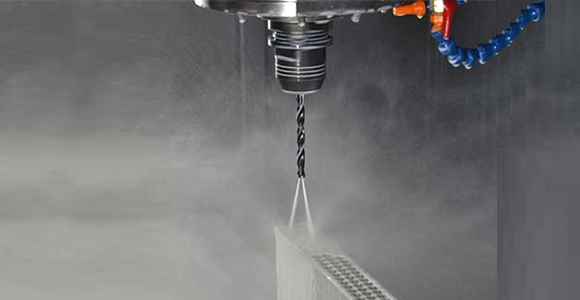
Significant heat is generated during machining of stainless steel, resulting in plastic deformation and severe crater wear. Therefore, a generous flow of cutting fluid removes heat from the cutting edge, helps chip breaking and improves dimensional stability of the component.
When using flood coolant, it is important to ensure a plentiful supply as any period of coolant starvation can cause temperature fluctuations. This can cause thermal cracking, resulting in reduced tool life. Cutting tools with through coolant also provide an instant reduction in temperature and supports chip evacuation.
Meanwhile, a Titanium Aluminium Nitride (TiAlN) coating is ideally suited for machining stainless steel as it holds its hardness at higher temperatures due to a layer of aluminium oxide, helping to transfer the heat away from the cutting tool.
The high strength of stainless steels combined with their high ductility makes chip breaking more difficult. This increases the risk of vibration, which can affect surface finish quality and reduce the service life of the tool or insert.
To address this, always make sure tooling and work pieces are stable and well clamped. Always keep tool overhang to a minimum, especially when drilling or internal turning. To help reduce vibration, use sharp tools or inserts with a small nose or corner radius.
Ferritic & Martensitic
The machinability of ferritic and martensitic stainless steels shows a resemblance to that of ISO P: Steel. Normal chromium content is 12-18 per cent, with only small additions of other alloying elements.
Ferritic materials are used in shafts for pumps, steam and water turbines, nuts, bolts, hot water heaters, and in the pulp and food processing industries. Martensitic steels can be hardened and are, as a result, used for edges in cutlery steel, razor blades and surgical instruments.
Machinability of ferritic and matensitic stainless steels is good and very similar to low alloyed steels.
Austenitic & Super-Austenitic
Austenitic stainless steels are the most commonly used ISO M material, accounting for 70 per cent of all stainless steel machined. This is due primarily to their very good resistance to corrosion.
The most common composition is 18 per cent chromium and 8 per cent nickel. Steel with greater corrosion resistance is created by adding two to three per cent molybdenum, often called “acid-proof steel” or type 316. Super-austenitic stainless steels have a nickel content of more than 20 per cent.
Austenitic and super-austenitic stainless steels are used where good resistance against corrosion is required. Typical industry sectors include the chemical, pulp and food processing industries. It is also used in aircraft exhaust manifolds.
Austenite stainless steel produces tough, long, continuous chips that are difficult to break. It is prone to work hardening during machining, producing hard surfaces and chips which lead to notch wear. It also creates adhesion and produces built-up edge, resulting in poor surface finish and reducing tool life.
To minimize this, avoid using tools with worn edges which could accelerate tool wear and cause breakage. Make regular checks for signs of wear and change tools or inserts regularly. Also, try to avoid any dwells or pauses in the cutting process as this will cause heat build-up and increase work hardening.
A high rake angle reduces heat generated during milling, minimising work hardening.
Duplex
Adding nickel to a ferritic chromium based steel will form a mixed base structure containing both ferrite and austenite. This is known as a duplex stainless steel.
Duplex materials have a high tensile strength and maintain very high corrosion resistance. Super-duplex and hyper-duplex indicate higher content of alloying elements and even higher corrosion resistance.
Chromium content between 18-24 per cent and nickel content between 4-7 per cent are common in duplex steels, producing a ferritic share of 25-80 per cent.
Duplex stainless steels are used in the chemical, food, construction, medical, cellulose and paper making industries, and in processes that include acids or chlorine. They are often used in equipment related to off-shore oil and gas applications.
Machinability of Duplex is generally poor due to high yield point and high tensile strength. Higher content of ferrite – above 60 per cent – improves machinability.
Dormer Pramet has developed a comprehensive assortment of indexable and rotary cutting tools to support machining of stainless steel.
Its solid carbide drill for applications up to 8xD has been specifically developed to overcome problems typically associated with deep-hole drilling of stainless steel. Created within the Dormer product portfolio, the R459 broadens the existing MP-X range which already consists of 3xD and 5xD solid carbide multi-material drills.
Meanwhile, a versatile range of OEHT octagonal inserts for cutting depths 4 – 10 mm, alongside REHT (round) and XEHT (wiper) inserts, is suitable for stainless steel.
By utilising eight cutting edges – the highest number available for positive inserts – the new range provides an economical offer for customers, while the wiper insert option boosts feed rate capabilities and surface finish quality.
For more information visit www.dormerpramet.comor contact your local Dormer Pramet sales office.