


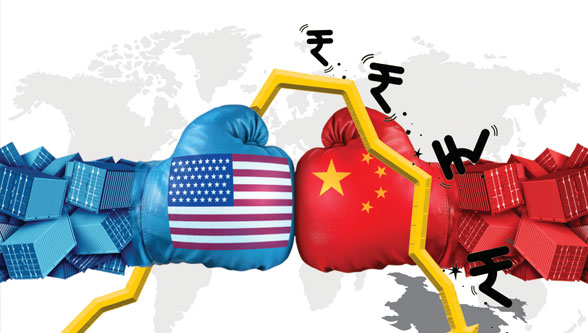
The Sino-US trade war, an indecisive Brexit and abject mismanagement have spelt doom for the Indian economy in the ongoing year. Despite fudging data, suppressing reports and wholesale denial things continue to spiral downwards. The government has, so far, come up with knee-jerk reactions and ad hoc measures which have made matters worse. In this two-part article we look at the first two quarters of FY2019-20
This year has not been a favourable one for the Indian economy. It has still not recovered either from the rude jolt of demonetisation unleashed in November 2016 or the chaotic implementation of the Goods and Services Tax (GST). On top of that the Sino-US trade war and the uncertain Brexit have not really helped India’s cause though India assumed that they would.
For the last four years, India has battled the suspicion that its new and ‘improved’ GDP series is a rose-tinted view of reality. Earlier this used to be the case with China but of late, it has also become a sad truth of India. Now that Narendra Modi is Prime Minister for a second term, he must see that battle for what it is: a lost cause. A top former government adviser, Arvind Subramanian, provided a statistical estimate which points out that the numbers put forward by the government are cooked up.
Unlike harmless advertising puffery around a toothpaste that kills 99.9 per cent of germs, the narrative of seven per cent growth has not done the national reputation any good.
Against a grim backdrop, including intensified US-China trade and technology conflict as well as the prolonged uncertainty around Brexit, momentum in global financial activity remained slow in the first half of 2019. Although there were positive signs of growth in advanced economies, weaker-than-expected activity in emerging market and developing economies were more than evident.
Growth was better than expected in the United States and Japan, and one-off factors that had hurt growth in the euro geography in 2018 (notably, adjustments to new auto emissions standards) appeared to recede as anticipated.
However, among emerging market and developing economies, first quarter GDP in China was stronger than forecast, but second quarter indicators suggest a weakening of activity. Elsewhere in emerging Asia, as well as in Latin America, growth has been disappointing.
- Global growth has continued to remain subdued. After the release of the World Economic Outlook (WEO) report in April, the United States further increased tariffs on certain Chinese imports and China retaliated by raising tariffs on a subset of US imports. However, additional escalation was averted following the G20 summit in June.
- Keeping this in view, global GDP growth is forecast at 3.2 per cent in 2019, picking up to 3.5 per cent in 2020 (0.1 percentage point lower than in the April WEO projections for both years). GDP reports so far this year, together with generally softening inflation, point to weaker-than-anticipated global activity. Investment and demand for consumer durables have been subdued across advanced and emerging market economies as firms and households continue to hold back on long-range spending. Accordingly, global trade, which is intensive in machinery and consumer durables, demand remains sluggish. The projected growth pickup in 2020 is precarious, presuming stabilisation in currently stressed emerging market and developing economies and progress toward resolving trade policy differences.
- Risks to the forecast are mainly to the downside. They include further trade and technology tensions that dent sentiment and slow investment; a protracted increase in risk aversion that exposes the financial vulnerabilities continuing to accumulate after years of low interest rates; and mounting disinflationary pressures that increase debt service difficulties, constrain monetary policy space to counter downturns, and make adverse shocks more persistent than normal.
Indian Economy Data
Source: Focus Economics
In Q2 FY 2019, i.e. from July to September, the Indian economy grew by 4.6 per cent compared to the same period a year ago, down from Q1’s five per cent expansion and a whisker below market analysts’ expectations of 4.7 per cent growth. It was also the sixth consecutive decline in economic growth and the weakest reading since Q4 FY 2012.
Fixed investment growth sunk to one per cent in Q2 (Q1: +4.0%), marking the weakest growth since Q3 FY 2014. Experts attributed this slowdown to weaker bank lending growth, which moderated to a nearly three-year low, despite five consecutive interest cuts by the Reserve Bank of India. In contrast, private consumption growth accelerated to 5.1 per cent (Q1: +3.1%), despite falling consumer confidence, while government consumption growth surged to 15.6 per cent (Q1: +8.9%).
However, there is a lot of contradiction in the claim that private consumption grew during the first half of the current financial year. The Minister of State for Statistics, Programme Implementation and Planning Rao Inderjeet Singh tried to defend the government claim that there has been no decline in consumption by putting forth specious arguments like free education and Ayushmaan Bharat scheme. While various experts and institutions have pointed out that private consumption has declined the most in the last 48 years the government refused to accept the CSO report.
The GDP data released recently confirmed distress stories emanating from different sectors. The private final consumption expenditure (PFCE), which reflects demand in the economy, grew 3.14 per cent in the first quarter (Q1) of 2019-20 (FY20) — a 17-quarter low.
The PFCE grew by 7.2 per cent in the previous quarter (January to March or Q4 of 2018-19 or FY19). In the year-ago period, PFCE growth was 7.31 per cent.
“Collapse of private consumption demand growth from 10.6 per cent in Q4FY18 to 3.1 per cent in Q1FY20 is the real cause of concern,” said Devendra Pant, chief economist at India Ratings.
In August of the current year a Ficci survey pegged India’s GDP growth rate at 6.9 per cent for the entire year which seems rosy when looked at in the month of December. The same is the case with the central Bank. The RBI had forecast seven per cent growth in June but brought it down to five per cent by November-end. However, the Union Finance Minister has continued to come up with weird explanations to defend her government.
Article by – Arijit nag
Arijit Nag is a freelance journalist who writes on various aspects of the economy and current affairs.
Read more article of Arijit nag