

By Shubham B. Thakare
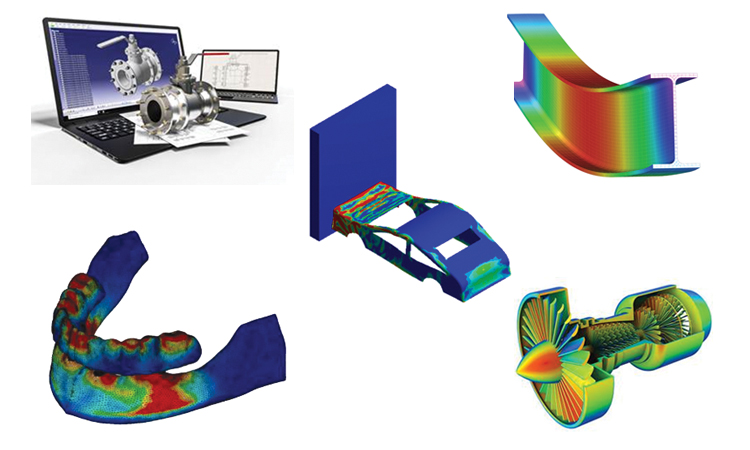
Engineers have seen major changes in how they design, test, and verify products. In the past, using physical models was common, but it took a lot of time and money. Now, Finite Element Analysis (FEA) helps engineers test designs by simulating real-world conditions on a computer. This method has transformed fields like aerospace and healthcare. From Physical Models to Digital Simulations Previously, engineers built many physical prototypes to validate designs, which was expensive and slow. For example, car companies had to destroy several cars for crash tests, aerospace parts faced lengthy testing due to complex flight conditions, and testing medical devices for safety was a long process. The FEA allows engineers to perform these tests digitally. It divides complex designs into smaller parts for thorough testing, reducing the need for physical prototypes and accelerating the time it takes to bring products to market, while fostering innovation.
The Evolution of Design Validation: From Prototypes to Simulations:
1. Building the Virtual Model:
Engineers import CAD designs into FEA software like ANSYS or SOLIDWORKS.
They create a mesh to achieve accurate results without overburdening computer resources.
Materials and conditions are assigned to the model.
2. Simulating Real-World Physics:
The software uses equations to predict outcomes such as stress and temperature changes.
High-performance computers handle complex scenarios.
3. Interpreting Results: Engineers review visuals like stress maps to guide improvements, such as strengthening a part or selecting different materials.
FEA in Practice in Real-World Applications
Case Study 1: Mechanical Design – Optimizing Industrial Beam Structures
Problem: A heavy machinery manufacturer needed to redesign an overhead crane’s support beam. The goal was to make the beam lighter while still being able to hold 50 tons. The traditional trial-and-error method led to making the beam stronger than needed and wasted materials.
Model Setup: Engineers used a program called SOLIDWORKS Simulation to create a digital model of the I-beam. They focused on making the mesh finer at the welding spots and on surfaces that bear loads.
Load Conditions: The design considered several types of forces: static loads (50 tons plus an extra amount as a safety factor), dynamic loads (caused by the crane lifting things), and wear from using the crane over and over.
Material Analysis: The team compared high-strength steel with aluminum composites to see which material offered a better balance of strength and weight.
Results: The analysis showed too much stress in the middle of the beam areas. By changing the shape of the beam’s cross-section using a method called topology optimization, they made the beam 22% lighter while keeping it safe. This redesign saved $18,000 in material costs per crane and removed the need for three rounds of creating physical test models.
Takeaway: Using FEA helped make data-driven improvements to an essential crane part. This optimization saved money and resources, aligning the design with important standards for industrial cranes set by ASME B30.
Case Study 1: Automobile Crash Testing
Companies like Tesla and Toyota use FEA to simulate crashes before the car’s physical creation.
It predicts how a car will deform and how airbags deploy.
It also assesses battery safety in electric vehicles, reducing physical crash tests and saving money.
Case Study 2: Designing Medical Implants
Hip implants need to distribute stress correctly.
Researchers use FEA to assess stress at the bone-implant interface and predict long-term fatigue.
This leads to better implants, decreasing the incidence of replacement surgeries by 30%.
Case Study 3: Validating Aircraft Parts
GE Aviation uses FEA to test jet engine components.
They simulate high-speed, high-temperature conditions to identify and fortify weak spots, and evaluate materials for improved fuel efficiency.
Benefits of FEA-Based Validation
Cost Savings: Virtual testing cuts 60–80% of the costs associated with physical prototypes. For instance, Ford reported an annual savings of $8 million by using simulations instead of wind tunnel tests.
Faster Development: Designing iterations that used to take weeks now take just hours. SpaceX, for example, utilizes FEA to quickly refine rocket engines.
Promote Innovation: Engineers can experiment with new materials and daring designs that were previously unfeasible.
Risk Mitigation: FEA helps uncover potential issues early and ensure compliance with industry standards.
Challenges and Limitations
Although invaluable, FEA does have its limitations:
Data Accuracy Issues: Incorrect input data results in inaccurate outcomes.
Mesh Complications: A mesh that’s too simple or too complex can lead to problems.
High Computational Demand: Large simulations need powerful computing infrastructure.
Need for Skilled Interpretation: Misunderstanding FEA results can lead to flawed design choices.
The Future of FEA:
AI, Cloud, and Making It Accessible Finite Element Analysis, or FEA, is undergoing significant changes due to new developments:
AI-Driven Simulations: Artificial intelligence is making a big impact. Tools such as Ansys Discovery use AI to automate the meshing process and offer design improvement suggestions. This speeds up the design process and makes it more efficient.
Cloud-Based FEA: Cloud platforms like SimScale are changing the game. They let people access high-performance computing (HPC) on a pay-as-you-go basis. This means small companies and educational institutions can now afford to use FEA, which was difficult for them before.
Generative Design Integration: Autodesk Fusion 360 is combining FEA with smart design algorithms that automatically generate efficient and unique shapes. This approach helps engineers create innovative designs with optimized geometry.
Digital Twins: Digital twins are becoming more advanced with the help of FEA. Real-time data from FEA can be used with Internet of Things (IoT) technology for predictive maintenance, like in the Siemens MindSphere platform. This helps identify issues before they arise, ensuring smooth operation.
Conclusion
Changing the way we perform FEA has completely transformed how mechanical designs are validated. What was once a trial-and-error process is now guided by data and proactive strategies. By linking Computer-Aided Design (CAD) models with real-world physics, FEA empowers engineers to improve performance, safety, and sustainability. As technologies like AI, cloud computing, and Multiphysics simulations continue to evolve, FEA will democratize innovation further. This ensures that groundbreaking developments, such as Mars exploration vehicles and life-saving medical implants, begin their journey in digital labs instead of traditional workshops.
About the Author:
Shubham B. Thakare is a Product Manager based in the USA, holding a degree in Mechanical Engineering and 6+ years of experience in engineering and product development. Passionate about merging technical rigor with market-driven strategy, he excels at transforming complex concepts into scalable, user-focused products. His expertise spans cross-functional collaboration, prototyping, and steering products from ideation to successful launch.