

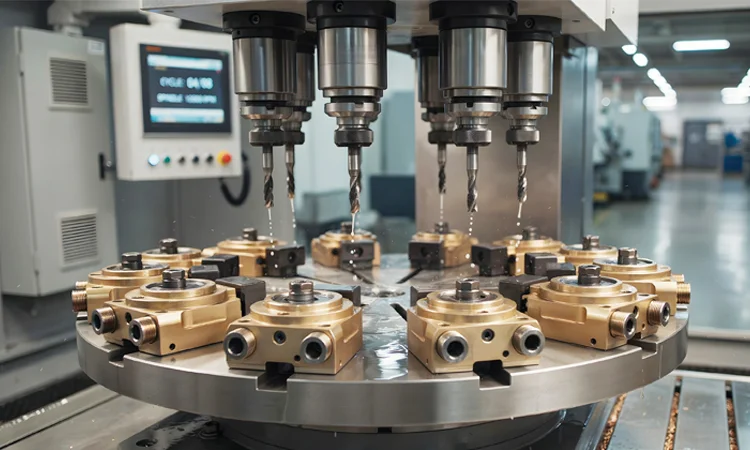
Multi-axis machining has evolved from being a specialised capability reserved for complex aerospace and mould-making applications into a strategic manufacturing technology for industries demanding extreme precision, shorter lead times and greater geometric freedom. As manufacturers move towards lighter components, tighter tolerances, difficult-to-machine materials and increasingly complex geometries, multi-axis machining is poised to become an even more important pillar of high-precision manufacturing.
Unlike conventional three-axis machining, which generally involves movement along the X, Y and Z axes, multi-axis machines add rotary and tilting axes to enable the cutting tool and workpiece to be oriented simultaneously. Five-axis machining, for instance, can position the tool at virtually any angle relative to the workpiece, allowing intricate features to be machined in fewer setups. The result is greater accuracy, improved surface finish, reduced machining time and, importantly, fewer opportunities for cumulative errors.
From Complexity to Capability
One of the biggest drivers behind multi-axis machining is the growing complexity of components. Aerospace structures, turbine blades, impellers, medical implants, automotive powertrain components, dies and moulds increasingly feature curved surfaces, deep cavities and intricate contours that are difficult or impossible to produce efficiently using conventional machining.
Multi-axis machining enables these geometries to be produced in a single setup or with considerably fewer setups. This reduces workholding requirements and eliminates errors associated with repeatedly repositioning the component. For high-value components, where dimensional deviations can lead to expensive rejection, this capability is particularly significant.
The technology is also changing the economics of complex manufacturing. Instead of relying on several specialised machines and multiple operations, manufacturers can consolidate processes on a single advanced machining centre. This reduces floor-space requirements, work-in-progress inventory and material handling while improving overall machine utilisation.
Precision Will Become More Intelligent
The future of multi-axis machining will not be defined simply by adding more axes. The real transformation will come from combining machine kinematics with digital intelligence.
Modern machining centres are increasingly equipped with high-resolution encoders, thermal compensation, vibration monitoring and sophisticated CNC controls. These technologies enable machines to detect and compensate for deviations caused by thermal growth, machine dynamics and changing operating conditions.
Artificial intelligence and machine learning will further strengthen this capability. By analysing historical and real-time machining data, intelligent systems can identify patterns associated with tool wear, chatter, dimensional drift and process instability. The CNC system can then recommend or automatically implement corrective actions.
This evolution points towards a future in which machines do not merely execute programmed toolpaths but continuously optimise the machining process.
Digital Twins and Simulation
Digital twins will become increasingly important in multi-axis machining. Programming a complex five-axis toolpath is considerably more challenging than programming a conventional three-axis operation because the interaction between the tool, holder, workpiece and machine structure must be carefully controlled.
Advanced simulation software can replicate the complete machine environment before production begins. It can identify collisions, over-travel, tool-holder interference, excessive tool-axis movement and potential surface-quality problems.
The next generation of digital twins will go further by incorporating actual machine data. The virtual model can therefore reflect machine condition, thermal behaviour and process performance more accurately. Manufacturers will be able to optimise programmes virtually, reducing prove-out time and minimising costly machine downtime.
Automation Around the Machine
Multi-axis machining will increasingly operate as part of an automated manufacturing cell rather than as a standalone machine. Robotic loading and unloading, automatic tool measurement, in-process probing, pallet systems and automated inspection will create highly integrated production environments.
In high-volume and lights-out manufacturing, this integration will be particularly valuable. A machining centre can automatically load a new component, identify the appropriate programme, measure the workpiece, compensate for process variation, monitor tool condition and transfer the finished part for inspection.
Such automation will also help address the shortage of skilled machining personnel. While expertise will remain essential, operators will increasingly supervise connected machining cells rather than manually perform every individual setup and adjustment.
Tooling Will Become a Critical Enabler
The performance of a multi-axis machine depends heavily on tooling. As cutting tools approach complex surfaces from different orientations, tool rigidity, reach, runout and holder design become increasingly important.
Advanced carbide grades, coatings, high-performance geometries and specialised toolholders are enabling higher cutting speeds and longer tool life. Shrink-fit and hydraulic holders, balanced tooling and advanced toolholding systems will become increasingly important as spindle speeds rise.
At the same time, manufacturers will use shorter and more rigid tools wherever possible. This reduces deflection and vibration, enabling more aggressive cutting while maintaining dimensional accuracy and surface quality.
Machining Difficult Materials
The growing use of titanium alloys, nickel-based superalloys, hardened steels, composites and advanced aluminium alloys is another major driver for multi-axis machining.
These materials present challenges ranging from excessive cutting forces and heat generation to poor chip evacuation and accelerated tool wear. Multi-axis capability allows manufacturers to optimise tool orientation and cutting conditions, improving access and maintaining more favourable cutting engagement.
In aerospace manufacturing, for example, maintaining a controlled tool orientation can improve surface quality and tool life while reducing machining forces. Similar benefits are emerging in medical, energy and high-performance automotive applications.
Sustainability Will Influence the Future
Sustainability is becoming an increasingly important consideration in machining. Multi-axis technology can contribute by reducing the number of setups, shortening machining cycles and lowering material movement.
More efficient toolpaths can reduce unnecessary tool motion and cutting time, while improved tool life reduces consumption of cutting tools. Better process control can also minimise scrap and rework—two major sources of resource waste.
The future will therefore see energy monitoring integrated into machining systems, enabling manufacturers to evaluate energy consumption at machine, operation and component levels.
The Road Ahead
The next generation of multi-axis machining will increasingly combine five-axis kinematics, high-speed spindles, intelligent CNC controls, advanced tooling, robotics, in-process measurement, simulation and data analytics. The distinction between machining, inspection and process control will become increasingly blurred.
Hybrid manufacturing is another promising development. Machines combining additive and subtractive processes can deposit material where required and subsequently machine it to precise dimensions. This approach can reduce material waste and enable the production of geometries that would otherwise be extremely difficult to manufacture.
Ultimately, the future of multi-axis machining lies not simply in more axes but in greater intelligence, connectivity and autonomy. The machine tool of tomorrow will be expected to understand the component, optimise the machining strategy, monitor its own performance and respond to process variations in real time.
For high-precision manufacturers, this transformation represents a significant opportunity. As product complexity increases and tolerances become tighter, multi-axis machining will move from being an advanced manufacturing option to a fundamental capability—helping manufacturers achieve higher precision, greater productivity, reduced setup time and smarter, more sustainable production.