


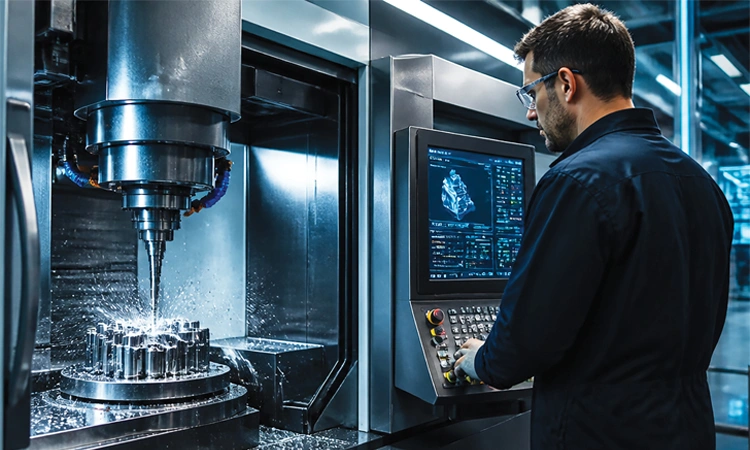
In today’s highly competitive manufacturing environment, machine downtime is far more than an operational inconvenience. An unexpected breakdown can disrupt production schedules, compromise delivery commitments, increase maintenance costs and, in extreme cases, damage a company’s reputation. As manufacturing systems become increasingly automated and interconnected, industries are therefore moving from traditional reactive maintenance towards more intelligent strategies. At the forefront of this transformation is predictive maintenance, which uses data, sensors and analytics to identify potential failures before they occur.
The fundamental objective is simple: maintain equipment when it actually needs attention, rather than waiting for it to fail or servicing it unnecessarily.
From Reactive to Predictive
Traditional maintenance practices have evolved through three broad stages. Reactive or breakdown maintenance involves repairing equipment only after a failure has occurred. While this approach may appear economical for non-critical equipment, it can result in costly unplanned downtime.
Preventive maintenance introduced scheduled servicing based on time or usage. Components are replaced or machines inspected at predetermined intervals, irrespective of their actual condition. This reduces unexpected failures but can lead to premature replacement of perfectly serviceable components.
Predictive maintenance takes the next step by monitoring the actual condition of machinery. Instead of asking, “When should this machine be serviced?”, it asks, “What is the condition of this machine, and when is intervention likely to become necessary?”
This distinction can have a significant impact on plant productivity.
Listening to the Machine
Modern industrial equipment generates enormous quantities of operational data. Sensors can continuously monitor parameters such as vibration, temperature, pressure, torque, current, speed, lubrication condition and acoustic emissions.
Changes in these parameters can provide early indications of developing problems. For example, abnormal vibration in a rotating machine may indicate bearing wear, shaft misalignment, imbalance or looseness. An increase in motor temperature could point towards excessive loading, inadequate cooling or insulation problems. Changes in electrical current may reveal mechanical overload or deterioration in motor components.
The challenge is not simply collecting this data but interpreting it intelligently.
Connected sensors, industrial networks, edge computing and cloud platforms are making it possible to convert raw machine data into actionable maintenance information. Advanced analytics and artificial intelligence can identify deviations from normal operating patterns and alert maintenance personnel before a minor anomaly develops into a major failure.
Sensors: The Foundation
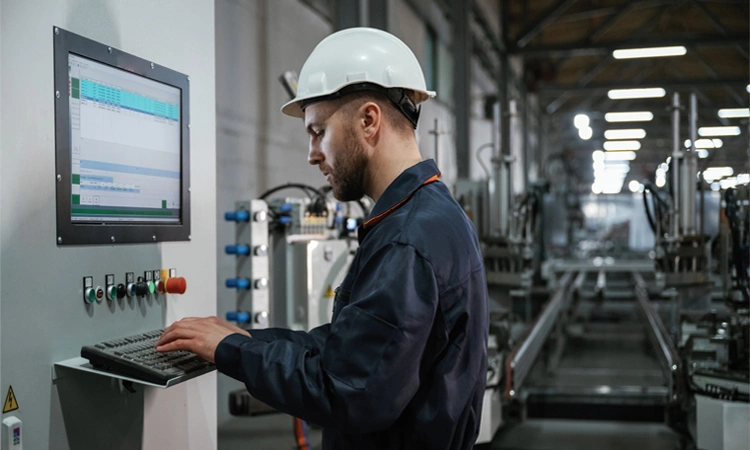
Sensors form the foundation of most predictive maintenance systems. Depending on the machine and application, different sensing technologies can be deployed.
Vibration monitoring is particularly important for rotating equipment such as motors, pumps, compressors, gearboxes, spindles and turbines. Temperature sensors can monitor bearings, motors, electrical panels and hydraulic systems. Pressure and flow sensors are useful in hydraulic and pneumatic equipment, while power-monitoring systems can reveal abnormalities in electrical loads.
Lubrication monitoring is another growing area. Contaminants, viscosity changes and the presence of wear particles can provide valuable information about the health of gears, bearings and other moving components.
The increasing availability of compact wireless sensors is also helping manufacturers monitor machines where conventional wired instrumentation may have been difficult or expensive to install.
AI and Advanced Analytics
Data by itself does not constitute predictive maintenance. The real value lies in analytics.
Modern predictive maintenance platforms can establish a baseline of normal machine behaviour and continuously compare real-time operating conditions against it. Algorithms can detect subtle deviations that may not be immediately visible to operators.
Artificial intelligence and machine learning are taking this capability further. By analysing historical machine data, maintenance records, operating conditions and failure patterns, algorithms can identify relationships associated with equipment degradation.
This enables systems to generate predictive alerts such as the likelihood of bearing failure or abnormal spindle behaviour. In more advanced applications, the system can estimate remaining useful life (RUL), helping maintenance teams plan interventions well before the equipment reaches a critical condition.
Digital Twins Add Another Dimension
Digital twin technology is increasingly complementing predictive maintenance. A digital twin is a virtual representation of a physical machine or production asset that is continuously updated using operational data.
By comparing actual machine behaviour with the expected behaviour represented by the digital model, manufacturers can identify deviations and investigate potential failure mechanisms. Digital twins can also be used to simulate different operating conditions and maintenance scenarios.
For complex production systems, this provides a powerful way to understand how individual machine degradation could affect the overall manufacturing process.
The Business Case
The biggest attraction of predictive maintenance is its ability to reduce unplanned downtime. A machine failure that previously resulted in several hours or days of lost production can potentially be addressed during a planned maintenance window.
But the benefits go beyond uptime. Predictive maintenance can reduce unnecessary component replacement, optimise spare-parts inventories, improve maintenance workforce utilisation and extend equipment life. It can also enhance safety by identifying hazardous equipment conditions before they result in accidents.
For high-value assets, the economics can be particularly compelling. A relatively inexpensive sensor and monitoring system can prevent the failure of a critical machine whose downtime could cost many times more.
Predictive Maintenance in Machine Tools
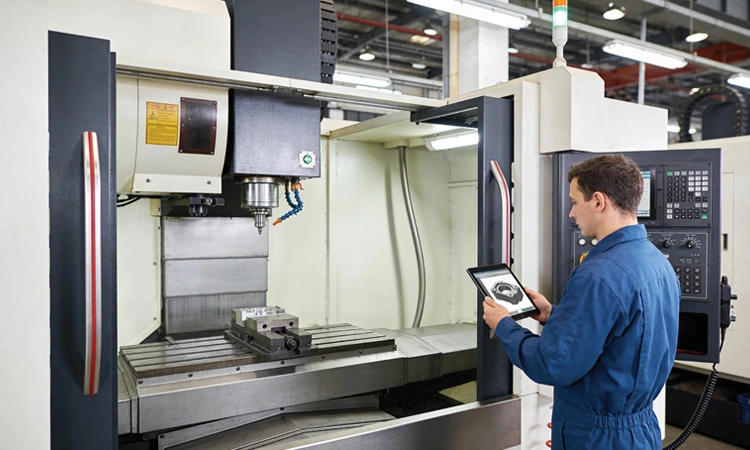
Machine tools represent a particularly important application area. CNC machines, machining centres, grinding machines and other precision equipment are expected to deliver high availability while maintaining accuracy.
Monitoring spindle vibration, temperature, power consumption, axis behaviour, lubrication and cutting conditions can help identify developing problems. Abnormal spindle vibration, for instance, may indicate bearing degradation or tool-related issues. Monitoring axis-drive performance can provide indications of mechanical wear or increased friction.
For manufacturers operating automated production lines, predictive maintenance can also be integrated with machine-control and production-management systems, allowing maintenance requirements to be considered alongside production schedules.
Moving Towards Prescriptive Maintenance
Predictive maintenance is increasingly evolving into prescriptive maintenance. While predictive systems answer the question, “What is likely to happen?”, prescriptive systems go a step further by suggesting what should be done.
For example, an intelligent system may detect an abnormal bearing condition, estimate the probable remaining operating life and recommend inspection or replacement during the next planned shutdown. It could also identify the required spare part and automatically trigger a maintenance work order.
This creates a more integrated maintenance ecosystem in which machines, maintenance teams, enterprise software and supply chains work together.
Overcoming the Challenges
Despite its advantages, predictive maintenance is not a universal solution that can simply be installed and switched on. Successful implementation requires careful planning.
The quality of data is critical. Poorly calibrated sensors, inadequate sampling or inconsistent machine data can produce misleading results. Manufacturers must also determine which assets are sufficiently critical to justify continuous monitoring.
Cybersecurity is another important consideration as machines become connected to plant networks and cloud platforms. Protecting operational technology from unauthorised access must therefore be part of the predictive maintenance strategy.
Equally important is the human factor. Maintenance personnel need the skills to understand condition-monitoring information and translate analytical insights into practical action.
The Future is Condition-Aware
Predictive maintenance is transforming the traditional concept of maintenance from a largely reactive function into a strategic productivity tool. The combination of industrial IoT, sensors, edge computing, artificial intelligence, digital twins and connected enterprise systems is making machines increasingly condition-aware.
The ultimate goal is not merely to predict failures. It is to create manufacturing systems in which failures are anticipated, maintenance is intelligently scheduled and production interruptions are minimised.
As factories move towards greater automation and lights-out manufacturing, equipment availability will become even more critical. In this environment, predictive maintenance will no longer be viewed simply as an advanced maintenance technique. It will become an essential pillar of smart, reliable and competitive manufacturing.