

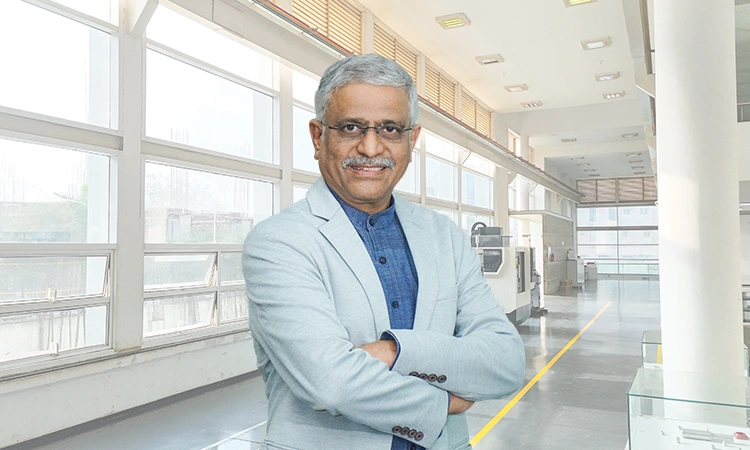
From a modest design consultancy to one of India’s most formidable machine-tool conglomerates, Ace Designers Ltd.,
An Ace Micromatic Group Company, has built its growth story on engineering depth,customer intimacy, and a relentless focus on scalability.
As manufacturing paradigms shift towards digitalisation, automation, and sustainability, the group is redefining what it means to be a machine-tool partner—one that enables customers to grow faster, smarter, and more competitively without compromising on flexibility or quality, discovers Machine Tools World in an interview with managing director T.K. Ramesh of Ace Designers Ltd. Excerpts:
Q1. Your organisation has grown to become one of India’s leading machine-tool manufacturers. Could you walk us through the major milestones or strategic decisions that shaped the group’s journey to this point?
Our journey began in 1979 with the founding of Ace Designers as a machine design consultancy. In the early years, we worked closely with several Indian manufacturers, contributing design expertise and application insights. However, the ecosystem at that time lacked long-term collaborative frameworks, which limited our ability to scale these efforts into commercially sustainable outcomes.
This realization led to a pivotal decision in 1982—to move from design to manufacturing. Our first significant opportunity came from the automotive sector, where we developed special-purpose machines for Indian valve manufacturers. These early successes helped us build deep process knowledge and customer intimacy, which became the foundation for our entry into CNC technology. By the late 1980s, this capability was externally validated when one of our CNC lathes received the Best Design Award at IMTEX.
The 1990s marked a defining phase in our evolution. As demand grew, we recognised that scale required focus. This led to the creation of specialised group companies—Ace Designers concentrating on CNC turning solutions, Ace Manufacturing Systems (established in 1992) focusing on machining centres, and Micromatic Machine Tools forming the dedicated sales and service backbone.
Similarly, we expanded our portfolio to cover metal 3D printing represented by amace, IoT solutions represented by AmiT and sheet metal solutions represented by SINAR. This structure allowed us to move beyond being a machine supplier to becoming a long-term manufacturing partner, offering installation, commissioning, training, and lifecycle support.
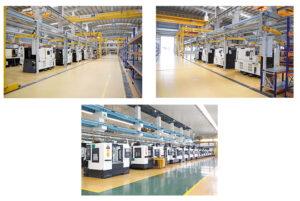
This integrated approach proved to be a powerful differentiator. By combining robust engineering with dependable service and application support, we earned customer trust over decades. What began as production of one machine a month in the early 1990s has today scaled to manufacturing thousands of machines annually built on consistency, credibility, and customer confidence.
Recently, Ace Designers, AMS, and Micromatic were amalgamated into a single entity—Ace Designers Ltd.—with the objective of creating a unified, scalable organization. The amalgamation enables operational synergies, strengthens customer engagement through an integrated solutions portfolio, accelerates innovation, and enhances governance and capital efficiency, positioning the company for sustained long-term growth.
Q2. With the ambition to reach US $1 billion in revenue by 2030, what are the key drivers that you believe will deliver that growth?
Our US $1 billion ambition is a natural extension of the foundation we have built—driven by market expansion, technology leadership and portfolio diversification.
On the demand side, CNC machine adoption is expanding well beyond traditional automotive applications. Sectors such as electronics manufacturing, defense and aerospace, electric vehicles, and medical devices are increasingly investing in high-precision, high-reliability manufacturing. These industries align closely with our strengths in engineering depth, application expertise, and scalable production platforms.
At the same time, the machine-tool industry itself is undergoing a structural shift. Digitalisation, automation, and connectivity are no longer differentiators—they are becoming baseline expectations. Our machines are designed for smart factory environments, with built-in readiness for automation, data-driven monitoring, and predictive maintenance.
We are also experimenting with alternative commercial models such as machine renting and outcome-based partnerships, which address customers’ needs for flexibility and faster ROI.
In parallel, we are investing in advanced manufacturing technologies. Our entry into metal 3D printing represents a strategic move into a high-potential domain that complements our core subtractive machining strengths, enabling hybrid manufacturing solutions for complex, high-value components.
Finally, global expansion remains a key lever. Together, these drivers—new sectors, advanced technologies, innovative business models, and international growth—form the backbone of our roadmap to 2030.
Q3. IMTEX Forming 2026 brings together diverse manufacturing segments. Which SINAR solutions are you planning to showcase, and how do they help customers improve efficiency, flexibility, and competitiveness?
IMTEX Forming 2026 is an important platform for us to demonstrate how sheet-metal fabrication is evolving toward higher intelligence, flexibility, and productivity. Founded in 2019 and backed by over 50 years of machine tool heritage and supported by state-of-the-art in-house machining and assembly facilities, SINAR delivers reliable, precise, and cost-effective solutions for the sheetmetal industry.
Through SINAR, we will showcase a new generation of solutions that combine advanced automation with practical, shop-floor usability.
A key highlight will be our high-performance fiber laser cutting solution, powered by FANUC CNC, a 6 kW IPG laser source, and a Precitec cutting head. Beyond cutting capability—up to 22 mm in mild steel—the focus is on ease of use. A next-generation, custom-developed user interface simplifies operation significantly, enabling operators to focus on throughput and quality rather than system complexity.
We will also demonstrate a robot-integrated press brake—a 100-ton, 3-meter solution designed to deliver consistent bend accuracy, repeatability, and higher output. By automating repetitive bending operations, this system improves productivity while reducing operator fatigue and skill dependency.
Another key exhibit will be our cobot-based MIG welding solution. Designed for today’s dynamic manufacturing environments, it bridges the gap between manual welding and rigid automation.
Its mobility and intuitive programming allow rapid redeployment across applications, delivering consistent weld quality with faster changeovers. Across all these solutions, the common theme is enabling customers to scale efficiently—without sacrificing flexibility or quality.
Q4. Sustainability, energy efficiency, and lean manufacturing are now central to industrial production. How are these themes integrated into your strategy?
Sustainability is integral to how we design, manufacture, and operate. Our approach spans environmental responsibility, social impact, and strong governance—embedded into day-to-day decision-making rather than treated as a parallel initiative.
From an environmental standpoint, 38% of our energy consumption is sourced from renewables, supported by 3.0 MW of rooftop solar capacity. Select facilities operate as net-positive energy units, and we are committed to achieving Net Zero emissions by 2050.
Design-led interventions have resulted in a 12% reduction in embodied CO₂ and an 18% reduction in idle energy consumption. Water stewardship initiatives have enabled 35% reuse, supported by rainwater harvesting capacity of 3.2 million litres annually, with a clear roadmap to become Water Positive by 2030.
On the social front, our CNC skill development programs have trained over 4,000 youth, enabling significantly improved employability.
Our CSR initiatives have benefited approximately 85,000 individuals since 2015 across education, healthcare, rural development, and environmental conservation.
Governance oversight is driven at the Board level, supported by integrated management systems certified under ISO 9001, 14001, 45001, and 27001. Our GreenCo Platinum and Gold certifications further reinforce our commitment to responsible manufacturing.
Q5. How are digitalisation, AI, and data analytics shaping your solutions portfolio?
We see AI-led transformation, grounded in data integrity, as the next major frontier for manufacturing.
With this belief, our group company AmiT has developed AMG-mIoT™, an AI-native manufacturing platform designed to go beyond basic connectivity.
AMG-mIoT™ integrates connected machines with intelligent decision-making, enabling predictive maintenance, production visibility, and autonomous operations. Our long-term vision is for it to become the “UPI for Manufacturing and AI”—a unified digital backbone connecting the entire value chain.
A key example is our patented AMG-MITRA™, an agentic AI co-pilot that provides real-time, contextual insights on process health and productivity. Complementing this, our Vision AI solutions help enforce quality, enhance safety, and improve operational reliability.
One important learning from real-world deployments is that AI delivers the greatest impact when it augments human expertise rather than replacing it—making insights actionable, explainable, and trusted on the shop floor.