

Surface coating and paint finishing have become indispensable elements of modern manufacturing, extending far beyond the traditional objectives of corrosion protection and aesthetic enhancement. Today, they are critical technologies that influence product performance, durability, reliability, safety and lifecycle costs. From automobiles and aerospace components to industrial machinery, electrical equipment, construction materials and consumer products, advanced surface finishing solutions are helping manufacturers meet increasingly demanding quality and performance expectations.
Driven by innovations in material science, application technologies, automation and environmental engineering, the surface coating industry is undergoing a significant transformation. Manufacturers are increasingly adopting sophisticated coating processes that deliver superior surface characteristics, consistent quality and improved production efficiency while minimising environmental impact.
Next-Generation Coatings: Delivering Superior Performance
One of the most important developments in surface engineering is the evolution of high-performance coating materials. Conventional paints and protective coatings are increasingly being supplemented by specialised formulations designed to withstand demanding operating environments.
Advanced epoxy, polyurethane, acrylic and fluoropolymer coatings offer excellent resistance to corrosion, chemicals, abrasion, moisture and extreme weather conditions. These coatings are extensively used in automotive bodies, industrial equipment, pipelines, marine structures and infrastructure applications.
Powder coating technology has also gained considerable popularity owing to its durability, uniform finish and environmental advantages. Unlike conventional solvent-based paints, powder coatings generally contain negligible or no solvents and can significantly reduce VOC emissions. Their resistance to chipping, scratching and fading makes them particularly suitable for automotive components, electrical enclosures, furniture and industrial machinery.
Specialised ceramic, thermal barrier, anti-microbial and anti-fouling coatings are further expanding the application horizon of surface finishing technologies.
Surface Preparation: The Foundation of Quality Finishing
The performance of any coating depends substantially on the condition of the underlying surface. Improper cleaning, contamination or inadequate pretreatment can compromise adhesion and lead to premature coating failure.
Modern surface preparation techniques are therefore receiving greater attention. Automated abrasive blasting, shot blasting, chemical cleaning, ultrasonic cleaning and precision degreasing systems are helping manufacturers achieve the required surface conditions consistently.
Laser cleaning is an emerging technology that offers controlled removal of rust, oxides, paint and other contaminants without the extensive use of chemicals or abrasive materials. Plasma surface treatment is also gaining acceptance for improving surface energy and adhesion, particularly when processing plastics, composites and other difficult-to-coat materials.
Nanotechnology-based pretreatment solutions are providing alternatives to conventional chemical processes, with the potential to improve corrosion resistance while reducing water consumption, chemical usage and waste generation.
Automation and Robotics: Transforming Paint Shops
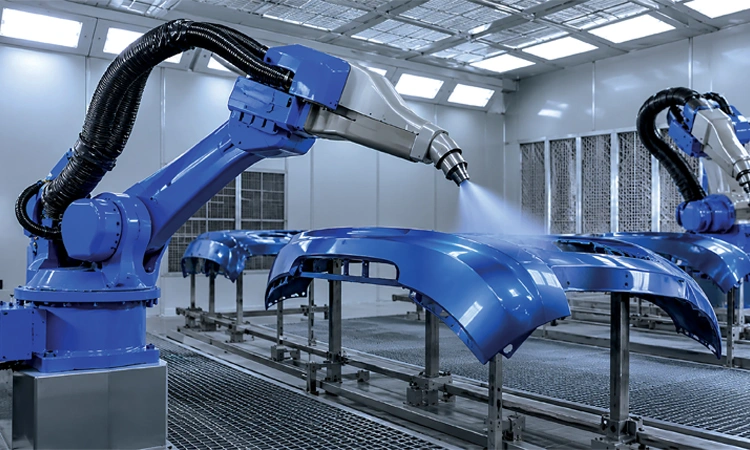
Automation has become a major driver of productivity and consistency in industrial paint finishing. Robotic painting systems are increasingly deployed in automotive plants and other manufacturing facilities where high-quality, repeatable finishes are essential.
Equipped with programmable spray guns, sensors and advanced control systems, painting robots can maintain consistent spray patterns, coating thickness and application speeds. Their ability to access complex geometries and difficult-to-reach surfaces helps improve coverage while minimising overspray and material wastage.
Automated paint-mixing and dispensing systems further enhance process control by maintaining accurate paint-to-hardener ratios, viscosity and colour consistency. Integrated conveyor systems, robotic handling and intelligent production monitoring help streamline operations and reduce manual intervention.
Artificial intelligence (AI), machine vision and digital monitoring are also making coating inspection more efficient. These systems can identify defects such as pinholes, orange peel, uneven coverage, colour variations and surface contamination, enabling timely corrective action and reducing rejection rates.
Innovative Curing Technologies: Improving Productivity
Curing and drying are essential stages in achieving the desired coating properties. Traditional thermal ovens are increasingly being complemented by technologies that offer faster processing, better energy utilisation and greater process flexibility.
Infrared curing systems provide rapid and targeted heating, while ultraviolet (UV) curing enables specially formulated coatings to harden almost instantly through photochemical reactions. These technologies can significantly reduce processing time and improve production throughput.
Low-temperature curing coatings are particularly useful for heat-sensitive materials and components. Meanwhile, improvements in oven insulation, airflow management, heat recovery and temperature control are helping manufacturers reduce energy consumption and operating costs.
Advanced Surface Engineering: Functional and Smart Coatings
Surface coating technologies are increasingly being developed to provide specialised functional properties beyond conventional protection.
Physical Vapour Deposition (PVD) and Chemical Vapour Deposition (CVD) processes are widely used to produce thin, hard and wear-resistant coatings on cutting tools, dies, moulds and precision components. These coatings improve tool life, reduce friction and enhance machining performance.
Self-healing coatings, which can repair minor surface damage through specialised chemical mechanisms, represent another promising development. Hydrophobic and superhydrophobic coatings provide water-repellent properties, while anti-corrosion and chemical-resistant coatings protect components operating in harsh industrial environments.
Smart coatings capable of responding to temperature, moisture, chemical exposure or mechanical damage are also attracting research interest. Such technologies could find increasing applications in aerospace, automotive, defence and infrastructure sectors.
Sustainability: A Key Driver of Innovation
Environmental responsibility is becoming a central consideration in the development and selection of coating technologies. Manufacturers are increasingly moving towards waterborne paints, low-VOC formulations, solvent-free coatings and powder coating processes.
Advanced spray technologies, including High Volume Low Pressure (HVLP) and electrostatic spraying, help improve transfer efficiency and minimise overspray. Paint recovery systems, solvent recycling and wastewater treatment facilities further contribute to sustainable operations.
Energy-efficient curing ovens, optimised ventilation, renewable energy adoption and reduced material wastage are helping coating facilities lower their environmental footprint. The growing emphasis on circular manufacturing is also encouraging the recovery and reuse of process materials wherever technically feasible.
Challenges and Future Opportunities
Despite considerable technological progress, the surface coating industry faces challenges relating to raw material price volatility, environmental compliance, specialised equipment investments and skilled manpower availability. Increasingly complex product designs and the use of diverse substrates also demand customised coating formulations and application techniques.
Going forward, the convergence of advanced materials, robotics, AI-driven quality inspection, digital process control and sustainable chemistry will redefine surface coating and paint finishing.
For manufacturers, investing in modern coating technologies is no longer simply an exercise in improving appearance. It is a strategic decision that influences product reliability, manufacturing efficiency, operating costs and market competitiveness.
As industrial products become increasingly sophisticated and performance expectations continue to rise, surface coating and paint finishing will remain vital to engineering excellence. The industry is steadily moving towards a future where coatings will not merely protect surfaces but actively enhance the functionality, longevity and value of manufactured products.
P.K. Balasubramanian
editor@divyamediaonline.com