

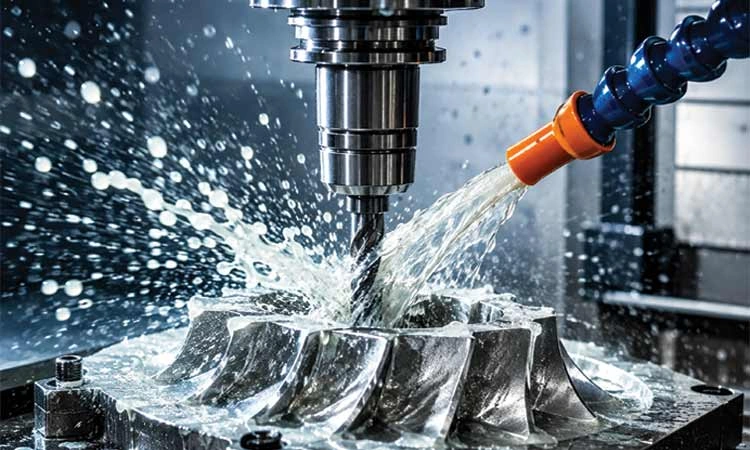
In modern metalworking, coolant is far more than a medium for cooling the cutting zone. It is a critical component of the machining process that directly influences tool life, surface finish, dimensional accuracy, machine uptime, and overall manufacturing costs. As machining operations become faster and more demanding-with higher spindle speeds, tighter tolerances, and difficult-to-machine materials-traditional coolant management practices are no longer sufficient. Manufacturers are increasingly embracing smart coolant management, an intelligent approach that combines advanced coolant delivery systems, real-time monitoring, filtration technologies, automation, and data analytics to maximize machining performance and productivity.
The Role of Coolant in Machining
During machining, significant heat is generated at the interface between the cutting tool and the workpiece. If not effectively controlled, excessive heat can lead to rapid tool wear, thermal distortion, poor surface finish, and inaccurate dimensions.
Cutting fluids perform several vital functions:
- Cooling the cutting zone
- Lubricating the tool-workpiece interface
- Flushing chips away from the cutting area
- Preventing corrosion of machine components and workpieces
- Improving surface quality
- Extending cutting tool life
Maintaining coolant in optimum condition is therefore essential for achieving consistent machining performance.
The Smart Coolant Management Approach
Smart coolant management integrates intelligent monitoring systems with automated coolant maintenance to ensure that coolant properties remain within specified limits throughout production.
Using sensors, automated dosing systems, filtration units, and cloud-based monitoring platforms, manufacturers can continuously track coolant performance and respond immediately to changing conditions.
Real-Time Monitoring
One of the defining features of smart coolant management is continuous monitoring.
Advanced sensors measure critical coolant parameters such as:
- Concentration
- pH value
- Temperature 0
- Conductivity
- Fluid level
- Tramp oil contamination
- Particle concentration
- Flow rate
The collected data are displayed on digital dashboards, allowing operators and maintenance personnel to monitor coolant health in real time.
Automatic alerts notify users whenever coolant parameters move outside acceptable ranges, enabling prompt corrective action.
Automated Coolant Mixing and Dosing
Maintaining the correct coolant concentration is crucial for machining performance.
If coolant is overly diluted, lubrication decreases, leading to higher tool wear. Excessive concentration, on the other hand, increases operating costs and may cause residue formation on machined components.
Modern coolant management systems automatically mix coolant concentrates with water at precise ratios and replenish coolant as required.
Automated dosing eliminates human error while ensuring consistent coolant quality across multiple machines.
High-Pressure Coolant Delivery
As machining speeds increase, conventional coolant delivery methods often struggle to penetrate the cutting zone effectively.
High-pressure coolant systems deliver fluid directly to the cutting edge through specialized nozzles or through-tool channels.
The benefits include:
- Improved heat removal
- Enhanced chip breaking
- Better chip evacuation
- Reduced cutting temperatures
- Extended tool life 0
- Improved surface finish
- Increased machining speeds
High-pressure coolant is particularly valuable when machining titanium, stainless steel, Inconel, and other difficult-to-machine materials.
Advanced Filtration Systems
Coolant quality depends heavily on effective filtration.
Metal particles, abrasive contaminants, tramp oil, and sludge gradually accumulate in coolant systems, reducing cooling efficiency and increasing tool wear.
Modern filtration technologies include:
- Magnetic separators
- Paper band filters
- Cyclonic separators
- Cartridge filtration
- Centrifugal filtration
- Vacuum filtration systems
These systems continuously remove contaminants, allowing coolant to remain cleaner for longer periods while improving machining consistency.
Centralized Coolant Management
Large manufacturing facilities increasingly use centralized coolant systems serving multiple CNC machines from a common reservoir.
Centralized systems provide several advantages:
- Uniform coolant quality
- Simplified maintenance
- Reduced coolant inventory
- Lower operating costs
- Better filtration efficiency
- Easier monitoring
Centralized management also enables automated chemical balancing and continuous circulation, extending coolant life significantly.
AI and Predictive Analytics
Artificial Intelligence is adding a new dimension to coolant management.
AI-powered software analyses sensor data to identify patterns indicating coolant degradation, bacterial growth, abnormal contamination, or equipment issues.
Machine learning algorithms predict when coolant replacement or maintenance will be required, enabling predictive rather than reactive maintenance.
This reduces unplanned downtime while optimizing coolant usage and minimizing waste.
Integration with Smart Factories
Smart coolant systems are increasingly integrated into Manufacturing Execution Systems (MES), Supervisory Control and Data Acquisition (SCADA), and Industrial Internet of Things (IIoT) platforms.
Plant managers can remotely monitor coolant conditions across multiple production lines using centralized dashboards.
Historical data help optimize machining parameters, improve maintenance planning, and support continuous process improvement initiatives.
Remote monitoring also allows suppliers to provide predictive maintenance services based on real-time coolant data.
variable-speed coolant delivery systems also reduce electricity consumption.
Applications Across Industries
Smart coolant management has become indispensable in several manufacturing sectors.
In the automotive industry, it supports high-volume machining of engine blocks, transmission components, and electric vehicle parts.
Aerospace manufacturers depend on precise coolant delivery when machining titanium and nickel-based superalloys.
Medical device manufacturers require contamination-free coolant systems for precision machining of implants and surgical instruments.
In tool and die manufacturing, optimized coolant delivery improves machining of hardened steels while maintaining exceptional surface quality.
General engineering industries also benefit from longer tool life, improved machine availability, and reduced maintenance costs.
Future Trends
The future of coolant management will be increasingly digital and autonomous.
Self-monitoring coolant systems equipped with AI, cloud connectivity, and predictive diagnostics will automatically optimize coolant concentration, filtration, temperature, and flow based on machining conditions.
Digital twins of coolant systems will simulate performance and recommend process improvements before production begins.
Nanotechnology-based cutting fluids, environmentally friendly synthetic coolants, and advanced lubrication technologies will further enhance machining efficiency while supporting sustainable manufacturing goals.
As unmanned and lights-out manufacturing becomes more common, intelligent coolant management will play an increasingly vital role in ensuring uninterrupted production.
Conclusion
In today’s competitive manufacturing environment, coolant management is no longer a routine maintenance activity but a strategic productivity tool. Smart coolant management combines intelligent monitoring, automated dosing, advanced filtration, AI-driven analytics, and digital connectivity to ensure that machining processes operate at peak efficiency.
The benefits are substantial-longer tool life, improved surface finish, reduced downtime, lower operating costs, enhanced workplace safety, and greater sustainability. As factories continue their transition towards Industry 4.0 and smart manufacturing, investing in intelligent coolant management systems will become essential for achieving higher productivity, superior quality, and long-term competitiveness. Smart coolant management is not merely about maintaining cutting fluids; it is about maximizing the performance and profitability of the entire machining operation.