

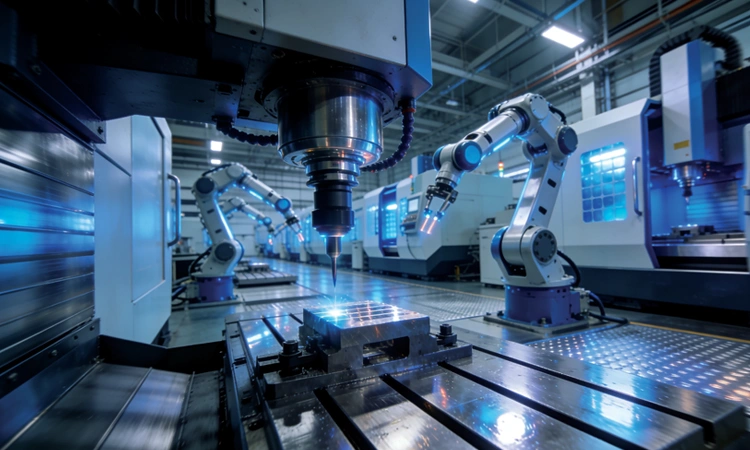
How integrated machining technologies are redefining manufacturing efficiency, precision and competitiveness
In today’s fiercely competitive manufacturing landscape, the demand for shorter lead times, higher precision, and greater flexibility has never been stronger. Manufacturers are under constant pressure to produce complex components while maintaining stringent quality standards and controlling production costs. This has led to the rapid adoption of multi-tasking machines-one of the most significant advancements in modern machine tool technology. Multi-tasking machines combine multiple manufacturing operations such as turning, milling, drilling, boring, tapping, grinding, and even gear cutting into a single platform. By consolidating several machining processes into one setup, these machines have transformed the way manufacturers approach production, enabling them to achieve unprecedented levels of productivity and efficiency. As industries such as aerospace, automotive, medical devices, defence, energy, and precision engineering demand increasingly sophisticated components, multi-tasking machines have become indispensable assets in smart manufacturing environments.
From Multiple Setups to Single-Setup Manufacturing
Traditionally, manufacturing a complex component required transferring the workpiece between several dedicated machines. A part might begin on a lathe, move to a machining centre for milling operations, proceed to a drilling machine, and finally undergo grinding or finishing. Every transfer introduced additional setup time, alignment challenges, handling costs, and the risk of dimensional inaccuracies.
Multi-tasking machines have fundamentally changed this approach. Equipped with advanced CNC controls, multiple spindles, rotary tables, and automatic tool changers, these machines perform a wide range of operations without removing the component from the machine.
Single-setup machining significantly improves geometric accuracy because the workpiece maintains a common reference throughout the manufacturing cycle. This eliminates cumulative errors associated with repeated repositioning while ensuring superior concentricity and dimensional consistency.
Productivity Beyond Machine Speed
While spindle speed and rapid traverse rates contribute to productivity, the real advantage of multi-tasking machines lies in reducing non-cutting time.
Setup activities, workpiece transportation, fixture changes, manual inspections, and waiting between operations often consume a significant portion of total production time. By integrating several operations into one machine, manufacturers dramatically reduce these unproductive intervals.
The result is:
- Higher spindle utilisation
- Reduced work-in-progress inventory
- Faster throughput
- Lower labour requirements
- Improved machine availability
For manufacturers handling high-value components, these productivity gains often outweigh the higher capital investment associated with multi-tasking equipment.
Meeting the Challenge of Complex Components
Modern engineering products are becoming increasingly intricate. Components used in aircraft engines, electric vehicles, medical implants, hydraulic systems, robotics, and semiconductor equipment often feature complex geometries that require machining from multiple angles.
Five-axis multi-tasking machines allow simultaneous machining across several axes, enabling manufacturers to produce highly sophisticated parts with exceptional precision.
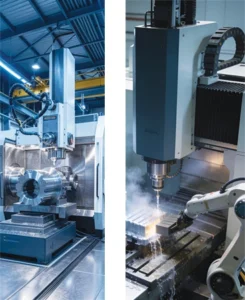
These capabilities include:
- Complex contour machining
- Angular drilling
- Deep cavity milling
- Helical interpolation
- Free-form surface machining
- Simultaneous turning and milling
Such versatility reduces dependence on special fixtures while expanding design possibilities for product engineers.
Precision Through Integrated Manufacturing
Every time a workpiece is removed from one machine and loaded onto another, slight positioning errors become inevitable. These cumulative deviations can affect dimensional tolerances, surface finish, and overall product quality.
Multi-tasking machines eliminate most of these challenges.
With sophisticated probing systems, automatic workpiece measurement, thermal compensation, and adaptive machining technologies, today’s machines continuously monitor machining accuracy throughout the manufacturing process.
This integrated approach enables manufacturers to consistently produce micron-level tolerances demanded by industries such as aerospace, medical equipment, defence, and precision instrumentation.
Reduced Lead Times for Competitive Manufacturing
Global manufacturing increasingly revolves around responsiveness. Customers expect rapid delivery without compromising quality.
By combining multiple operations within a single machining cycle, multi-tasking machines significantly shorten manufacturing lead times.
Prototype development becomes faster because components can be produced without waiting for availability across multiple machines. Production scheduling becomes simpler, while engineering changes can be implemented more quickly.
This agility provides manufacturers with a significant competitive advantage, particularly in high-mix, low-volume production environments where flexibility is essential.
Automation Enhances Machine Utilisation
Modern multi-tasking machines are designed to integrate seamlessly with automation technologies.
Robotic loading systems, pallet changers, bar feeders, automatic workpiece measurement, tool monitoring systems, and intelligent tool management software enable lights-out manufacturing.
Artificial Intelligence is also beginning to influence machine optimisation. AI-based software analyses cutting conditions, predicts tool wear, recommends optimal machining parameters, and minimises machine idle time.
Combined with Industrial Internet of Things (IIoT) connectivity, manufacturers gain real-time visibility into machine performance, production efficiency, and maintenance requirements.
Economic Benefits Beyond Production
Although multi-tasking machines represent a significant capital investment, their long-term economic advantages are compelling.
By replacing multiple standalone machines, manufacturers reduce factory floor space requirements and simplify production layouts. Fewer machines translate into lower maintenance costs, reduced energy consumption, and simplified operator training.
Inventory levels also decrease because fewer semi-finished components remain between machining stages.
The cumulative financial benefits include:
- Lower production costs
- Reduced scrap and rework
- Better capital utilisation
- Improved return on investment
- Higher equipment effectiveness
- Increased manufacturing flexibility
These advantages become particularly important as manufacturers face rising labour costs and increasing global competition.
Driving Sustainability in Manufacturing
Sustainability has become a strategic priority across manufacturing industries.
Multi-tasking machines contribute to environmental goals in several ways.
Reduced handling lowers the risk of component damage and material wastage. Single-setup machining consumes less energy compared to operating multiple independent machines. Advanced cutting strategies minimise tooling consumption while improving machining efficiency.
Modern machines also incorporate energy-saving drives, intelligent coolant management systems, and regenerative technologies that reduce overall power consumption.
As manufacturers pursue carbon neutrality and greener operations, these efficiencies support broader sustainability objectives.
Industry Applications Continue to Expand
The adoption of multi-tasking machines is accelerating across numerous sectors.
In aerospace manufacturing, they produce turbine shafts, landing gear components, structural parts, and engine housings with exceptional precision.
The automotive industry uses them for crankshafts, transmission components, steering systems, electric vehicle motor housings, and battery-related components.
Medical device manufacturers rely on them for orthopaedic implants, surgical instruments, dental components, and prosthetic devices requiring micron-level accuracy.
Oil and gas companies machine valves, drilling tools, pump components, and high-pressure fittings, while defence manufacturers produce precision weapon systems, missile components, and specialised mechanical assemblies.
The versatility of these machines makes them equally valuable for job shops handling diverse customer requirements.
Integration with the Smart Factory
Multi-tasking machines are increasingly becoming intelligent production systems rather than standalone machine tools.
Connected through Industry 4.0 platforms, they continuously exchange information with Manufacturing Execution Systems (MES), Enterprise Resource Planning (ERP) software, quality management systems, and digital twins.
Real-time dashboards provide insights into machine utilisation, Overall Equipment Effectiveness (OEE), energy consumption, tool life, and production quality.
Predictive maintenance algorithms analyse vibration, spindle loads, temperature, and cutting forces to schedule maintenance before failures occur, reducing costly downtime.
As digital manufacturing ecosystems mature, multi-tasking machines will serve as central nodes within highly connected, data-driven factories.
Challenges to Wider Adoption
Despite their advantages, implementing multi-tasking machines requires careful planning.
Programming these sophisticated systems demands highly skilled CNC programmers familiar with advanced machining strategies and five-axis toolpaths. Operators require specialised training to fully exploit machine capabilities.
Initial investment costs can also be substantial, making careful return-on-investment analysis essential. Manufacturers must ensure adequate utilisation levels to justify the investment.
Furthermore, successful deployment depends on integrating tooling systems, software, automation, and process planning into a cohesive production strategy.
However, as machine technology becomes more user-friendly and digital support tools continue to evolve, these barriers are gradually diminishing.
Looking Ahead
The future of multi-tasking machines lies in greater intelligence, autonomy, and connectivity. Advances in artificial intelligence, digital twins, adaptive machining, collaborative robotics, and cloud-based analytics will make these systems even more capable of self-optimising production.
Hybrid machines that combine additive manufacturing with subtractive machining are already emerging, enabling manufacturers to build and finish complex parts within a single machine. Enhanced sensor technologies, autonomous process control, and AI-driven decision-making will further reduce human intervention while improving productivity and consistency.
For manufacturers striving to remain competitive in an increasingly demanding global market, investing in multi-tasking machining is no longer simply about acquiring a versatile machine tool. It is about embracing a smarter, more agile, and future-ready manufacturing philosophy. As production requirements continue to evolve, multi-tasking machines will play a pivotal role in delivering the speed, precision, flexibility, and efficiency that define the factories of tomorrow.