

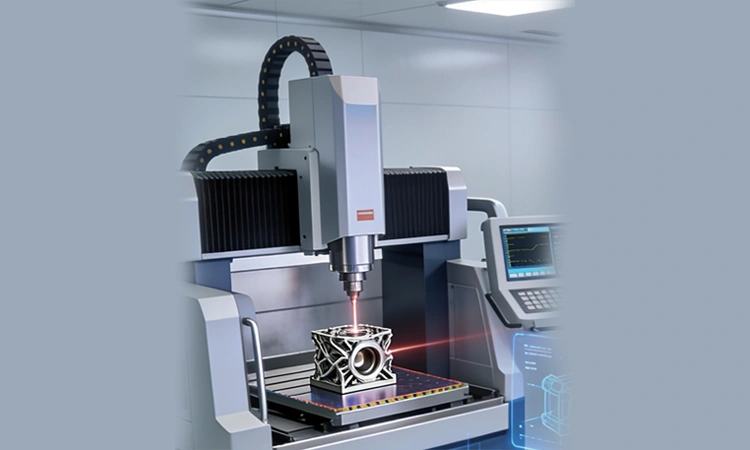
Enabling precision manufacturing for the next generation of miniature,
high-performance components
As products become smaller, smarter, and more sophisticated, manufacturing technologies are evolving to meet unprecedented demands for precision and accuracy. From miniature medical implants and semiconductor devices to aerospace sensors and micro-electromechanical systems (MEMS), industries are increasingly relying on components measured in microns rather than millimetres. At the heart of this transformation is micromachining-a highly specialized manufacturing process that enables the production of intricate features and ultra-precise components with exceptional dimensional accuracy.
Micromachining has emerged as one of the most significant enablers of modern manufacturing, allowing engineers to create tiny yet highly functional components that were once impossible or prohibitively expensive to produce. With advancements in CNC technology, laser processing, electrical discharge machining (EDM), ultrasonic machining, and precision tooling, micromachining has become indispensable across a wide range of high-technology industries.
Understanding Micromachining
Micromachining refers to manufacturing processes used to produce components or features typically ranging from a few microns to a few millimetres in size. Unlike conventional machining, which focuses on larger workpieces, micromachining emphasizes extreme precision, tight tolerances, superior surface finishes, and intricate geometries.
The process often involves miniature cutting tools, high-speed spindles operating at speeds exceeding 100,000 rpm, ultra-precision positioning systems, and sophisticated CNC controls capable of achieving micron-level accuracy.
Depending on the material and application, micromachining may employ technologies such as micro-milling, micro-turning, micro-drilling, laser micromachining, wire EDM, sinker EDM, ultrasonic machining, electrochemical machining (ECM), and focused ion beam machining.
Each technology offers distinct advantages depending on component geometry, material hardness, and production requirements.
Why Precision Matters
In today’s advanced manufacturing environment, even microscopic deviations can have significant consequences.
A slight dimensional variation in a medical implant may affect patient safety. Tiny imperfections in semiconductor components can compromise electronic performance, while inaccuracies in aerospace sensors may impact flight reliability.
Micromachining addresses these challenges by delivering:
- Ultra-tight dimensional tolerances
- Exceptional repeatability
- Superior surface finishes
- Burr-free machining
- High aspect ratio features
- Intricate three-dimensional geometries
Such capabilities enable manufacturers to consistently produce components that meet stringent industry standards and regulatory requirements.
Technologies Driving Micromachining
Modern micromachining encompasses a broad spectrum of advanced manufacturing technologies.
Micro-Milling
Micro-milling employs miniature cutting tools, often smaller than one millimetre in diameter, to produce intricate cavities, channels, slots, and complex contours.
This process is widely used for mould manufacturing, microfluidic devices, medical instruments, and precision aerospace components.
Laser Micromachining
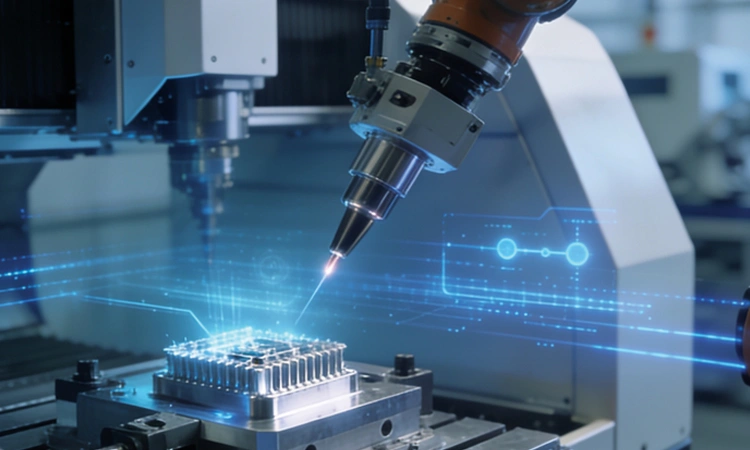
Laser technology offers exceptional flexibility by machining without physical contact.
Ultrafast femtosecond and picosecond lasers minimize heat-affected zones while enabling precision drilling, cutting, engraving, and surface texturing on metals, ceramics, polymers, and composites.
Laser micromachining is particularly valuable in electronics, semiconductor manufacturing, and medical device production.
Micro-EDM
Electrical discharge machining has become an essential technology for machining extremely hard materials.
Micro-EDM produces intricate cavities, fine holes, miniature moulds, fuel injector nozzles, and precision dies without inducing cutting forces, making it ideal for delicate components.
Ultrasonic and Electrochemical Machining
For brittle materials such as glass, ceramics, and advanced composites, ultrasonic machining offers precise material removal without cracking.
Electrochemical machining enables stress-free machining of difficult-to-cut alloys, superalloys, and titanium components frequently used in aerospace and medical industries.
Together, these technologies provide manufacturers with versatile solutions for an increasingly diverse range of applications.
Industrial Applications Continue to Expand
Micromachining has found applications across virtually every high-technology manufacturing sector.
Medical Devices
Healthcare is among the largest beneficiaries of micromachining technology.
Manufacturers produce minimally invasive surgical instruments, cardiovascular stents, orthopaedic implants, dental components, pacemaker parts, and catheter systems requiring extraordinary precision.
The smooth surface finish achieved through micromachining minimizes tissue damage while enhancing patient safety and device reliability.
Semiconductor Manufacturing
The semiconductor industry depends heavily on micromachining to fabricate wafer handling equipment, precision moulds, connectors, inspection systems, cooling channels, and packaging components.
As integrated circuits continue to shrink while performance increases, the demand for ultra-precise manufacturing technologies continues to grow.
Aerospace and Defence
Modern aircraft contain thousands of miniature precision components.
Micromachining enables the production of fuel injector nozzles, miniature sensors, turbine cooling holes, guidance system components, optical assemblies, and micro-mechanical devices that operate under extreme environmental conditions.
The technology contributes significantly to weight reduction while improving reliability and fuel efficiency.
Electronics and Telecommunications
Miniaturization has become the defining trend in consumer electronics.
Smartphones, wearable devices, communication equipment, connectors, antennas, printed circuit board components, and optical communication devices all incorporate parts manufactured using micromachining techniques.
High precision enables manufacturers to integrate greater functionality into increasingly compact products.
Automotive and Electric Vehicles
Modern vehicles rely extensively on precision electronics and miniature mechanical components.
Micromachining supports the production of fuel injection systems, pressure sensors, battery management components, electric motor assemblies, transmission parts, micro-connectors, and advanced driver assistance systems (ADAS).
As electric mobility expands, demand for highly precise miniature components continues to accelerate.
Materials Present New Challenges
One of the distinguishing characteristics of micromachining is the wide variety of materials involved.
Manufacturers routinely machine:
- Stainless steels
- Titanium alloys
- Nickel-based superalloys
- Aluminium alloys
- Copper
- Ceramics
- Glass
- Silicon
- Tungsten carbide
- Engineering plastics
- Composite materials
Each material presents unique machining challenges, including tool wear, heat generation, vibration, burr formation, and dimensional stability.
Consequently, process optimization becomes critical for achieving consistent quality.
Digital Technologies Enhance Precision
Industry 4.0 technologies are significantly improving micromachining capabilities.
Artificial intelligence assists in selecting cutting parameters, predicting tool wear, and optimizing machining strategies. Machine learning algorithms continuously analyse production data to improve process stability.
Digital twins simulate machining operations before production begins, reducing trial-and-error while minimizing material wastage.
Real-time monitoring systems track spindle vibration, cutting forces, temperature, and tool conditions, allowing manufacturers to detect deviations before defects occur.
Automation further enhances productivity through robotic loading systems, automated inspection, intelligent tool management, and lights-out manufacturing.
Together, these digital technologies make micromachining faster, more reliable, and economically viable even for complex, low-volume production.
Benefits Beyond Precision
The advantages of micromachining extend well beyond dimensional accuracy.
Manufacturers benefit from:
- Faster product development
- Reduced material wastage
- Improved production consistency
- Lower assembly requirements
- Enhanced product performance
- Greater design flexibility
- Shorter manufacturing lead times
- Higher production efficiency
As products become increasingly compact, micromachining enables engineers to consolidate multiple functions within a single miniature component, reducing overall assembly complexity.
Challenges in Micromachining
Despite its advantages, micromachining presents several technical challenges.
Miniature cutting tools are inherently fragile and susceptible to wear and breakage. Maintaining stable cutting conditions requires exceptionally rigid machines, high-quality spindle systems, precise thermal control, and vibration-free environments.
Inspection also becomes more demanding. Conventional measuring instruments often lack the required accuracy, leading manufacturers to rely on coordinate measuring machines (CMMs), optical measurement systems, laser scanners, white-light interferometers, and electron microscopes.
Additionally, programming micro-scale toolpaths requires highly skilled engineers capable of balancing cutting parameters, tool life, and machining efficiency.
The Road Ahead
The future of micromachining is closely linked with advances in nanotechnology, additive manufacturing, artificial intelligence, and smart manufacturing. Hybrid manufacturing systems that combine additive and subtractive processes are enabling the creation of complex micro-components with unprecedented efficiency. Ultrafast laser technologies, adaptive process control, and AI-driven optimization will further enhance accuracy, reduce cycle times, and improve productivity.
Emerging sectors such as quantum computing, biomedical engineering, micro-robotics, advanced sensors, photonics, and renewable energy will continue to push the boundaries of precision manufacturing, creating new opportunities for micromachining technologies.
As industries continue their pursuit of miniaturization without compromising functionality or reliability, micromachining will remain a cornerstone of advanced manufacturing. By delivering unparalleled precision, enabling innovative product designs, and supporting the production of high-performance components, this technology is shaping the future of engineering-one micron at a time.