


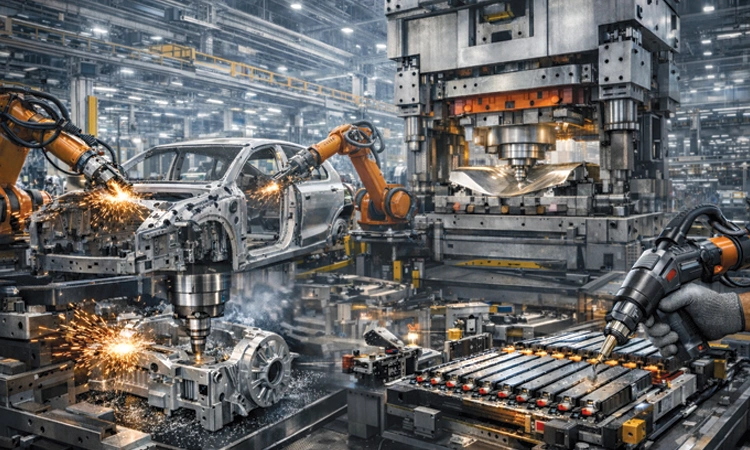
The automotive industry is one of the most tooling-intensive manufacturing sectors in the world. From body-in-white to powertrain, from press shops to final assembly, every vehicle that rolls off the production line is the outcome of millions of precise cutting, forming, welding and fastening operations—each dependent on robust and intelligent tooling. As vehicle designs evolve rapidly, driven by electrification, lightweighting, safety regulations and sustainability imperatives, tooling solutions are also undergoing a fundamental transformation.
Today, tooling is no longer just about holding, cutting or shaping a component. It has become a strategic enabler of productivity, quality, cost competitiveness & flexibility in automotive manufacturing.
The Expanding Scope of Automotive Tooling
Traditionally, automotive tooling revolved around dies, moulds, jigs, fixtures, cutting tools and gauges. While these continue to be indispensable, modern vehicle manufacturing now demands a far wider ecosystem of tooling solutions, including:
- High-performance cutting tools
- Modular and flexible fixtures
- Advanced forming and stamping dies
- Welding and joining tooling
- Assembly and fastening tools
- Inspection and metrology systems
- Additive manufacturing-based tooling
The shift from purely mechanical vehicles to software-driven, electrified and lightweight automobiles has added new layers of complexity to the tooling landscape.
Cutting Tools: Machining the Heart of the Vehicle
Despite the growth of casting, forming and near-net-shape processes, machining remains a backbone of automotive manufacturing. Engine blocks, cylinder heads, gearboxes, brake components, suspension parts and electric drive units all rely heavily on precision machining.
Modern automotive cutting tools are designed for:
- High speeds and feeds to meet mass production volumes
- Extended tool life for uninterrupted manufacturing
- Superior surface finish to reduce post-processing
- Machining of advanced materials such as high-strength steels, aluminium alloys and composites
Indexable inserts, solid carbide tools, multi-flute cutters and coated drills are now optimized specifically for automotive materials and geometries. Tool manufacturers increasingly offer application-specific tool packages for crankshafts, camshafts, EV housings and transmission components, reducing cycle time and improving consistency.
Press Tools and Stamping Dies for Lightweighting
The body and chassis of modern vehicles are witnessing a rapid transition towards lighter and stronger materials. High-strength steels (HSS), ultra-high-strength steels (UHSS) and aluminium alloys are now widely used to meet crash safety and fuel-efficiency targets.
This shift has created a new generation of stamping and forming dies that must:
- Withstand higher forming forces
- Provide precise spring-back control
- Offer longer life despite abrasive materials
- Enable complex geometries
Advanced surface coatings, optimized die designs and better cooling and lubrication strategies are now integral to press tooling. Hot stamping tools, used for forming ultra-high-strength steel parts, are becoming increasingly common in body-in-white applications.
Jigs and Fixtures: The Backbone of Accuracy
Automotive production involves thousands of parts that must be positioned, welded, machined and assembled with repeatable accuracy. This is where jigs and fixtures play a critical role.
Modern automotive fixtures are no longer rigid, single-purpose structures. They are designed to be:
- Modular, enabling quick changeovers
- Reconfigurable, supporting multiple variants
- Sensor-enabled, providing real-time feedback
- Automation-friendly, compatible with robots and CNC systems
In flexible manufacturing lines, fixtures now allow OEMs to produce different vehicle models on the same line, a key requirement in an era of rapid model proliferation and customization.
Welding and Joining Tooling
Vehicle bodies and structures are assembled using a variety of joining processes including resistance spot welding, laser welding, arc welding, riveting, clinching and adhesive bonding. Each of these requires specialized tooling.
Resistance welding guns, electrodes, backing bars and clamps must withstand heat, current and mechanical stress while maintaining precision. With the increasing use of aluminium and mixed-material structures, joining tooling must accommodate different thermal and electrical properties.
Laser welding and hybrid joining methods are driving demand for high-precision positioning and fixturing systems that ensure consistent weld quality in high-speed production environments.
Assembly Tools in the Era of Mechatronics
Vehicle assembly today involves far more than mechanical fastening. Electronic control units, sensors, wiring harnesses, battery modules and motors must be assembled with precision and traceability.
Torque-controlled fastening tools, automated screwdrivers, press-fit tools and smart assembly systems ensure:
- Correct tightening and fit
- Digital traceability
- Zero-defect assembly
- Compliance with quality standards
In EV manufacturing, battery pack assembly requires specialized tooling for cell handling, welding, bonding and thermal management components, creating a whole new category of automotive tooling solutions.
Tooling for Electric Vehicles
Electric vehicles are redefining the tooling ecosystem. While EVs have fewer moving parts than internal combustion vehicles, they demand extremely high precision in critical areas such as:
- Motor housings
- Rotor and stator laminations
- Battery trays and enclosures
- Power electronics housings
These components are often made from aluminium, copper and advanced composites, requiring tailored cutting tools, forming dies and joining fixtures. Battery safety and thermal management also place stringent demands on sealing, welding and assembly tooling.
Digitalization and Smart Tooling
The future of automotive tooling lies in its integration with digital manufacturing. Tools are increasingly becoming “smart” through embedded sensors and connectivity.
Smart tooling enables:
- Tool wear monitoring
- Predictive maintenance
- Real-time quality control
- Data-driven process optimization
This not only improves productivity but also aligns with Industry 4.0 and the connected factory vision, which many automotive OEMs are actively pursuing.
Additive Manufacturing in Tooling
3D printing is revolutionizing automotive tooling, particularly for jigs, fixtures, gauges and even mould inserts. Additive manufacturing allows:
- Rapid prototyping of tools
- Lightweight, ergonomic designs
- Integrated cooling channels
- Fast design changes
For low-volume production, prototyping and EV programs, 3D-printed tooling significantly reduces lead time and cost, making manufacturing more agile.
Sustainability and Tooling
Sustainability is now a key driver in automotive manufacturing, and tooling plays a role here too. Longer-life tools, recyclable materials, energy-efficient processes and reduced scrap are becoming part of tooling design philosophy.
Advanced coatings extend tool life, while better fixturing reduces rework and rejects. Efficient tooling directly contributes to lower carbon footprint and improved resource utilization.
Conclusion
Tooling solutions are the invisible force behind every automobile that reaches the customer. As vehicles become more complex, electrified and lightweight, tooling is evolving into a sophisticated blend of mechanical engineering, materials science and digital intelligence.
For automotive manufacturers, investing in the right tooling is no longer just an operational necessity—it is a strategic decision that determines speed to market, quality, cost and competitiveness. In a world where model cycles are shrinking and technologies are rapidly changing, flexible, smart and future-ready tooling solutions will define the winners in the automotive industry.