

Most manufacturers that work with metal have some form of experience with aluminum — one of the most popular metals for fabrication. Aluminum’s resistance to corrosion, high conductivity and top strength-to-weight ratio — along with the material’s ease of recyclability — means the metal has found a home in a wide range of industrial and manufacturing applications.
Despite aluminum’s popularity and versatility, however, it’s not always easy to work with. Welding this metal is often challenging, and its chemical composition means it tends to break up under stress.
Fortunately, the right practices can make aluminum much easier to manage. These tips and tricks will help any manufacturer or machinist use aluminum without risking damage or weakness in the final product.
1. Know when to use aluminum
Aluminum is softer than other common manufacturing metals and is significantly easier to bend into the desired shape. This softness can be a disadvantage — aluminum products will dent much more easily than a stainless steel product of similar thickness, for example.
Thermal conductivity is another advantage. However, this means aluminum melts very easily — making welding aluminum a significant challenge.
The light weight and corrosion resistance of aluminum make it an excellent choice for food packaging, such as cans or foil. In aerospace applications, the flexibility makes it a good fit for wings and fuselages.
2. Familiarize yourself with the types of aluminum available
As with other metals, there is a wide range of aluminum alloys manufacturers use, depending on what a particular product needs. Knowing the differences between the main alloys and their families can help you select the best one based on your needs and available resources.
1xxx aluminum alloys, for example, have no alloying components. They are at least 99% pure aluminum. These alloys have a bright appearance, and many manufacturers use them for surface decoration or cladding. However, they have an extremely narrow melting range and are difficult to weld successfully. The pureness of the metal also means 1xxx alloys will generally have good corrosion resistance and conductivity — although the same pureness means they’ll likely have poor mechanical strength.
Alloys in the 7xxx aluminum family have the highest strength of all. They are commonly used in aerospace applications and in other industries where an extremely strong and lightweight material is necessary.
However, 7xxx alloys also aren’t considered weldable. They must be joined together with other methods or subbed out for an alloy in another family.
Familiarizing yourself with some of the most commonly used aluminum alloys — like 6061, 3003/4 and 7xxx — will also help you select the best material for your particular situation. If necessary, you may also be able to rely primarily on industry-standard alloys.
3. Use the right manufacturing techniques
You can weld and grind many aluminum alloys. However, most manufacturers prefer methods like extruding, drawing and forming the metal into shape. These methods don’t generate enough heat to melt the aluminum, and the high ductility of the metal helps facilitate extrusion and drawing.
If you can’t do extrusion in-house, several aluminum fabricators and manufacturers offer extrusion services, allowing you to outsource some of the work. Many of these fabricators also provide cutting, machining and quality assurance — meaning you may be able to benefit from outside expertise in a few other ways, as well.
If you plan to shape, cut or weld your aluminum in-house, you must use the right kind. Typically, manufacturers base their choice on the desired qualities they want in their finished product, as well as the manufacturing techniques they plan to use. Common options include 6061 alloys, as well as others from the 6xxx family.
4. Approach welding and grinding carefully
Bending, shaping and extruding is often easier with aluminum than it is with metals like steel or iron. However, the material’s soft and ductile nature, coupled with its low melting point and unusual chemical composition, means grinding and welding can be more complicated.
For example, welding aluminum may require different equipment or resources than what you have available. Typically, welders will either use gas arc metal welding (GMAW) or gas tungsten arc welding (GTAW) when working with this material. As a nonferrous metal, aluminum needs 100% argon shielding gas or something similar, like pure helium.
With the use of the right gas and careful management of welding speed and arc voltage, welders can avoid common issues like discoloration, shrinkage cracks and porosity in the weld.
However, weld defects will still be a possibility — which is why manufacturers sometimes use alternatives to join aluminum pieces. This results in a better-quality finished product.
For example, some adhesives can adhere to the outer layer of aluminum oxide. They may be more effective at joining pieces of aluminum than welding or other high-heat joining methods.
Because aluminum has such a low melting point, grinding may cause it to begin melting. This makes the metal harder to work with and can also coat the grinding wheel in molten aluminum — which will harden and need to be removed before using it again.
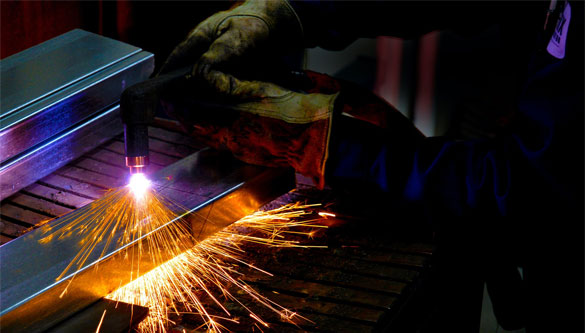
Some manufacturers prefer to use waterjet cutting, which does not generate as much heat as grinding, plasma or laser cutting.
Best practices for aluminum fabrication
Aluminum is one of the most versatile materials you have access to. The metal’s light weight, corrosion resistance, and ductility make it valuable for many applications — from food packaging to airplane wings. The wide range of types available makes it versatile as well, so it is ideal for countless applications.
However, the material isn’t always easy to work with. The right practices and tools will be necessary if you want to avoid welding defects or damage when using aluminum. Your choice of alloy, welding gas and joining method can all have a major impact on the quality of finished products made with aluminum. Once you have your strategy figured out, the results will be spectacular.
Article by —

Megan Ray Nichols
Freelance Science Writer
nicholsrmegan@gmail.com
www.schooledbyscience.com/about
Read More article