


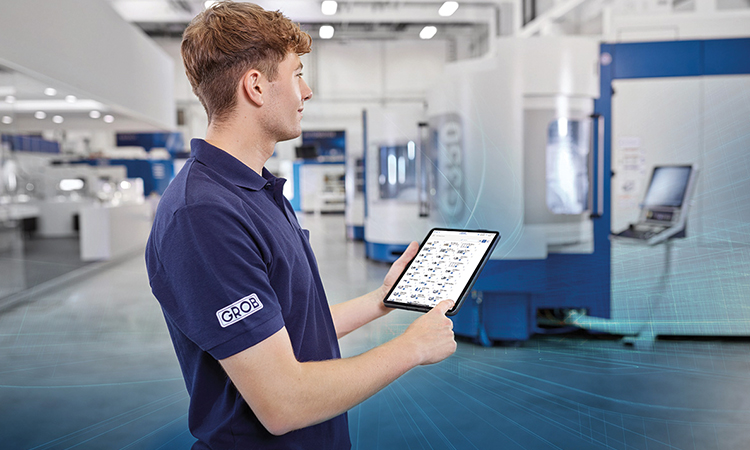
For 100 years, GROB, headquartered in Mindelheim, Germany, has been a globally operating family business engaged in the development and manufacture of production equipment and machine tools. Until now, GROB has been known primarily as a decades-long market leader in the automotive industry, which places the highest demands on process reliability, productivity, and availability. The horizontal axis concept of the G series and in-house automation have always been the guarantee of success.
They ensure maximum stability and process reliability, and thus maximum productivity in fully automated 3-shift operation 365 days a year. In combination with the extremely dynamic drives, GROB machines are perfectly suited for 5-axis simultaneous machining, even of demanding materials such as cobalt-chromium alloys or titanium.
Challenges Galore
Without a doubt, GROB offers the right basis for high-quality, reliable, and productive manufacturing of medical devices. However, the challenges of the future are complex: Production in medical technology is currently characterized by increasing requirements due to regulations such as the new Medical Device Regulation or ISO 13485. Increased documentation requirements, the establishment of traceability, and ultimately even the partial withdrawal of products from the market are leading to a significant decline in profitability. At the same time, the requirements for safe medical products are increasing in general, patent applications are on the rise, and new market entries are further intensifying global competition.
The economic management of product and process quality poses almost insurmountable problems for companies with conventional production systems, given the growing product variance, flexible batch sizes, and the increase in customized products. It is becoming apparent that the economic acquisition, management, and further processing of the necessary information in the vertical and horizontal process chain is becoming a relevant success factor in medical technology.
In reality, companies often fail to meet the prerequisites for digital consistency within the company, which enable the linking and harmonization of existing IT systems. Agile production systems require agile software systems to record and process the resulting volume of data.
Enter GROB-NET4Interface
This requires vertical and horizontal networking. This is exactly where GROB-NET4Interface comes in. The interface, developed in-house by GROB, provides the basis for vertical networking. What makes it special is that the interface was developed independently of manufacturers and control systems. The result is uniform semantics, which forms the basis for traceability. Suitable employees can use this to collect specific process and quality data and use it for performance, quality, and error analysis.
Satisfied employees and more efficient processes quickly pay for the investment. Rapid economic success can also be achieved with standard applications. These are particularly interesting for small and medium-sized companies.
With GROB4Line, for example, the live status or alarm messages of the machine can be displayed on a smartphone. This allows a person on standby duty to ensure a successful unmanned shift. In addition, GROB4Track can be used to further maximize availability through predictive maintenance. In GROB4Analyze, all machine data is recorded and its history visualized. With the Office Client, data can be correlated and evaluated using Excel.
Changes on the shop floor thus become immediately transparent. However, the interface offers far more potential, especially for medical technicians. The data is available in a uniform semantic format in near real time or, with an upgrade, in real time. Linking this data together via a graphical rule engine is relatively easy to implement.
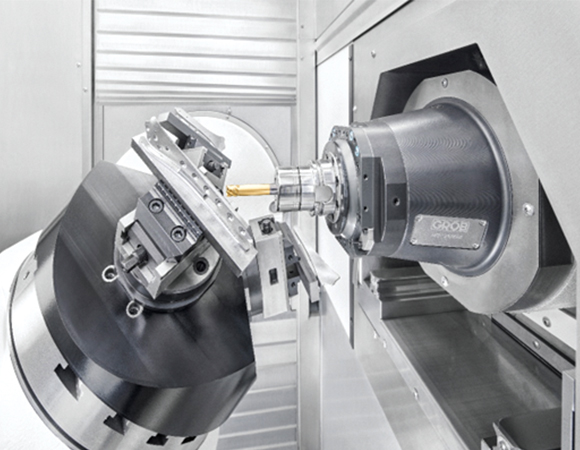
Measurement results can be automatically derived as measurement reports and loaded into the existing ERP system. GROB provides the GROB4Gateway application to securely link the data. This allows the data to be linked to the graphical rule editor. In IIoT applications, the data can be transformed into the desired documentation form with additional information. The result is simple automation of the entire documentation process. Validation and verification in accordance with the risk and quality management system can provide the basis for individual rules.
The ability to equip all machines, from milling machines to grinding machines, with the GROB interface, largely independent of control systems and manufacturers, makes fully automated documentation the next logical step. Even more complex quality characteristics can be determined thanks to the variety of machine, workpiece, tool, and process data. In cooperation with Hufschmied or Promicron, for example, vibrations at the spindle tip are recorded to ensure surface quality.
Near-real-time or, with an upgrade, real-time data makes it possible to create control loops for quality characteristics that are significantly smaller than those used in conventional quality assurance at the end of the process. This means that rejects can be identified more quickly in the process, stopped at an early stage, and excluded from further refinement. The design of the control editor also digitizes the most important potential, the experience and knowledge of the employees, and makes it internationally scalable. Self-regulating systems for the productive and process-reliable manufacture of individual medical parts under changing conditions no longer seem utopian, but rather a realistic goal for the future.
Customized MES Systems
GROB supports its customers with implementation. Its many years of broad experience go beyond the development of standardized applications. For example, GROB has already developed customized MES systems for customers. Employees can be integrated into the system in a company-specific manner and their actions can be documented as needed.
Together with its customers, GROB is taking rapid and significant steps toward digitalization, thereby securing a long-term competitive advantage for its customers. GROB offers the perfect conditions for seeing not only challenges but, above all, opportunities in the future.