

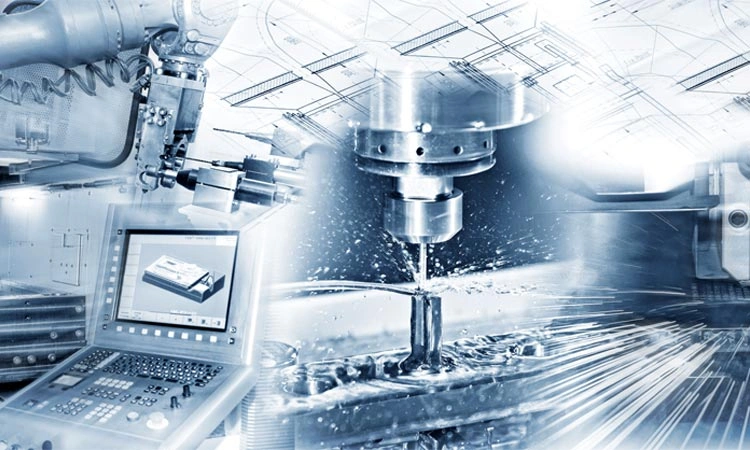
Integrating the Best of Both Worlds to Redefine Modern Manufacturing
Manufacturing is undergoing a profound transformation as industries demand faster production, greater design flexibility, higher precision, and improved resource efficiency. Traditional manufacturing processes, while highly effective, often require compromises between complexity, cost, and lead time. At the same time, additive manufacturing (AM), popularly known as 3D printing, has emerged as a disruptive technology capable of producing intricate geometries that were once impossible to manufacture. However, additive manufacturing alone cannot always deliver the dimensional accuracy, surface finish, and productivity required for many industrial applications. The answer lies in hybrid manufacturing-a revolutionary approach that combines additive and subtractive manufacturing technologies into a single, integrated production process. By leveraging the strengths of both methods, hybrid manufacturing enables manufacturers to build complex components layer by layer and then finish them to exact specifications through precision machining. As industries such as aerospace, defence, automotive, energy, medical devices, and tooling continue to push the boundaries of engineering, hybrid manufacturing is rapidly becoming one of the most promising production technologies of the Industry 4.0 era.
Understanding Hybrid Manufacturing
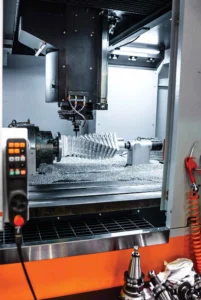
Hybrid manufacturing refers to the integration of additive manufacturing processes with conventional subtractive machining operations, often within a single machine or production cell.
In a typical hybrid manufacturing system, material is first deposited using technologies such as laser metal deposition (LMD), directed energy deposition (DED), or wire arc additive manufacturing (WAAM). Once the required geometry has been built, CNC milling, turning, grinding, or drilling operations are performed to achieve the desired dimensional accuracy, surface finish, and functional characteristics.
Unlike standalone additive or subtractive systems, hybrid machines seamlessly alternate between depositing material and machining it, eliminating the need to transfer workpieces between different machines.
This integration significantly improves productivity while reducing setup time, handling errors, and production costs.
Why Hybrid Manufacturing Matters
Neither additive nor subtractive manufacturing is perfect in isolation.
Additive manufacturing excels at producing complex geometries, internal cooling channels, lattice structures, lightweight components, and customised parts with minimal material waste. However, it often struggles with surface finish, tight tolerances, and machining-critical features.
Subtractive manufacturing, on the other hand, delivers exceptional dimensional accuracy, excellent surface quality, and high repeatability but can generate considerable material waste, especially when machining expensive alloys from solid billets.
Hybrid manufacturing bridges these limitations by combining the design freedom of additive manufacturing with the precision and reliability of conventional machining.
The result is a production process that is faster, more flexible, and significantly more economical for many high-value applications.
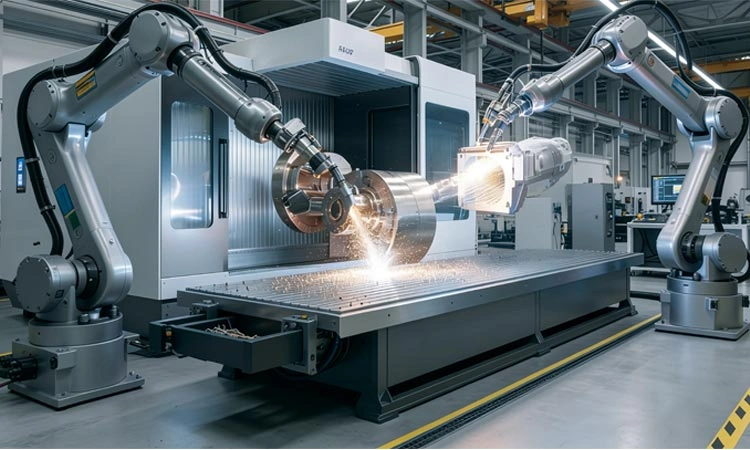
The Technology Behind Hybrid Systems
Modern hybrid manufacturing machines integrate multiple advanced technologies into a single platform.
Directed Energy Deposition (DED)
One of the most widely adopted additive processes in hybrid systems is Directed Energy Deposition. A focused laser or electron beam melts metal powder or wire as it is deposited onto the workpiece.
DED is particularly suitable for:
- Repairing worn components
- Adding features to existing parts
- Manufacturing near-net-shape components
Producing large metal structures
Laser Metal Deposition (LMD)
Laser Metal Deposition enables controlled deposition of metallic materials with excellent metallurgical bonding.
It is widely used for:
- Turbine blade repair
- Mould refurbishment
- Aerospace component restoration
- High-value tooling
Wire Arc Additive Manufacturing (WAAM)
WAAM uses welding technology to deposit metal rapidly.
Its advantages include:
- High deposition rates
- Lower material cost
- Capability to manufacture large components
- Reduced production time
It has become increasingly popular in shipbuilding, defence, heavy engineering, and energy sectors.
Precision CNC Machining
Once material deposition is completed, integrated CNC machining performs:
- Milling
- Turning
- Drilling
- Boring
- Grinding
- Thread cutting
These operations ensure that the finished component meets stringent industrial tolerances and surface quality requirements.
Advantages of Hybrid Manufacturing
Reduced Material Waste
Traditional machining may remove up to 90 per cent of the raw material when producing complex aerospace components.
Hybrid manufacturing deposits material only where required, dramatically reducing material consumption.
This is especially valuable when machining costly materials such as titanium, Inconel, cobalt-chromium, and nickel-based superalloys.
Complex Geometries Become Practical
Hybrid systems make it possible to manufacture:
- Internal cooling channels
- Lightweight lattice structures
- Organic shapes
- Conformal cooling passages
- Integrated assemblies
Many of these geometries are impossible or prohibitively expensive to produce using conventional machining alone.
Shorter Lead Times
Manufacturers no longer need multiple production stages involving separate additive and machining operations.
Since deposition and machining occur within one machine, production cycles become significantly shorter.
This is particularly valuable for prototype development, low-volume production, and customised manufacturing.
Repair Instead of Replacement
One of the biggest advantages of hybrid manufacturing is component repair.
Instead of discarding expensive worn parts, manufacturers can rebuild damaged areas using additive deposition and restore them through precision machining.
Industries repairing high-value components include:
- Aerospace
- Mining
- Oil and gas
- Power generation
- Defence
The economic savings can be substantial.
Improved Component Performance
Hybrid manufacturing allows engineers to optimise material placement.
Different alloys may be deposited only where specific properties such as wear resistance, corrosion resistance, or heat resistance are required.
This creates functionally enhanced components while reducing overall weight and material cost.
Industrial Applications
Aerospace
Aircraft manufacturers increasingly employ hybrid manufacturing for producing lightweight structural parts, turbine components, fuel nozzles, and engine casings.
The technology enables substantial weight reduction while maintaining structural integrity and precision.
Automotive
The automotive industry uses hybrid manufacturing for:
- Prototype development
- High-performance engine components
- Lightweight structural parts
- Tooling
- Injection mould inserts
Shorter product development cycles significantly reduce time-to-market.
Medical Devices
Patient-specific implants, surgical instruments, and orthopaedic devices benefit enormously from hybrid manufacturing.
Complex implant geometries can be additively manufactured while critical surfaces are precision machined for perfect fit and finish.
Tool and Die Industry
Toolmakers increasingly use hybrid systems for:
- Mould repair
- Die restoration
- Conformal cooling channels
- Rapid tooling
Injection moulds with conformal cooling significantly reduce cycle times while improving product quality.
Energy and Heavy Engineering
Gas turbines, hydro turbines, drilling equipment, and power generation components frequently require expensive repairs.
Hybrid manufacturing extends component life through precise material deposition and machining.
Digital Manufacturing Drives Hybrid Success
Hybrid manufacturing fits naturally into the broader Industry 4.0 ecosystem.
Modern systems incorporate:
- CAD/CAM integration
- Digital twins
- Process simulation
- AI-assisted toolpath optimisation
- In-process monitoring
- Laser scanning
- Adaptive machining
- Industrial Internet of Things (IIoT)
Real-time feedback ensures consistent quality while reducing production errors.
Artificial intelligence can automatically adjust deposition parameters based on thermal conditions, material behaviour, and machining performance.
Challenges to Wider Adoption
Despite its enormous potential, hybrid manufacturing still faces several challenges.
High Capital Investment
Hybrid machines combine sophisticated additive systems with advanced CNC platforms, making them significantly more expensive than conventional machine tools.
However, lower production costs and higher flexibility often justify the investment over the long term.
Process Complexity
Successfully integrating additive and subtractive operations requires careful process planning.
Manufacturers must optimise:
- Deposition parameters
- Heat management
- Toolpaths
- Material compatibility
- Residual stress control
This demands advanced engineering expertise.
Workforce Development
Operating hybrid manufacturing systems requires multidisciplinary skills.
Engineers must understand:
- CNC machining
- Additive manufacturing
- Metallurgy
- CAD/CAM
- Robotics
- Process simulation
- Inspection technologies
Training and skill development remain essential for widespread adoption.
Standards and Certification
Industries such as aerospace, medical devices, and defence require rigorous certification.
Developing globally accepted standards for hybrid manufacturing processes remains an ongoing effort.
Quality assurance, repeatability, and process validation will continue to receive considerable attention.
India’s Growing Opportunity
India’s push towards advanced manufacturing presents an ideal environment for hybrid manufacturing.
Initiatives such as Make in India, Atmanirbhar Bharat, defence indigenisation, semiconductor manufacturing, aerospace expansion, and the growing electric vehicle ecosystem are creating strong demand for advanced production technologies.
Indian machine tool manufacturers are increasingly collaborating with research institutions, technology providers, and academia to develop indigenous hybrid manufacturing capabilities. Research organisations and engineering institutes are also exploring metal additive manufacturing, laser-based deposition, and advanced machining techniques suited to Indian industrial requirements.
The country’s strengths in software development, precision engineering, automation, and digital manufacturing provide a strong foundation for accelerating the adoption of hybrid manufacturing technologies. As more industries recognise the economic benefits of repair, remanufacturing, and near-net-shape production, hybrid manufacturing is expected to gain significant traction across sectors.
The Road Ahead
Hybrid manufacturing is far more than the convergence of additive and subtractive processes; it represents a new philosophy of manufacturing that combines innovation, efficiency, and sustainability. By enabling manufacturers to build complex geometries with minimal waste and finish them to exceptional precision, it unlocks possibilities that neither technology could achieve independently.
As machine builders continue to integrate intelligent software, artificial intelligence, automation, and real-time process monitoring into hybrid systems, these machines will become even more capable, flexible, and accessible. Their ability to repair high-value components, reduce material consumption, shorten lead times, and manufacture high-performance parts will make them indispensable in the factories of the future.
For India, embracing hybrid manufacturing is not merely about adopting a new production technique-it is about strengthening technological self-reliance, enhancing global competitiveness, and moving up the manufacturing value chain. With continued investment in research, skills, and industrial collaboration, hybrid manufacturing is poised to become a cornerstone of next-generation manufacturing, where the precision of subtractive machining and the design freedom of additive manufacturing work together to shape a smarter, more sustainable industrial future.