

Die and mould manufacturing occupies a pivotal position in modern industrial production. From automobiles and consumer electronics to medical devices and packaging materials, dies and moulds form the foundation upon which mass manufacturing is built.
Virtually every product manufactured in large volumes relies on precision tooling to shape, form, stamp, or mould components. As a result, the quality, efficiency, and competitiveness of manufacturing industries are closely linked to the strength of their die and mould sector. At the heart of this sector lies the machine tool industry.
Machine tools provide the technological backbone for producing high-precision dies and moulds capable of withstanding demanding production cycles. Without advanced machining capabilities, the creation of sophisticated tooling required by modern industries would simply not be possible.
Machine Tools – The Mother Machines of Tooling
Machine tools are often referred to as the “mother machines” of manufacturing because they produce the components and tooling that enable other machines to operate. In die and mould manufacturing, machine tools perform the critical functions of shaping, cutting, drilling, grinding, and finishing tool steels and other hard materials into precise geometries.
Dies and moulds must meet extremely tight tolerances because even a minor deviation in dimensions can lead to defective products in large-scale production. Hence, machine tools used in this sector must deliver exceptional rigidity, accuracy, and repeatability. Modern machining equipment ensures that tooling components maintain dimensional integrity throughout long production runs.
From Craftsmanship to CNC Precision
Historically, die and mould manufacturing relied heavily on manual machining and the craftsmanship of skilled machinists. Conventional lathes, milling machines, and grinders were used to shape hardened materials, often requiring long hours of meticulous work. While the role of skilled operators remains important, technological advancements have transformed the sector with the introduction of Computer Numerical Control (CNC) machines.
CNC machining centers have revolutionized die and mould production by enabling manufacturers to produce complex shapes with remarkable precision. These machines follow computer-generated instructions that guide cutting tools along programmed paths, ensuring consistent accuracy and repeatability. Complex mould cavities and intricate die geometries can now be manufactured with minimal human intervention, significantly improving productivity and reducing errors.
High-Speed Machining and Multi-Axis Capabilities
High-speed machining technology has become a cornerstone of modern die and mould manufacturing. CNC machining centers equipped with high-speed spindles can remove material rapidly while maintaining excellent surface quality. This capability significantly reduces machining time during the roughing and semi-finishing stages of die production.
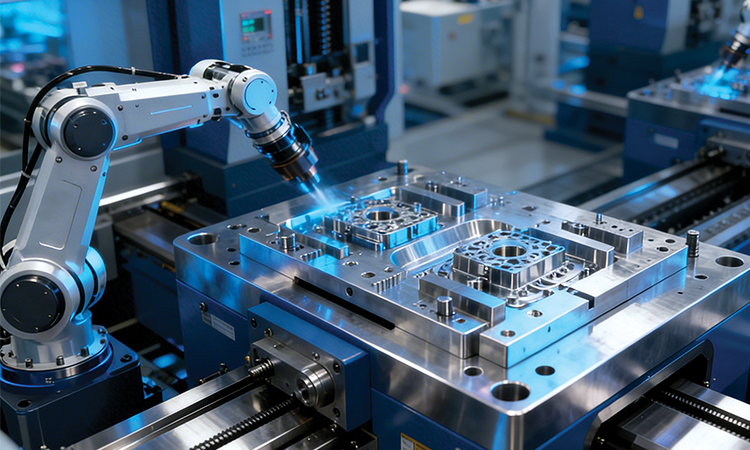
Another important advancement is the use of multi-axis machining centers, particularly five-axis machines. These machines allow simultaneous movement along multiple axes, enabling manufacturers to machine complex geometries in a single setup. By reducing the need for repeated repositioning of the workpiece, multi-axis machining improves accuracy and shortens production cycles. Such capabilities are especially valuable in moulds used for automotive components, electronic housings, and intricate plastic parts.
EDM Technology: Shaping Complex Cavities with Accuracy
Electrical Discharge Machining (EDM) has become indispensable in the die and mould industry. EDM works by eroding material using controlled electrical sparks between an electrode and the workpiece. This process allows manufacturers to machine extremely hard materials and create intricate shapes that would be difficult or impossible to achieve using traditional cutting methods.
EDM is particularly useful for producing deep cavities, sharp corners, and complex contours commonly required in injection moulds and stamping dies. Wire-cut EDM machines further enhance this capability by allowing extremely precise cutting of profiles and shapes, making them ideal for punch and die manufacturing.
Grinding and Finishing for Micron-Level Perfection
Achieving high dimensional accuracy and superior surface finish is essential in die and mould manufacturing. Grinding machines play a vital role in meeting these stringent requirements. Surface grinding, cylindrical grinding, and jig grinding are widely used to refine machined components and achieve precise tolerances.
Precision grinding ensures that mating surfaces in dies align perfectly, enabling consistent product quality during mass production. In many cases, fine finishing processes are followed by manual polishing to achieve mirror-like surfaces required for certain mould applications, particularly in the production of optical components and high-quality plastic products.
Material Challenges in Die & Mould Production
Dies and moulds are typically manufactured from hardened tool steels, alloy steels, or carbide materials designed to withstand extreme pressures, high temperatures, and repeated wear during production. Machining these materials presents unique challenges, requiring robust machine tools equipped with advanced cutting technologies.
Modern machine tools incorporate features such as high-rigidity structures, precision ball screws, thermal stability systems, and advanced spindle designs to ensure accurate machining even under demanding conditions. High-performance cutting tools and effective cooling systems also play an important role in improving machining efficiency and tool life.
CAD/CAM Integration Streamlining Tooling Processes
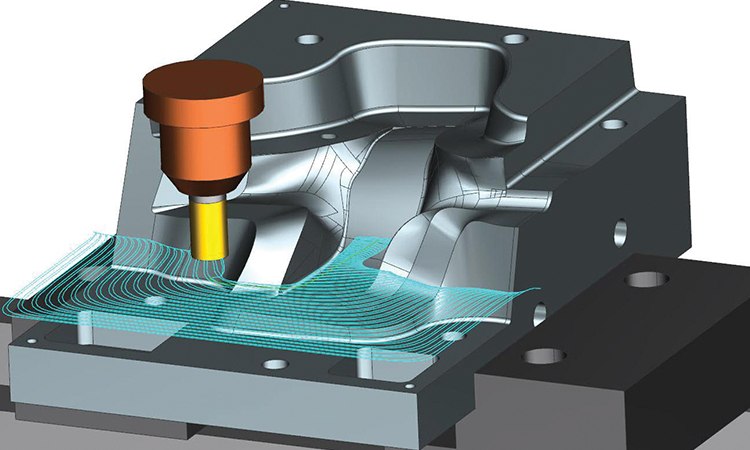
The integration of Computer-Aided Design (CAD) and Computer-Aided Manufacturing (CAM) systems has greatly enhanced the efficiency of die and mould manufacturing. Engineers can design detailed three-dimensional models of dies and moulds using CAD software. These digital models are then converted into machining instructions using CAM systems.
This seamless integration allows manufacturers to optimize tool paths, reduce machining time, and improve accuracy. Advanced simulation tools further enable engineers to visualize machining operations before production begins, helping identify potential errors or collisions and ensuring smoother manufacturing processes.
Automation and Smart Manufacturing in Tool Rooms
Automation is increasingly becoming a key feature in modern tool rooms. Machine tools equipped with automated tool changers, pallet changers, and robotic loading systems enable continuous operation with minimal manual intervention. Such automation improves productivity and allows manufacturers to maintain consistent quality standards.
Industry 4.0 technologies are also making their way into die and mould manufacturing. Smart sensors, machine monitoring systems, and data analytics tools provide real-time insights into machine performance, enabling predictive maintenance and improved operational efficiency.
Metrology and Quality Assurance in Precision Tooling
Precision measurement is an essential part of die and mould production. Coordinate measuring machines (CMMs), laser scanners, and optical inspection systems are widely used to verify that tooling components meet design specifications. Accurate measurement ensures that any deviations are identified early in the production process.
Some advanced machine tools now incorporate in-process measurement systems that allow dimensional checks during machining itself. This reduces the likelihood of errors and helps maintain tight tolerances throughout the manufacturing process.
Additive Manufacturing and Hybrid Tooling Solutions
Additive manufacturing is beginning to influence die and mould production as well. Hybrid manufacturing systems that combine additive processes with CNC machining are capable of building complex mould components layer by layer and then finishing them with precision machining.
One of the most significant advantages of this approach is the ability to create conformal cooling channels inside moulds. These cooling channels improve heat dissipation during injection moulding, leading to shorter production cycles and better product quality.
Strengthening India’s Die & Mould Ecosystem
In emerging manufacturing economies, strengthening the die and mould sector is essential for industrial growth. India, in particular, has been investing in the development of advanced tool rooms, training institutes, and manufacturing clusters dedicated to tooling and machine tools.
Growing demand from industries such as automotive, electronics, consumer appliances, and packaging is driving the need for high-quality dies and moulds. As Indian manufacturers adopt advanced machine tools and modern manufacturing technologies, the country is gradually enhancing its capabilities in precision tooling.
The Future: Digital, Intelligent, and Highly Precise Manufacturing
The future of die and mould manufacturing will be shaped by rapid technological advancements in machine tools. Artificial intelligence, digital twins, smart sensors, and real-time data analytics will enable machine tools to become more intelligent and adaptive. These technologies will allow machines to monitor their own performance, predict maintenance requirements, and optimize machining parameters automatically.
As manufacturing industries continue to demand greater precision, faster production cycles, and increasingly complex product designs, machine tools will remain central to the evolution of the die and mould sector. The continued advancement of machine tool technology will therefore play a decisive role in shaping the future of manufacturing worldwide.