

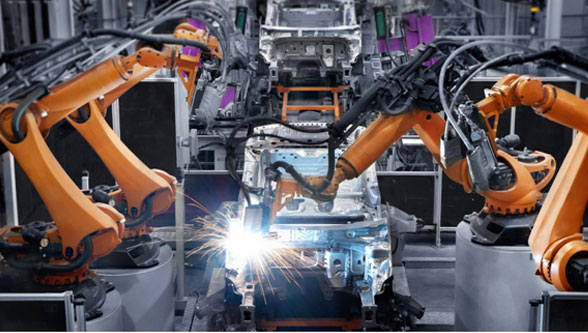
Today’s industrial robots work in a wide range of industries, from semiconductors and automobiles to plastics processing and metal forging. Pretty much any repetitive operation is a great job for a robot, particularly if it’s dangerous or difficult for humans. Robots have been used for high-volume operations, but as the technology advances and costs declines, more options and opportunities are opening even for medium- and small-sized operations. At the same time, these robots are helping manufacturers address many of the key challenges they face, including tight labour pools, global market competitiveness and safety.
Automobile manufacturing robots give car companies a competitive advantage. This is due to the fact that robotics enhance quality and reduce warranty costs; boost capacity and relieve bottlenecks; and protect workers from dirty, difficult and dangerous jobs. Usually, auto assembly factories use robots exclusively for spot welding and painting, but there are also several other opportunities to use robots throughout the supply chain. Using robotics benefit OEMs, Tier 1s and all other part producers in the car manufacturing industry.
Generally, manufacturers turn to robots for various reasons. Three biggest drivers in the automotive industry are quality, capacity and safety.
Auto plant robots reduce part-to-part variability. Robots perform highly repeatable processes, they never tire or get distracted like human labour, so every cycle is performed the same way. They do not drop parts or mishandle them in a way that causes damage. As a result, it reduces waste caused by human error, which leads to less variability in car assembly. Additionally, robots are equipped with vision systems and they can even detect variation in incoming materials and adapt their programmed paths suitably. Needless to say, that this translates to better customer satisfaction, lesser mistakes and lower warranty costs.
In an automobile assembly line, robots protect workers from exposure to fumes from welding and painting, as well as weld flash and the noise of stamping presses. For manufacturers, automotive robotics cut down accidents and injury claims, by removing workers from these dirty and dangerous tasks and environments.
Advantages of industrial robots
- Better quality and consistency: Along with other tech — such as the industrial internet of things (IIoT) or 3D printing robots — industrial robots are able to provide better production quality and more precise and reliable processes. Additionally, benefits also include reduced cycle times and real-time monitoring to improve preventive maintenance practices.
- Maximum productivity and throughput: An industrial robot increases speed for manufacturing processes, in part by operating 24/7. Unlike humans, robots do not need any break or shift changes. The speed and dependability of robots ultimately reduce the cycle time and maximise throughput.
- Greater safety: Using robots for repetitive tasks means fewer risks of injury for workers, especially when manufacturing has to take place under hostile conditions. There is no need for human presence at the site as supervisors can oversee the process online or from a remote location.
- Lower investment in labour costs: The cost of having a person handle many manufacturing operations is often more expensive than robot. Deploying robots instead of human resource can free up workers so their skills and expertise can be used in other spheres such as engineering, programming and maintenance.
- Keeping manufacturing open to jobs: There is an argument that robots are taking jobs away from U.S. workers, but that’s not necessarily true. Industrial robots in the US are usually integrated into a series of operations that require human expertise. For instance, you may deploy a robot for welding parts which are then handed over to a person to perform a task that requires a human’s intuitive “if, then” thinking.
There are also certain disadvantages of industrial robots
- High initial investment: Robots typically require a large upfront investment. In the process of gathering information about your business to purchase robots, you need to take into consideration all the costs, including installation and configuration. It is necessary that you analyse whether your robot can be easily tweaked if you need to alter operations in the future.
- Scarce expertise: Industrial robots demand sophisticated operation, maintenance and programming. Although the number of skilled people is growing still it’s not enough. In view of this it’s important to focus on the investment you’ll need to make to bring in that expertise or “retool” your existing staff to take on the task.
- Recurring costs: Industrial robots may cut down some manufacturing labour costs but they do come with their own ongoing expenses, such as maintenance. Additionally, you must consider the costs to keep your robot and any related IIoT connected devices protected from cyberthreats.
Robots are most commonly used in the following areas of auto manufacturing:
- Collaborative Robots
- Robotic Painting
- Robotic Welding
- Robotic Assembly
- Material Removal
- Part Transfer and Machine Tending
In conclusion we would like to mention that robots and artificial intelligence have been used in the automotive industry for quite some time now. Today they are used in many different aspects of automobile manufacturing but the ambit of robotic in the automobile sector is growing by leaps and bounds.
Article by Arijit Nag
Arijit Nag is a freelance journalist who writes on various aspects of the economy and current affairs.