


Optical measurement techniques play an essential role in the increasing automation of manufacturing and inspection processes. Most modern laser triangulation technology is responsible for fast, high precision and reliable measurements of manufactured components and their measuring points. Measurement data is generally available in real time and so can be used to automatically correct and control the production process
Optimised processes improve product quality, reduce raw materials and energy, which minimises production costs. With its wide range of precision, high speed optical displacement and distance measurement sensors, for many years Micro-Epsilon has held a leading position in the market for non-contact measurement technology. The triangulation principle involves the measurement of distance on a wide range of material surfaces where different measurement techniques are employed: the measurement of displacement, distance and position using a laser point, and profile or gap measurement using a laser line. Regardless of how different these techniques are, they are united by their high precision, high speed and reliability.
Laser point sensors
The laser triangulation principle is based on a simple geometric relation. A laser diode transmits the laser beam onto the measurement object. A lens focuses the reflected rays onto a CCD/CMOS array. The distance to the measurement object can be determined by the three-point relationship be-tween the laser diode, the measuring point on the target object, and the pro-jection on the CCD array. The measurement resolution can achieve a frac-tion of a micrometre. As well as analogue interfaces, digital interfaces are also available for direct connection with the existing environment. Sensors with digital interfaces are configured via an external PC.
Laser-based optical displacement sensors measure from a large distance to the target using a very small spot which enables measurements on the very small parts. The large measurement distance in turn enables measurements to be taken against difficult target surfaces such as hot metals. The non-contact principle enables wear-free measurements as the sensors are not subject to any physical contact with the target. Furthermore, the laser triangu-lation principle is ideal for very fast measurements with high accuracy and resolution.
One example that requires fast, high precision measurements in a minimum design envelope are automated pick-and-place machines. Here the laser point sensors demonstrate their advantages when it comes to quality control of tiny components as these must be positioned the correct side up, at the correct location and at the correct height. Other challenges include the in-spection of even smaller IC pins of a component in order to check that they are positioned at precisely the correct distance from the circuit board. These pins later enable connection to the circuit board. In order to guarantee proper soldering, the distance between both components must not be too high. The so-called ‘coplanarity’ indicates if all the pins are arranged in line with each other and is therefore considered to be the critical factor that must be in-spected using high precision measurement technology. The component is guided over a triangulation displacement sensor whose laser beam scans the pins. After calculation of the distance values, the sensor arrives at a decision on whether the component should be placed or removed. The requirements on the measurement technology are enormous; not only because the parts are extremely small, but also primarily due to the rapid change from shiny to matt surfaces. The pins consist of a shiny metal, whereas the circuit board presents a matt surface. Therefore, the receiver element in the sensor is at frequent intervals alternately exposed to strong and then weak reflections – a task that the optoNCDT 1420 laser sensors are optimised to perform. The Auto Target Compensation (ATC) feature provides fast control of different reflections and enables a smooth signal frequency of the distance signal.
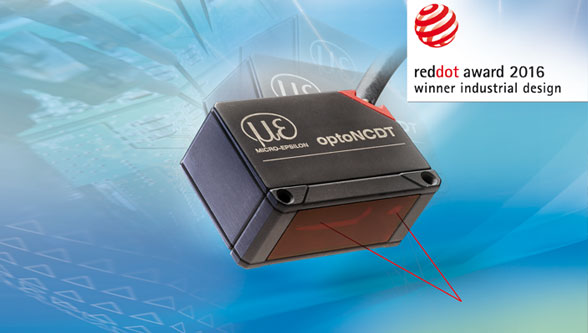
With the optoNCDT 1320/1420 laser sensors, Micro-Epsilon sets new stand-ards in laser triangulation in terms of functionality and design which has re-cently been awarded with the Red Dot Award Industrial Design 2016. Since 1954, the “Red Dot” award has been a globally acknowledged seal of quality. These laser sensors stand out due to their perfect and unique combination of various characteristics. The extremely small laser spot size, which is focused through an optical system to a very small diameter, enables the measure-ment of extremely fine details. Their compact design without external control-ler enables their installation in restricted space and even the integrated evalu-ation electronics is space-saving and simplifies cabling. Furthermore, the ex-cellent price/performance ratio and the innovative web interface, which sim-plifies sensor set up by providing predefined set ups for different surfaces (e.g. circuit boards). As well as in the electronics production, the laser sensors are also applied in the packaging industry, wood processing, logistics, medi-cal engineering, laser engraving equipment and quality assurance.
Laser line triangulation
As well as for the inspection of one-dimensional quantities, there is a demand for the multi-dimensional quality control in industrial production. Laser profile scanners are increasingly used for profile and contour measurement applica-tions. Their operating principle is based on the laser triangulation technique for two-dimensional profile detection. They detect, measure and evaluate the profiles on different object surfaces. By using special lenses, a laser beam is enlarged to form a static laser line instead of a point and is projected onto the target surface. An optical system projects the diffusely reflected light of this laser line onto a highly sensitive sensor matrix. In addition to distance infor-mation (z-axis), the controller also uses this camera image to calculate the position along the laser line (x-axis). These measured values are then output in a two-dimensional coordinate system that is fixed with respect to the sen-sor. In the case of moving objects or a traversing sensor, it is therefore possi-ble to obtain 3D measurement values. Laser scanners are equipped with an integrated, highly sensitive receiving matrix that enables measurements on almost all industrial materials, largely independent of the surface reflexion.

The inspection of adhesive beading in smartphone housing is a typical appli-cation. A particular challenge here is the very fine contours inside the smartphone and extremely thin, partially semi-transparent adhesive beading. Here, absolute reliability and 100 per cent control of the completeness of the beading, the height and width of the applied adhesive are required. This also applies to the logos on tablets and laptops: grooves are milled into the alumin-ium housing, in which the logo elements are glued afterwards. The latter must be flush with the housing. Haptics (i.e. touch sensation) is a critical factor, as the customer would immediately feel any protruding logo or depression. Us-ing laser line scanners, these depressions are measured in order to determine the planarity as well as the depth. The parts being glued are also measured in order to ensure a perfect fit.
Laser profile scanners operate with a red or more recently a blue laser line. From the very early days, these optical standard sensors used a red laser light as the receiving element as this had the highest sensitivity. With a lot of applications, the laser profile scanner using a red laser line provides precise results. However, when detecting red-hot glowing, transparent or organic ob-jects, the red laser has limitations. Micro-Epsilon has revolutionised this tech-nology and presented some years ago a world first: the Blue Laser Technolo-gy in the form of laser point sensors. Unlike the red laser, the blue laser light does not penetrate the measurement object and projects a sharp line. There-fore, red-hot glowing and organic objects can be measured reliably and with high precision.

The scanCONTROL 29xx-10/BL sets a new standard in terms of profile reso-lution. Equipped with Micro-Epsilon’s innovative Blue Laser technology, the new model provides an effective measuring range of just 10mm with a profile resolution of 1280 points. This results in a point distance of just 7.8µm, which enables the laser profile scanner to provide twice the resolution of previous laser scanners with a 25mm measuring range. These special characteristics enable these laser scanners to detect even smallest parts with highest preci-sion. Therefore, reliable quality control involving the monitoring of individual production steps is necessary. The combination of compact scanner, integral controller and different interfaces makes this laser profile scanner highly suit-able for inline applications and for dynamic production control.

Measurement and inspection systems using laser triangulation
Triangulation sensors are also used in measurement systems e.g. for thick-ness measurement of metals. The principle of dimensional, geometric thick-ness measurement includes one optical distance sensor on each side of the material. Thickness measurement using laser point sensors is based on one point respectively, whereas in thickness measurements using laser profile sensors, the entire laser line is processed. For thickness measurement during production, the difference between the sum of the distance signals and the value of the operating range is determined. Both laser lines must be projected congruently onto the top side and the rear side of the material in order to achieve an accurate thickness measurement.
The right choice
With its high precision, measurement speed, compact size and fast data pro-cessing, non-contact measurement technology offers many benefits. The user can choose from different measurement systems. Each principle comes with its own particular advantages and limitations that all need to be carefully considered. As demanding applications require e.g. higher resolution, robust-ness, temperature stability, linearity or special mounting and installation condi-tions, Micro-Epsilon offers special solutions and custom designs that are adapted to the customer’s specifications.