

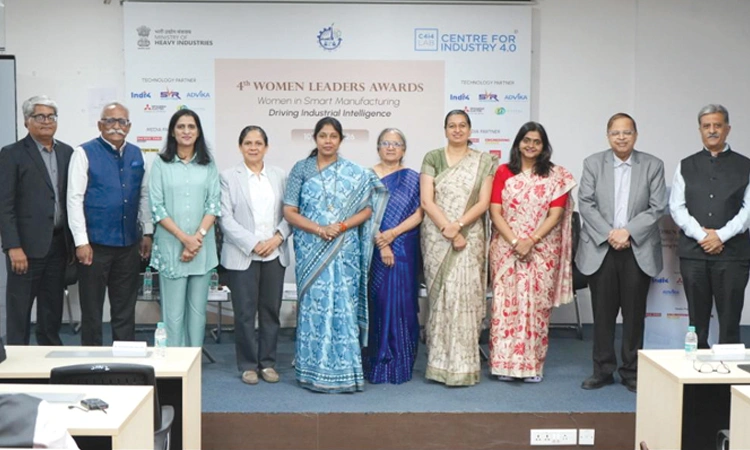
At a time when manufacturing systems are undergoing accelerated digital integration, the 4th Edition of the Women Leaders Awards in Digital Transformation 2026 alongside the Industrial Intelligence Expo, concluded successfully at the Savitribai Phule Pune University Research Park on the 10th of April, convened by the Centre for Industry 4.0 (C4i4) Lab. The event brought together industry, academia, policymakers, and technology providers to examine applied use of artificial intelligence, industrial IoT, and data-led systems within production environments.
With the global Industry 4.0 market expected to exceed USD 400 billion by 2030 and India working toward increasing manufacturing contribution to 25% of GDP, the event positioned industrial intelligence as a central operational layer within production systems, supported by enterprise-wide integration and workforce readiness.
The inaugural session was attended by Chief Guests Ms. Manjusha Nagpure, Mayor, Pune Municipal Corporation and Ms. Rashmi Urdhwareshe, Former Director, Automotive Research Association of India (ARAI) and Non-Independent Director, along with Guest of Honour Ms. Mohini Kelkar, President, Indian Machine Tool Manufacturers’ Association (IMTMA) and Founder, Grind Master Machines Pvt. Ltd.
The event was further marked by the presence of Prof. Dr. Suresh Gosavi, Honourable Vice Chancellor, Savitribai Phule Pune University, and Dr. Parag Kalkar, Pro Vice Chancellor, Savitribai Phule Pune University and Director, Sinhgad Institute of Management, representing academic leadership within the ecosystem.
In his address, Mr. Dattatraya Navalgundkar, Co-founder, Centre for Industry 4.0 (C4i4) Lab, outlined the organisation’s evolution since its inception, mentioning, “We started with a small team and today we have expanded across multiple locations in India, working closely with both MSMEs and large enterprises. The trust that industry has placed in us has been significant.” He highlighted that the organisation has grown to over 90 professionals, largely under the age of twenty-five, supported by a reinvestment-led approach focused on talent and infrastructure. Addressing participation in advanced technology domains, he noted that women’s representation in data science and automation remains limited globally, adding, “The intent of this platform is to recognise contributions and encourage greater participation across engineering and digital domains.”
The Women Leaders Awards recognised Ms. Kamna Sama, Chief Technology and Information Officer, Volkswagen Group Technology Solutions India, Pune; Ms. Neha Misra, Portfolio Leader – Supply Chain Digitization and Smart Manufacturing, Webtec Corporation; and Ms. Sneha Israni, Director – Projects and Engineering, Bekaert India, for their contributions to industrial and digital transformation.
The jury panel included Mr. Krishna Bhojkar, Partner, Bhojkar Consulting and Former CGM, Škoda Auto Volkswagen India; Mr. Manish Kulkarni, Co-founder and Director, Pro MFG Media Pvt. Ltd.; and Mr. PV Sivaraman, Advisor, C4i4 Lab. Speaking on the evaluation criteria, Mr. Krishna Bhojkar shared, “The recognition goes beyond measurable results. It includes the ability to influence mindset, create organisational impact, and bring thought leadership into industrial systems. Change begins with the thought process.”
A central part of the event was the panel discussion moderated by Mr. Krishna Bhojkar, where industry leaders examined the realities of implementing industrial intelligence across organizations.
Responding to the evolving role of artificial intelligence, Ms. Kamna Sama stated, “The first fundamental aspect is to remove the fear associated with AI. It will amplify human intelligence, it will not replace it.” She elaborated on how AI is being applied within manufacturing ecosystems to address foundational data challenges, including cleansing, correlation, and structuring of sensor-based datasets. Referring to implementation within global operations, she noted, “Earlier, data interpretation required multiple interventions. Today AI enables rapid cleansing and correlation, significantly improving efficiency.” She also accentuated the role of factory cloud systems, knowledge graph architectures, and GenAI-based tools in quality and material intelligence, while pointing to enterprise-wide integration across IT, HR, and finance. On leadership and participation, she added, “Having a voice on the table is critical. Participation alone is not enough; ideas need to be expressed with conviction.”
Addressing the measurement of transformation outcomes, Ms. Neha Misra added, “Digital initiatives must align with business ambition. When technology is implemented without that alignment, value realisation remains limited.” She emphasised the importance of addressing root causes within processes, explaining that metrics such as cost of quality often originate in gaps between design, manufacturing, and execution. “ROI is realised when cross-functional systems work together and when organisations address process inefficiencies before digitisation,” she added, spotlighting the need for interoperability across R&D, engineering, manufacturing, and quality functions.
Providing an execution perspective, Ms. Sneha Israni said, “The real challenge is not legacy systems, it is legacy thinking.” She also pointed to organizational culture as a key factor influencing adoption of digital systems, adding, “Unless the right people are involved at the right time, acceptance does not happen, and without acceptance, sustenance is not possible.”
Moreover, stressing the importance of prioritisation, Ms. Sneha noted that organizations must identify industry-specific challenges and avoid applying digital solutions across all areas without focus.
Offering an entrepreneurial perspective, Ms. Mohini Kelkar shared insights based on her experience building Grind Master Machines Pvt. Ltd., stating, “Garage and global are both mindsets.” She described the company’s growth since 1984, starting with an initial investment of Rs. 25,000 and expanding into global markets including the United States, Germany, Japan, and China. Referring to value creation, Mohini expressed, “We should move away from the idea of being a low-cost country. If we create value, customers will pay for it.” She further pointed out the importance of engineering fundamentals, adding, “Processes such as finishing, tooling, and design remain critical. Technology adoption must be supported by strong engineering practices.” She also cited examples of competing with global manufacturers through innovation and risk acceptance, including successful engagements with major automotive companies under stringent operational requirements.
The Industrial Intelligence Expo complemented these discussions through live demonstrations of connected systems, robotics applications, and AI-enabled manufacturing environments, allowing participants to engage with real-world implementation frameworks.
The event wrapped up on a forward-looking note with participation from industry delegates, C4i4 Lab management, and media partners including Cover2Voice, Engineering Review, Machine Tools World, and Cutting Tools World. Discussions across sessions indicated that the next phase of industrial growth will depend on the integration of digital systems with operational processes, backed by workforce capability and strong leadership presence. The increasing participation of women across engineering, data systems, and industrial leadership roles showcases a transformation, contributing to the advancement of industrial digitization and innovative engineering in India within the global manufacturing ecosystem.