

Manufacturing today is undergoing a profound transformation, driven by rapidly changing customer demands, shorter product life cycles, and the need for high precision at competitive costs. At the heart of this transformation lie CNC machines and flexible manufacturing systems (FMS), which together have redefined how components are designed, produced, and delivered. From automotive and aerospace to heavy engineering, defence, and general engineering, CNC-enabled flexible manufacturing has become the cornerstone of productivity, agility, and quality.
Evolution from Conventional to CNC Manufacturing
Traditional manufacturing relied heavily on manual machines and skilled operators, with each machine dedicated to a specific task. While effective in low-mix, high-volume production, such systems struggled when product variety increased. Setup times were long, repeatability was inconsistent, and scalability was limited.
The advent of Computer Numerical Control (CNC) machines marked a decisive shift. By integrating computers into machine tool control, CNC technology enabled precise, repeatable, and automated machining operations. Programs written in G-code allowed machines to execute complex tool paths with minimal human intervention. This not only improved dimensional accuracy but also drastically reduced setup times and dependence on operator skill.
As CNC machines matured, manufacturers began to see them not merely as standalone assets, but as building blocks for more flexible and integrated production systems.
Understanding Flexible Manufacturing
Flexible manufacturing refers to the ability of a production system to adapt efficiently to changes in product type, design, volume, and process without significant downtime or retooling. This flexibility can be achieved at multiple levels—machine flexibility, process flexibility, routing flexibility, and volume flexibility.
CNC machines are inherently flexible because a change in product often requires only a change in program, tooling, or fixtures rather than physical modifications to the machine. When CNC machines are combined with automated material handling, pallet systems, tool management, and centralized control software, they form a Flexible Manufacturing System (FMS).
Such systems can manufacture a family of parts with minimal manual intervention, enabling manufacturers to respond swiftly to market demands while maintaining high levels of productivity and quality.
Role of CNC Machines in Enabling Flexibility
CNC machines form the core of any flexible manufacturing setup. Modern CNC machining centres—vertical, horizontal, double-column, 5-axis, and multitasking machines—are designed to perform multiple operations in a single setup. Milling, drilling, tapping, boring, turning, and even grinding can be integrated into one machine platform.
Multi-axis CNC machines further enhance flexibility by allowing complex geometries to be machined in fewer setups. This is particularly critical in aerospace, medical, and mould & die applications, where precision and surface integrity are paramount.
Advanced CNC controls with features such as adaptive machining, tool wear compensation, and real-time monitoring allow machines to automatically adjust cutting parameters, ensuring consistent output even under varying conditions.
Integration of Automation and CNC Systems
True flexibility emerges when CNC machines are integrated with automation. Robotic loading and unloading, pallet changers, automated guided vehicles (AGVs), and conveyor systems ensure uninterrupted material flow. Pallet pool systems allow multiple jobs to be queued and processed unattended, enabling lights-out or manless manufacturing.
Tool management systems automatically track tool life, replace worn tools, and ensure the right tools are available for each job. This reduces machine downtime and prevents quality issues caused by tool failure.
Centralized manufacturing execution systems (MES) and cell controllers coordinate machines, robots, and logistics, dynamically scheduling jobs based on priorities, due dates, and machine availability. This level of orchestration is what transforms a collection of CNC machines into a truly flexible manufacturing environment.
Benefits of CNC-Based Flexible Manufacturing
The most significant advantage of CNC-driven flexible manufacturing is responsiveness. Manufacturers can switch from one product to another with minimal setup time, making it economically viable to produce small batches or even customized components.
Productivity is enhanced through reduced idle time, faster cycle times, and parallel processing of different parts. Quality improves due to consistent machining, reduced human error, and in-process inspection capabilities. CNC machines equipped with probing systems can measure parts during machining and make automatic corrections.
Cost efficiency is another key benefit. While the initial investment in CNC machines and automation may be high, the long-term gains in throughput, reduced scrap, lower labour dependency, and better asset utilization result in a lower cost per part.
CNC and Flexible Manufacturing in Heavy Engineering
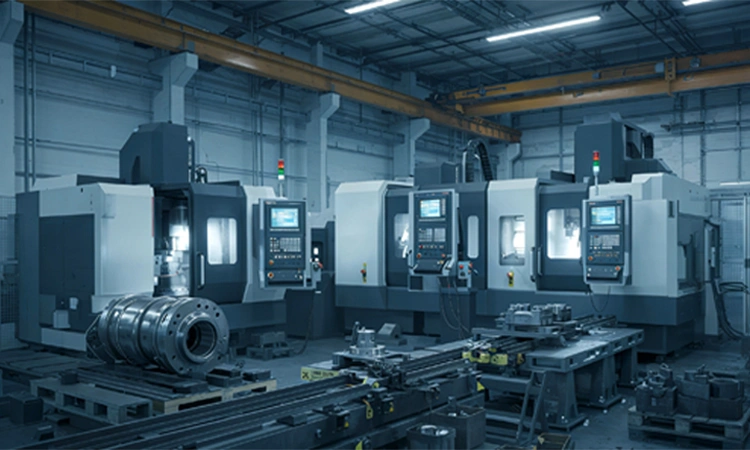
In heavy engineering sectors such as power generation, railways, defence, and infrastructure, flexibility takes on a different dimension. Components are often large, complex, and produced in low volumes. Here, CNC machines such as large double-column machining centres, horizontal boring mills, and vertical turning lathes play a vital role.
Flexible manufacturing in heavy engineering focuses on accommodating varying component sizes, weights, and machining requirements. Modular fixturing, programmable rotary tables, and interchangeable heads allow a single CNC machine to handle a wide range of jobs. This reduces the need for multiple dedicated machines and optimizes shop floor space.
Digitalization & Industry 4.0 Synergy
The convergence of CNC machines with digital technologies is further enhancing manufacturing flexibility. Smart CNC machines equipped with sensors generate vast amounts of data related to machine health, spindle load, vibration, and energy consumption.
When integrated with IIoT platforms, this data enables predictive maintenance, reducing unplanned downtime. Digital twins simulate machining processes and production flows, allowing manufacturers to test changes virtually before implementing them on the shop floor.
Cloud connectivity and remote monitoring allow production managers to oversee multiple facilities in real time, making informed decisions to balance workloads and meet delivery commitments.
Challenges in Implementing Flexible Manufacturing
Despite its advantages, implementing CNC-based flexible manufacturing is not without challenges. High capital investment, complexity of system integration, and the need for skilled personnel can be barriers, especially for small and medium enterprises.
Programming complexity increases as machines become more sophisticated, necessitating advanced CAM software and trained programmers. Change management is another critical aspect, as operators and supervisors must adapt to new roles focused more on monitoring and optimization than manual operation.
However, with modular automation, scalable CNC platforms, and increasing availability of user-friendly software, these challenges are gradually being mitigated.
The Road Ahead
As markets continue to demand customization, faster deliveries, and consistent quality, CNC machines and flexible manufacturing systems will become even more indispensable. The future will see greater adoption of hybrid machines, AI-driven controls, autonomous production cells, and fully connected smart factories.
For manufacturers aiming to remain competitive, investing in CNC-enabled flexible manufacturing is no longer a strategic option—it is a necessity. Those who successfully harness this synergy will be best positioned to thrive in an increasingly dynamic and demanding industrial landscape.