


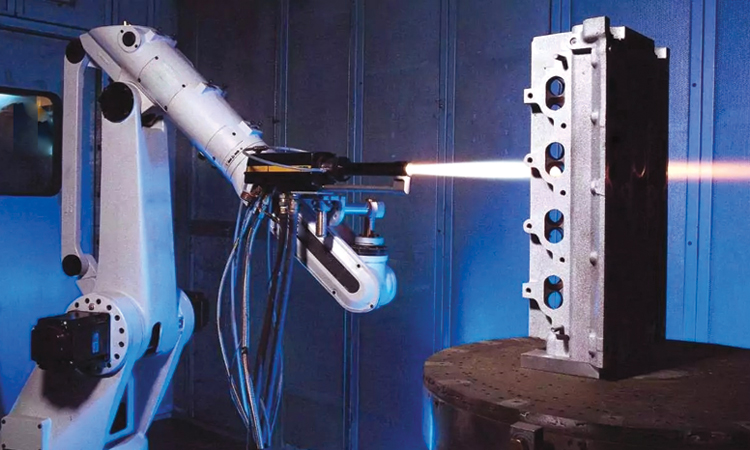
Thermal spray technology has evolved from a basic surface coating technique to a sophisticated surface engineering process that caters to diverse industries ranging from aerospace to biomedical. Over the decades, rapid technological advancements have propelled thermal spray from its traditional role in corrosion protection and wear resistance to cutting-edge applications in electronics, energy, and biomedical implants. As demands for high-performance surfaces increase in extreme operating conditions, so do the expectations from thermal spray techniques. The latest developments in feedstock materials, spraying methods, process control, and application-specific customization have redefined what thermal spraying can accomplish.
Understanding Thermal Spray Technology
Thermal spraying is a process where melted or semi-melted materials are sprayed onto a surface to form a coating. These materials can be in powder, wire, or rod form. They are melted by a heat source such as a flame, electric arc, or plasma, and are propelled toward the substrate using a gas or air stream. On impact, the particles flatten, cool rapidly, and form a dense, adherent layer. This ‘cold’ process, compared to welding, does not significantly heat the substrate, preserving its structural integrity.
Thermal spray methods include flame spraying, arc spraying, plasma spraying, high-velocity oxy-fuel (HVOF) spraying, and more recently, cold spraying. Each of these techniques has its own domain of applications based on required coating characteristics like hardness, porosity, adhesion strength, and thermal conductivity.
Emerging Techniques and Process Innovations
One of the most significant advances in thermal spraying is the development of cold spray technology. Unlike traditional methods that rely on high temperatures to melt materials, cold spray uses supersonic gas jets to accelerate powder particles at very high velocities. The kinetic energy upon impact causes bonding without significant thermal input, making it ideal for temperature-sensitive substrates and oxidation-prone materials. Cold spray is gaining traction in aerospace and defense applications for repair and additive manufacturing purposes.
Another breakthrough is suspension and solution precursor plasma spraying (SPS and SPPS). These techniques enable the deposition of nanostructured coatings by using fine suspensions or solutions instead of traditional powders. SPS/SPPS coatings exhibit finer microstructures, higher surface area, and improved functionality, making them particularly attractive for thermal barrier coatings (TBCs), fuel cells, and biomedical applications.
Hybrid thermal spray processes are also being explored. These involve integrating two or more technologies such as laser-assisted thermal spray, combining thermal spray with laser remelting or peening to enhance coating adhesion, reduce porosity, and improve surface finish. The convergence of thermal spraying with additive manufacturing and robotics is leading to smarter, more automated processes, enabling precision coating with improved repeatability.
Advances in Materials and Feedstock Engineering
The success of any thermal spray process heavily depends on the feedstock material. Recent years have witnessed a transformation in the type and quality of materials used. Traditional materials such as carbides, oxides, and metals are now supplemented by advanced ceramics, nanocomposites, intermetallics, and even high entropy alloys (HEAs). These materials exhibit superior wear, oxidation, and thermal resistance properties, expanding the capabilities of thermal spray coatings.
Nanostructured powders and composite materials allow for the tailoring of properties such as hardness, toughness, and thermal conductivity at the micro and nano scales. In particular, coatings made from yttria-stabilized zirconia (YSZ) have become the benchmark for thermal barrier coatings in turbine engines. These coatings protect components from extreme heat and extend the life of high-value parts in aerospace and power generation.
Data-Driven Process Control and Diagnostics
As thermal spray applications become more critical, the need for precision and quality assurance has never been higher. The industry is increasingly leveraging real-time process monitoring using advanced diagnostics tools such as laser Doppler velocimetry, infrared thermography, and particle image velocimetry. These tools allow in-situ measurement of particle velocity, temperature, and spray plume characteristics, enabling better control over coating quality.
In addition, Industry 4.0 and digitalization are making inroads into thermal spray systems. Sensors embedded in spray guns, real-time analytics, and feedback control loops are making the process more intelligent and adaptive. Predictive maintenance, process simulation, and machine learning algorithms are being used to optimize spray parameters, reduce defects, and ensure consistency.
Expanding Application Horizons
Thermal spray’s reach has extended far beyond its early applications in corrosion and wear protection. Today, it plays a critical role in some of the most demanding industrial sectors.
In the aerospace industry, thermal spray coatings are indispensable. From thermal barrier coatings on turbine blades to erosion-resistant coatings on wing edges and landing gear, the industry relies on thermal spray for enhanced performance and extended component life.
The automotive sector uses thermal spray to coat engine cylinder bores, camshafts, and brake discs. These coatings reduce wear, improve heat dissipation, and enable the use of lightweight materials, contributing to fuel efficiency and performance.
In energy and power generation, particularly in gas turbines and boilers, thermal spray coatings provide high-temperature oxidation resistance and insulation. The coatings also prevent erosion caused by high-velocity particulates in steam and gas flows.
Thermal spray is finding a growing niche in the biomedical field, especially for coating implants such as hip and knee joints with bioactive materials like hydroxyapatite. These coatings promote better integration with bone tissue and enhance implant life.
The electronics industry is also tapping into thermal spray for electromagnetic shielding, heat sinks, and wear-resistant contacts, while chemical and marine industries benefit from anti-corrosive and non-stick coatings.
Environmental and Sustainability Aspects
Thermal spray processes are evolving to meet environmental regulations and sustainability goals. Unlike electroplating or painting, thermal spraying does not involve hazardous chemicals or produce toxic effluents. Furthermore, it enables repair and refurbishment of components rather than replacement, thereby saving raw materials and reducing waste.
The push toward eco-friendly feedstocks, recycling of overspray materials, and reduction in energy consumption are helping thermal spray processes align with global green manufacturing trends. Cold spray, for instance, is an inherently low-emission, environmentally benign process that is gaining favor for sustainable manufacturing and repair.
Challenges and Future Directions
Despite these advances, challenges remain. Thermal spray coatings can suffer from residual stresses, porosity, and adhesion issues depending on process parameters and substrate properties. Uniformity and repeatability, especially for complex geometries, remain a concern. The high capital cost of advanced systems and the need for skilled operators also limit adoption, particularly in small- and mid-sized enterprises. Looking ahead, artificial intelligence and machine learning are expected to drive the next wave of innovation in thermal spray. Smart systems that can self-adjust based on input data, digital twins of spray processes, and autonomous robotic spraying systems are on the horizon.
The development of novel materials such as functionally graded coatings, amorphous alloys, and multi-layered architectures is also expected to unlock new functionalities. Coupled with advancements in process control and environmental sustainability, thermal spray technology is set to play a pivotal role in future manufacturing ecosystems.
Conclusion
Thermal spray technology has transformed from a niche protective coating method into a versatile and high-performance surface engineering process. With ongoing research and innovation in processes, materials, and applications, it is poised to address the ever-evolving demands of modern industries. As it integrates with digital tools, advanced materials, and sustainable practices, thermal spray is no longer just about protecting surfaces—it is about enabling performance, extending life, and adding value in ways previously unimaginable.