

How Thales Alenia Space & Poly-Shape SAS built Europe’s largest qualified 3D metal printed part for satellites
Additive manufacturing makes more than just headlines. The industrial revolution of 3D metal printing is pointing the way to a change in manufacturing strategies. And facts are being established which will herald a fundamental paradigm shift for the manufacture of metal parts. AM is really pointing the way forward when it comes to substitution or as a hybrid strategy in combination with conventional machining methods.
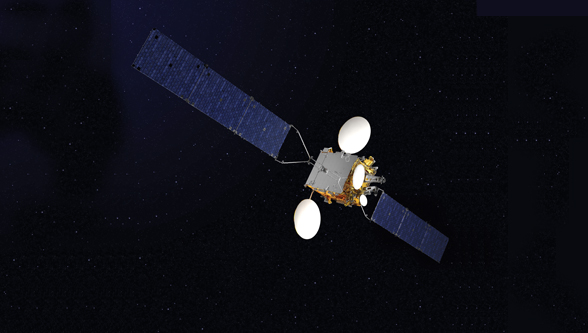
 Once again, the aerospace industry is driving forward innovation and acting as the spearhead for digital manufacturing. The most recent signal comes from Thales Alenia Space. Working in collaboration with the 3D printing service company Poly-Shape, it has produced additively manufactured parts for the new South Korean communications satellites Koreasat-5A and Koreasat-7. Koreasat-7 is set to go into orbit in 2017 at position 116º East in order to provide coverage for South Korea, the Philippines, Indonesia and India. Koreasat-5A will cater for Korea, Japan, Indochina and the Middle East from the position 113° East. Koreasat-5A should be launched before 2017 second quarter.
XXL component produced in collaborative working relationship
The Koreasat-5A and Koreasat-7 antenna supports will be the largest volume parts so far produced by powder-bed-based laser melting of metals from Europe to be in orbit. With dimensions of 447 x 204.5 x 391 mm3– and weighing just 1.13 kg – they really can be referred to as lightweight components. The additively manufactured 3D components are used as basic antenna supports for the communication with ground base of the Koreasat-5A and Koreasat-7 satellites. An identical part was installed in both satellites. The dimensions presented a real challenge for ThalesAlenia Space.
Lightweight construction and reduction in costs as crucial advantages
Aluminum (Al) is the metallic material most commonly used for satellites due to its weight and thermal conductivity. The less weight that needs to be put into orbit, the better. Florence Montredon, Head of AM at ThalesAlenia Space, says: “As a rule of thumb, the actual costs of putting 1 kg into orbit are around EUR 20,000. So every gram really does count. The starting weight of the two new satellites is around 3,500 kg.” AM’s potential for lightweight design was therefore a key reason to move away from the traditional methods.
For these AM parts Thales Alenia Space chose an AISi7Mg alloy. Applications in space demand high strength, rigidity and resistance to corrosion from the materials that are used. The component validation process also revealed a low porosity rate on the finished component of < 1%. The tests of tensile and shear strengths also produced pleasing results. For example, the tests in relation to symptoms of fatigue according to Wöhler yielded values that significantly exceeded the required specifications.
Minor deviations in the geometry were corrected with simple reworking, as was a small crack which was revealed by the CT. Fairly small pores inside the geometry were accepted following localized mechanical analysis. Ultimately, the parts successfully passed the dynamic tests carried out at Thales. Florence Montredon: “The effects were huge: A 22% weight saving for the bionic AM structure compared to a conventional structure. Not forgetting a reduction in costs of around 30% with the finished part being available very much faster.” The cost reduction of 30% is attributable to various factors. First there is the reduction in outlay on assembly: The redesign as an additive, bionic part replaced the number of parts that were previously produced from nine to one. And this was done through one-shot manufacturing, without the previous outlay on assembly. Secondly there was no need for mold construction, as casting would have needed to make the same part. Thirdly the temporal aspects are interesting when it comes to completing the ambitious stages of a project such as this on time. This is known in industry as time to market. In this sector, it is referred to as time to fly.
Machine and plant technology from Concept Laser on XXL scale
Poly-Shapehas 28 3D metal printing machines which have different sizes of build envelope. The largest build envelope dimension for 3D printing with aluminum at Poly-Shape is currently an X line 1000R from Concept Laser. It offers a build envelope of 630 x 400 x 500 mm3 and has a closed system for reliable process and powder management in accordance with the ATEX directives. The X line 1000R also has a rotating mechanism which allows two build modules to be used reciprocally, thus guaranteeing constant production with no downtimes. This unique machine design not only results in greater availability, but also simple and above all secure handling when arming and disarming the machine.

The LaserCUSING process technology from Concept Laser was very important for the project: What makes systems from Concept Laser unique is stochastic navigation of the slice segments (also referred to as “islands”) which are processed successively. This patented process ensures a significant reduction in stresses when manufacturing very large parts. With huge dimensions of 447 x 204.5 x 391 mm3, it is obvious to want to control warping to the maximum extent possible.
The X line 1000R offers balanced temperature regulation of the build envelope in order to prevent warping in the “oversized” parts. The large, bionic and intricate geometry takes a great deal of time to assemble: It took only a few days to print it.
Design to suit the process
The transition over to AM also means rethinking the design. To make full use of the potential offered by laser melting, it makes no sense to replicate a geometry 1:1. Lightweight design and bionics demand a design to suit the process. CAE-CAD-based methods are used to trim the 3D components to a performance-focused geometry, bionics, and lightweight design. The design was optimized in several transitions at Thales Alenia Space (AM design optimization), for example in respect of the various joining and mounting techniques. In addition, there was fine-tuning in the area surrounding the satellite in order to guarantee a maximum precision fit. The topology was optimized in 2-3 passages.
The CAD data then underwent a redesign and smoothing before a mechanical analysis and simulation took place. Furthermore, the design was optimized to suit the process-related circumstances in the build envelope with Poly-Shape. This involved the orientation of the part in the build envelope and the necessary support structures. Thales Alenia Space also incorporated methods of LBM (Layer-Based Manufacturing). Florence Montredon: “It is clear that we have identified AM as a good prospect for further projects. In the future, we would also like to incorporate thermal control technology or radio functions directly on or within the 3D structures. So functional integration is the next task. This is also a logical consequence of the potential offered by AM.”
The benefits
In the Koreasat-5A and 7 project, the feasibility of highly sophisticated and very large AM parts for applications in space was highlighted. The redesign as an additive, bionic part made it possible to reduce the number of parts from nine to just one part. Thanks to this method, the manufacturing process was carried out in one shot, so without the previous outlay that was needed for assembly. There was also significantly enhanced potential for a lightweight design. 22%of the mass was saved with this AM solution.
This resulted in a final weight of just 1.3 kg. This was a huge leap because in these applications every gram really does count. The 3D geometry was optimally trimmed for use in orbit. The project’s impressive results highlighted the potential that additive manufacturing offers in space travel and this project will undoubtedly not be the last of this type.